
There are three other churches located within the Borough of Sunderland that have a ring of bells, all being on the south side of the river. These are:
Holy Trinity, 8: 13-2-14 IN F (NZ406573)
 |
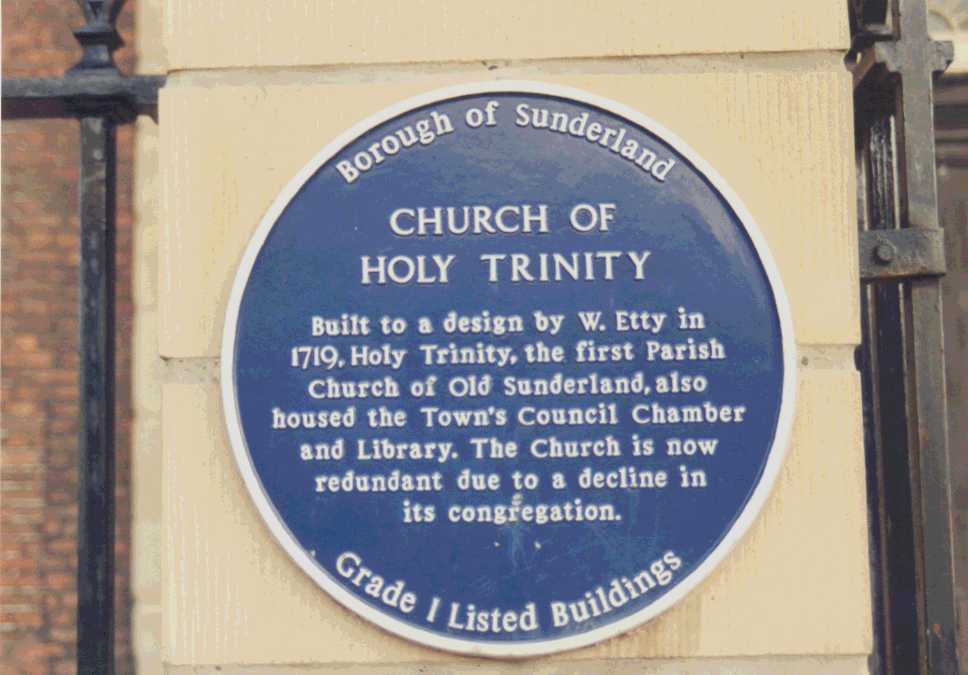 |
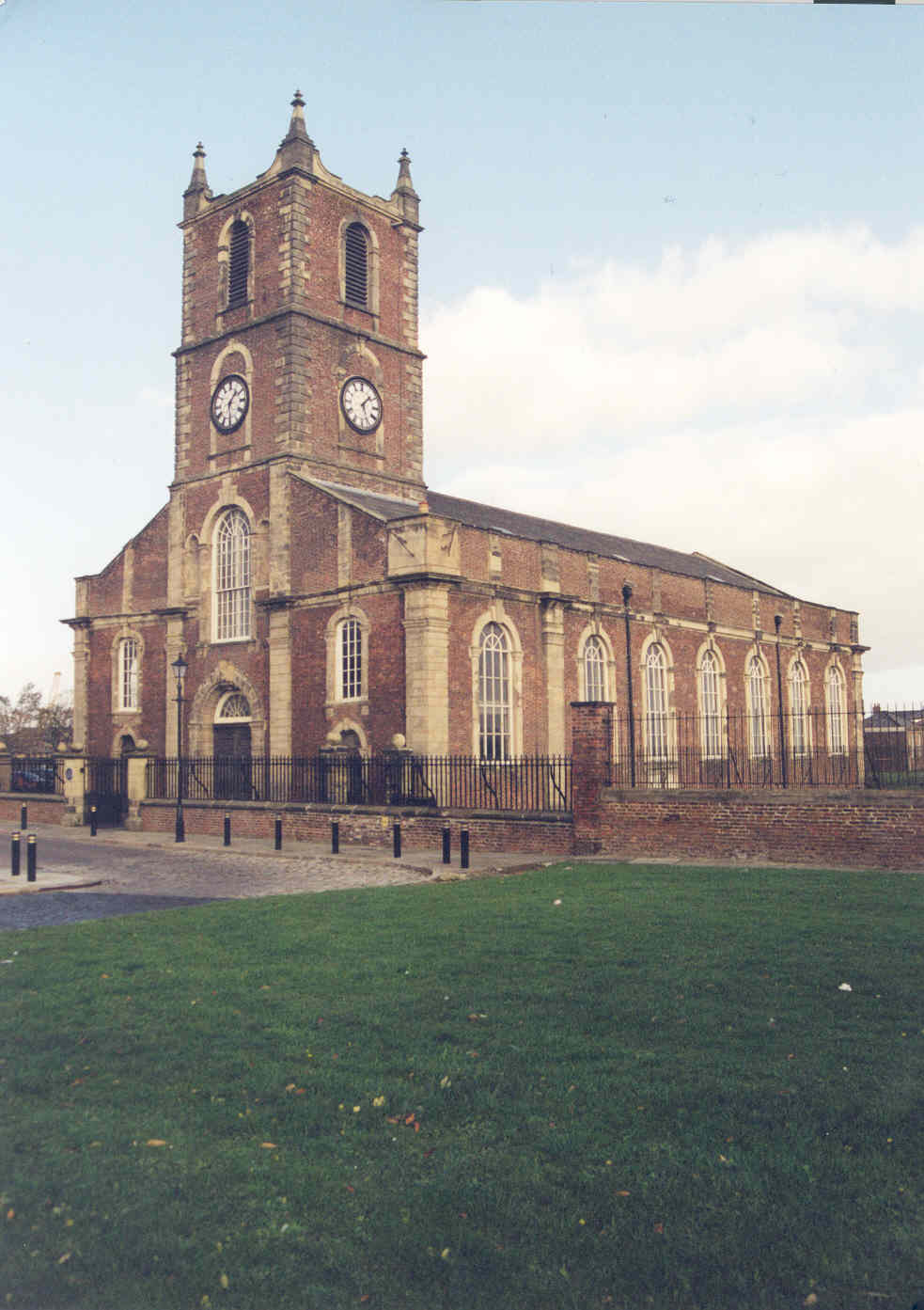
| Holy Trinity Church | The Blue Plaque |
This Grade I Listed brick church, built in 1719 to a design by W. Etty, is the Parish Church of Sunderland. In Hendon, and therefore quite close to St. Ignatius, this church suffered a drop in congregation due to the movement of people away from the riverside area. The area has undergone some regeneration recently and the area looks much more welcoming than previously. Opposite the church used to be a catholic church and Presbytery, this being demolished some time ago.
It was made redundant, (see plaque), several years ago but the bells are still rung by arrangement. The bells were cast by Whitechapel in 1829 and then rehung by the same firm, (with the two trebles recast), in 1951.
To find the church go East at the roundabout at the south end of Sunderland’s “Sydney Harbour” like bridge (ours was built first!). Follow this road, signposted the A1018 to Teeside, round until you get to a roundabout. Turn left into High Street East, signposted B1293 The Port, and after a few hundred yards third right into Church Street East. The church is built of brick and has a tower. There is parking by the church. Entry is by the main west door of the church.
The Bells
| Inscription | Date | Weight | Diameter | Frequency | Note | |
| 1 | T. MEARS OF LONDON FECIT 1829 | 1951 | 4-2-10 | 27.00″ | 1361.0Hz | F-45c |
| 2 | T. MEARS OF LONDON FECIT 1829 | 1951 | 4-3-03 | 28.00″ | 1292.0Hz | E-35c |
| 3 | T. MEARS OF LONDON FECIT 1829 | 1829 | 5-2-21 | 30.50″ | 1152.0Hz | D-34c |
| 4 | T. MEARS OF LONDON FECIT 1829 | 1829 | 6-2-00 | 32.25″ | 1037.0Hz | C-16c |
| 5 | T. MEARS OF LONDON FECIT 1829 | 1829 | 7-0-07 | 34.13″ | 912.0Hz | Bb-38c |
| 6 | T. MEARS OF LONDON FECIT 1829 | 1829 | 8-2-07 | 37.00″ | 855.5Hz | A-49c |
| 7 | T. MEARS OF LONDON FECIT 1829 | 1829 | 9-3-02 | 38.38″ | 772.0Hz | G-27c |
| 8 | T. MEARS OF LONDON FECIT 1829 THE REVD ROBT GRAY RECTOR THOMAS WOOD } CHURCHWARDENS ROBT YOUNG THOMAS HODGE |
1829 | 13-2-14 | 43.63″ | 687.5Hz | F-27c |
| 1 & 2 were recast at Whitechapel in 1951 and all the bells rehung | ||||||
St Ignatius, Hendon 8: 12-3-20 IN G (NZ404564)
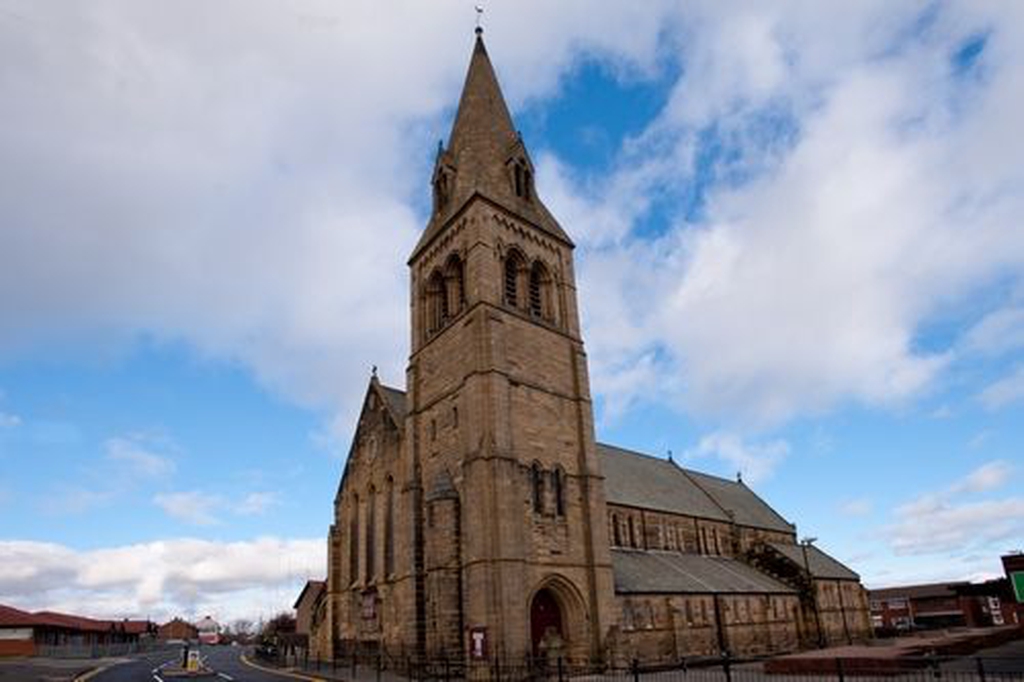
This is very much an Anglo-Catholic church. Originally there were six bells placed in the tower in 1898/9. For some reason the tenor had to be recast in 1905 and then the bells were augmented to eight in 1913. Service ringing is nominally 10.00 and practice night is Thursday, 2nd & 4th, at 19.00. There is a relatively new band here, so it would be sensible to check if ringing is to take place before travelling.
As said above, this church is not far from Holy Trinity and they used to share the same clergy. Again turn east at the end of the bridge and follow this main road. Keep following the signs for Durham. Keep going south, going straight on towards Grangetown rather than Durham at a roundabout, and you will come to back the church after less than a mile on your right at another roundabout. It has a spire. You can park behind the church. Depending upon when you ring the entry may be by the main church door by the tower or the small door down the north side of the church.
|
The Bells
|
||||||||||||||||||||||||||||||||||||||||||||||||||||||||||||||||||||||||||||||||||||||||||||||
St Michael & All Angels, (SUNDERLAND MINSTER) 10: 12-2-7 in F# (NZ406573)
This church is often known as “Bishopwearmouth” to local ringers. It became a Minster church after Sunderland was granted City Status in 1992 to mark the 40th Anniversary of the accession to the throne of H.M. Queen Elizabeth II. On High Street, it is over the road from the Empire Theatre and beside the Crowtree Leisure Centre. Entry is by the south door.
Service ringing is at 9.30 and 17.30. Practice night is Monday, 19.30
Email David Cox to confirm that ringing will take place
The original six bells, the first ring in Sunderland, were cast by Thomas Mears in 1809 and were augmented to eight by them in 1894. The whole ring was recast by Whitechapel in 1932 and rehung in the existing frame. The bells become a ring of 10 in 2012, when they were rehung in a new 2-level frame by Fred Pembleton, with two new treble that had been cast by Whitechapel.
The church is now one without its own parish! It is therefore “extra-parochial”. It is the church for all Church of England members in Sunderland; it is, “A church for the whole City”. At the same time it added “St Benedict Biscop” to its name.
The Bells
| Founder | Date | Weight | Diameter | |
| 1 | Whitechapel Bell Foundry Ltd | 2009 | 3-1-27 | 23.188″ |
| 2 | Whitechapel Bell Foundry Ltd | 2009 | 3-3-13 | 24.438″ |
| 3 | Mears & Stainbank, Whitechapel, London | 1932 | 4-0-15 | 25.125″ |
| 4 | Mears & Stainbank, Whitechapel, London | 1932 | 4-2-16 | 23.675″ |
| 5 | Mears & Stainbank, Whitechapel, London | 1932 | 4-3-02 | 28.000″ |
| 6 | Mears & Stainbank, Whitechapel, London | 1932 | 5-2-22 | 29.750″ |
| 7 | Mears & Stainbank, Whitechapel, London | 1932 | 6-0-01 | 31.750″ |
| 8 | Mears & Stainbank, Whitechapel, London | 1932 | 7-0-23 | 33.000″ |
| 9 | Mears & Stainbank, Whitechapel, London | 1932 | 8-2-09 | 35.750″ |
| 10 | Mears & Stainbank, Whitechapel, London THESE BELLS WERE CAST 1809 REVD DR GRAY RECTOR MR INO. RAIN CHURCHWARDEN. RECAST BY MEARS & STAINBANK 1932 |
1932 | 12-2-07 | 41.000″ |
 |
|
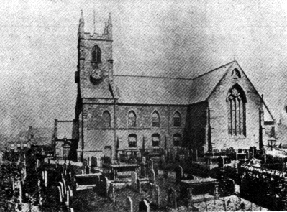
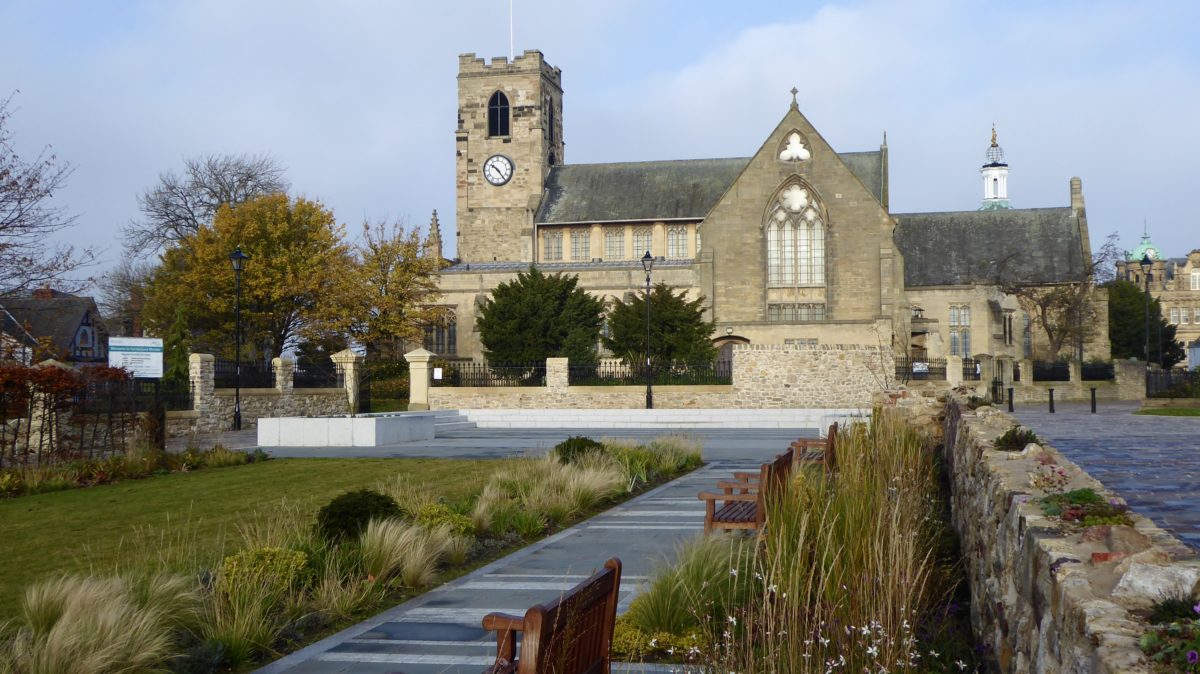
| Here is an old engraving and also a modern photograph taken from a similar position to where the artist stood. The church itself has not changed dramatically from the outside. The pinnacles have disappeared and there has been a south aisle built. The churchyard has now been cleared and the locality is much more built up. |
|
Houghton-le-Spring, St Michael & All Angels 8: 12-0-0 IN G (NZ342498)
Technically Houghton, (please pronounce it “Hoe-tun” and not “How-ton”!) is in the Borough of Sunderland, so it gets a mention here.
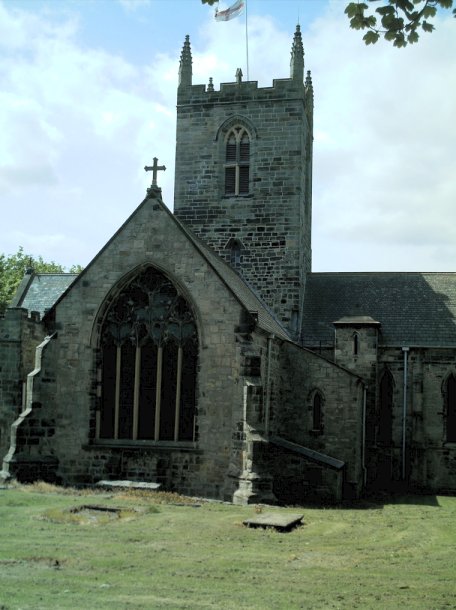
This lovely old church is easily visible from the A690 Sunderland to Durham road. It can be a little tricky to get to if you are not careful. Take the exit on the Durham side of the church from the A690 and not the Sunderland side and you can get right to the it. There are some free parking spaces very close to the church and you can drive up the church pathway and park by the church rooms round the back. The entrance to the ringing room is round the back of the church, up a short spiral staircase and then a short walk over the roof to the central tower. You can just make out the entrance to the ringing room from the photo on the left in the V created by the two roof lines.
The bells are easy to ring and are, in fact, used as the Durham & Newcastle D.A. Ringing Centre. The tower is equipped with a computer and sensors, as well as a video camera and TV. They are a slightly old fashioned sounding back 6 with 2 very nice G & J trebles.
 |
 |
| The Church | The Treble Note the standard G & J Fittings of time |
| Inscription | Date | Weight | Diameter | |
| 1 | ELLA MARY CHRYSTAL 1928 | 1928 | 4-3-21 | 26.500″ |
| 2 | RALPH WATSON RECTOR O.N. FLETCHER AND J. HOWARD CHURCHWARDENS 1928 |
1928 | 5-0-19 | 27.500″ |
| 3 | T. MEARS OF LONDON FECIT 1826 | 1826 | 5-2-08 | 30.375″ |
| 4 | T. MEARS OF LONDON FECIT 1826 | 1826 | 6-0-06 | 31.875″ |
| 5 | T. MEARS OF LONDON FECIT 1826 | 1826 | 6-1-20 | 36.625″ |
| 6 | T. MEARS OF LONDON FECIT 1826 | 1826 | 6-3-22 | 35.000″ |
| 7 | T. MEARS OF LONDON FECIT 1826 | 1826 | 9-0-14 | 38.250″ |
| 8 | T. MEARS OF LONDON FECIT 1826 REVD EDWD, SOUTH THURLOW RECTOR RALPH MEGGISON } CHURCHWARDENS THOMAS JOHNSON RALPH WALLACE ROBT HUMPHREY |
1826 | 12-0-00 | 42.625″ |
NB the date of the trebles is incorrectly given as 1926 in “Bells of the Durham and Newcastle Dioceses”.
Chimes
Hylton, St Mary 8: 2-3-13 in F
 There was supposed to have been a peal of Grandsire Triples at this tower on the 4th of March 1845. I was always extremely suspicious of this as a local history book says that the church building then standing was converted from a previous property given for the purpose, suggesting a tower containing ringing bells was unlikely. The newpaper report that lead to it being believed a peal was rung here read:
SUNDERLAND.-On Tuesday the Newcastle and Gateshead Union Society of Change-ringers having been waited upon by Mr. Thomas Gay, of the Union Society, York, and Mr. Charles Balle, of the Cumberland Society, London, visited the town of Sunderland, and rung upon their melodious peal of eight bells, at the parish church of St. Mary’s, a true and complete peal of Grandsire Tripples, consisting of 5040 changes, which was performed in an admirable style in two hours and fifty-four minutes, being the first peal ever accomplished upon these bells, and was performed by the following persons:-John Bennett, treble; Charles Walker, 2nd; George Hyde, 3rd; Charles Balle, 4th; Joseph Pesscott, 5th; Thomas Gay, 6th; Robert Balmbra, 7th; Thomas Marshall, tenor. The peal consisted of 194 bobs, and 46 singles, and was ably conducted by Mr. Thomas Gay, it being the first peal of this composition ever performed in the counties of Durham or Northumberland. Weight of tenor, 14 cwt. (Era, Sun. 9 March 1845; also reported in similar terms in the Newcastle Courant of Fri. 7 March 1845.)
This fits Holy Trinity, Sunderland; it being the only ring of 8 in Sunderland at the time and its tenor was the right weight. The peal is now recorded on Felstead as being rung at Holy Trinity. (With thanks to Tim Jackson/John Eisel)
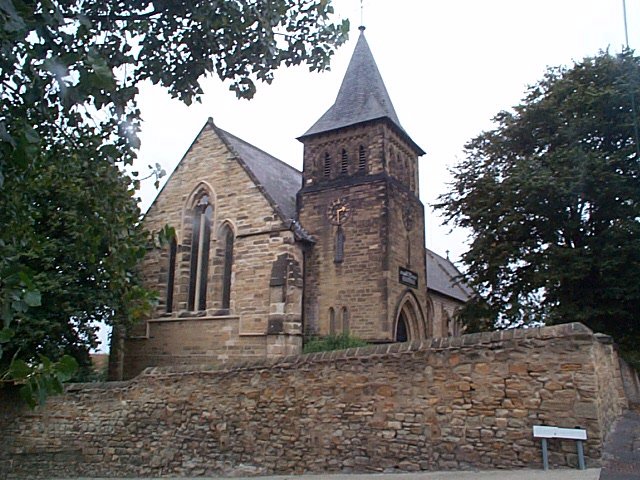
The present building is from the 1870s, a replacement for the original one that burnt down.
Four bells were installed in c.1930, the gift of Reverend William Marshall Teape, Vicar of the church until he retired in 1922 due to ill health, when the tower was built and the four others in 1938. All were cast by Mears & Stainbank.
The church is currently redundant and for sale and the bells will be, at some point, removed.
Ryhope, St Paul. 6: 5½ cwt
 This church, built in the 1870s, is found in the middle of the village, just off the main road in from the A19 towards Sunderland. It is very obvious if you look to your right when travelling away from Sunderland, less so travelling towards it. Turn off the main road to the right in the middle of a sweeping S bend by a sort of village green area.
I last visited the church in the autumn of 2001, but was unable to gain access to the upstairs chiming room. The substantial looking tower is half way down the North side of the church and provides the main entrance to it. The bells are chimed from an Ellacombe apparatus located in the first floor of the tower. The bells have had some work done to them recently, corroded girders have been replaced and the chiming hammers overhauled or replaced as necessary.
Pennywell, St Thomas 6: 5½cwt
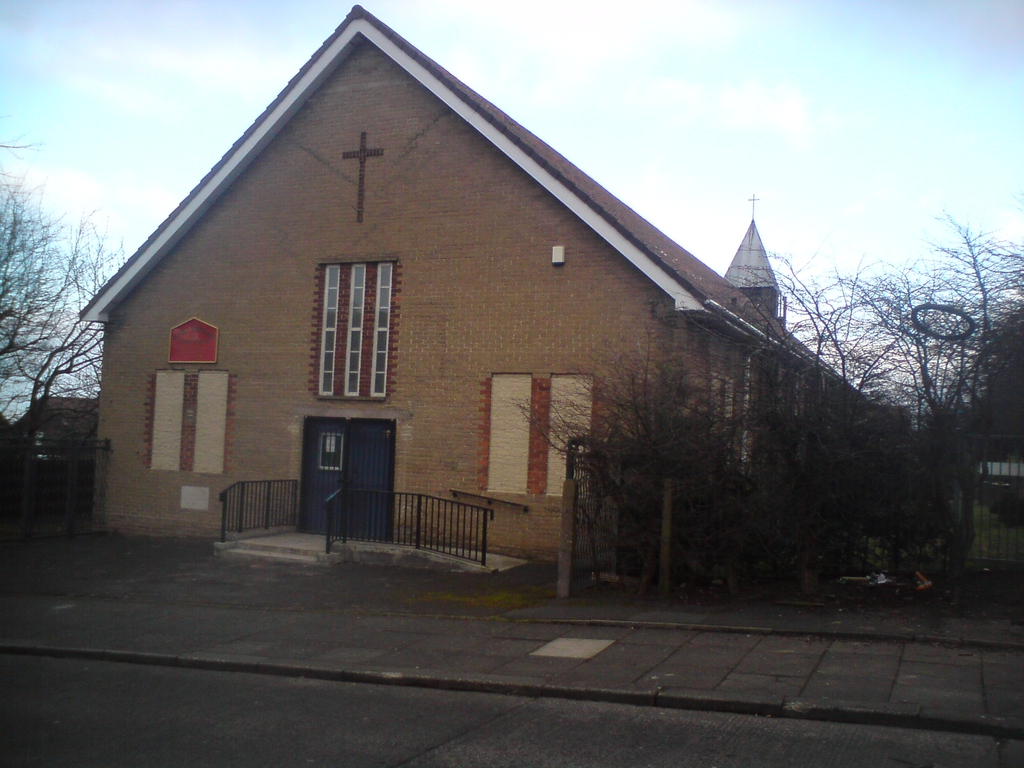 The church is on Petersfield Road in Pennywell.
The bells were transferred from Monkwearmouth, Venerable Bede, when this church was closed.
Pennywell church was built around 1964, to the design of Francis Johnson.
Southwick, Holy Trinity 8 Tubular Bells
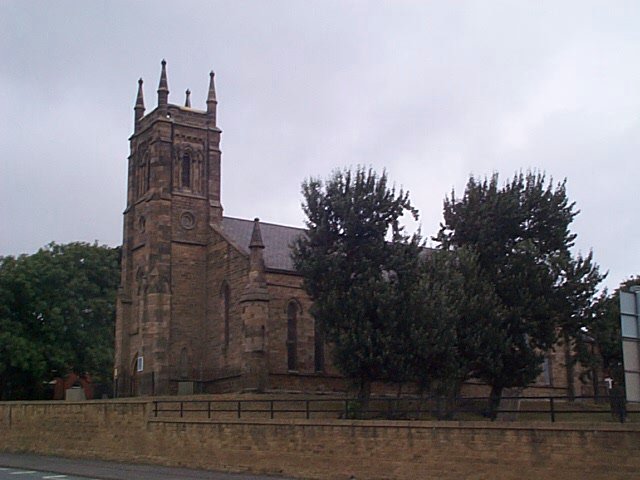 Holy Trinity was built in 1842-1845 to the designs of the Architect and Clerk Of Works to Durham Cathedral George L Jackson. It is a Grade II listed building situated on an area of elevated ground overlooking the River Wear to the south, bounded by Northern Way to the west, Church Bank to the south and the former rectory to the north.
The Sunderland Echo of January 10th 1895 reports:
“A very pleasing and useful addition to the church takes the form of a peal (eight) of Harrington’s tubular bells, which are both powerful and musical. These were the gift of Mr Priestman, of Southwick. The money required for carrying out the work will not be less than, even if it is covered by £600. By means of donations, etc., this has been practically raised, but it is not unlikely that when the accounts are made up there will be a balance still to provide for.”
| Homepage | Church History | Roker Bells | Roker Peals |
| Other Local Towers | The Parish | Picture Gallery | Contact Us |