
St Bartholomew 8: 10-0-14 in G (GF)
| Grid Reference | 139/057847 |  |
| Postcode | B15 3BT | |
| Affiliation | St Martin’s Guild | |
| Peals | Felstead Database | |
| Sunday | 0945-1025 | |
| Practice | Friday 1930-2100 | |
| Other Information | Regular ringing in university term time only | |
| Guild Website Entry | ||
History
This church was originally a dependent chapelry of Harborne, Staffs, becoming a parish in its own right around the time of the Reformation. Little remains of the old church, several rebuilding schemes being enacted in the 19th century.
The west tower is believed to have been erected at the cost of Margerie Middlemore, the widow of the Lord of the Manor. It dates from around 1530 but shows signs of having been altered and repaired in the seventeenth century – possibly to rectify damage sustained during the Civil War. A brief to raise £800 for repairs to the church was circulated in 1658 and further funds were sought in 1684-5. Repairs to the tower seem to have been completed by about 1685 when new bells were installed.
In the east window of the south aisle there is a stained glass window erected in about 1895 to commemorate William Henry Maxwell Blews (the Birmingham bellfounder) and his wife Frances who were married here in 1860. William died on 30 January 1887 and his widow, Frances, on 29 December 1894.
In 1552 there were three bells, two sacring bells or small bells and a handbell. The church suffered serious damage in the Civil War. Dugdale’s account suggests that the church was “utterly demolished by the Parliamentary forces in the late wars, when they garrison’d Eggebaston-house”. It is claimed that Col. John Fox and his men sold the bells. After the Restoration the parishioners began to rebuild the church but they had been unable to complete it. In 1683 the cost of the remaining work was estimated at £430, “besides the casting of the bells and the mounding of the churchyard”
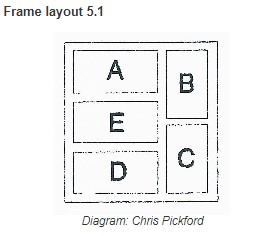
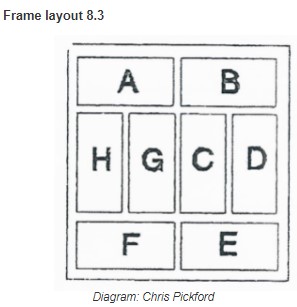
By 1898 there were 5 bells, the back 4 by Matthew Bagley who installed a ring of 5 in 1685. The treble recast by Thomas Pyke of Bridgwater in 1781. They were hung in a wooden frame with three parallel pits and two pits ed-to-end on the side, Treble: A, 2nd: B, 3rd: C, 4th: D and Tenor E.
In this year Charles Carr of Smethwick recast the treble and added a further bell to make 6, tenor 7-2-26 in A (850Hz). They had standard Carr fittings and all had canons. The fourth old bells were quarter turned.
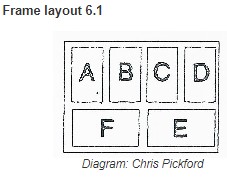
The frame had 6 pits in a line and two transverse to these. The treble was in Pit C, 2nd: Pit C, 3rd: Pit E, 4th: Pit F, 5ths Pit A and Tenor: Pit B
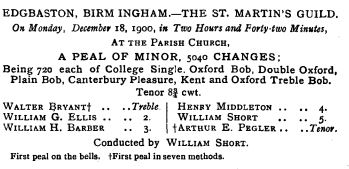
The first peal on the bells was rung in 1900

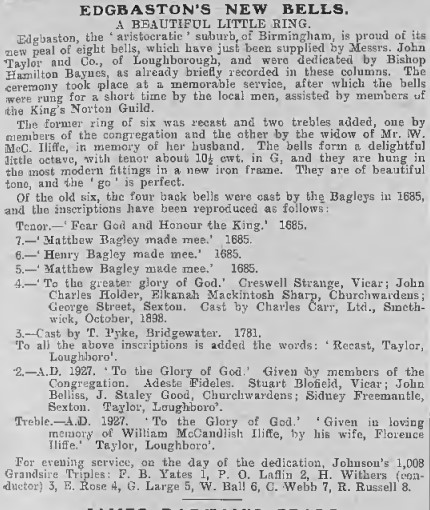
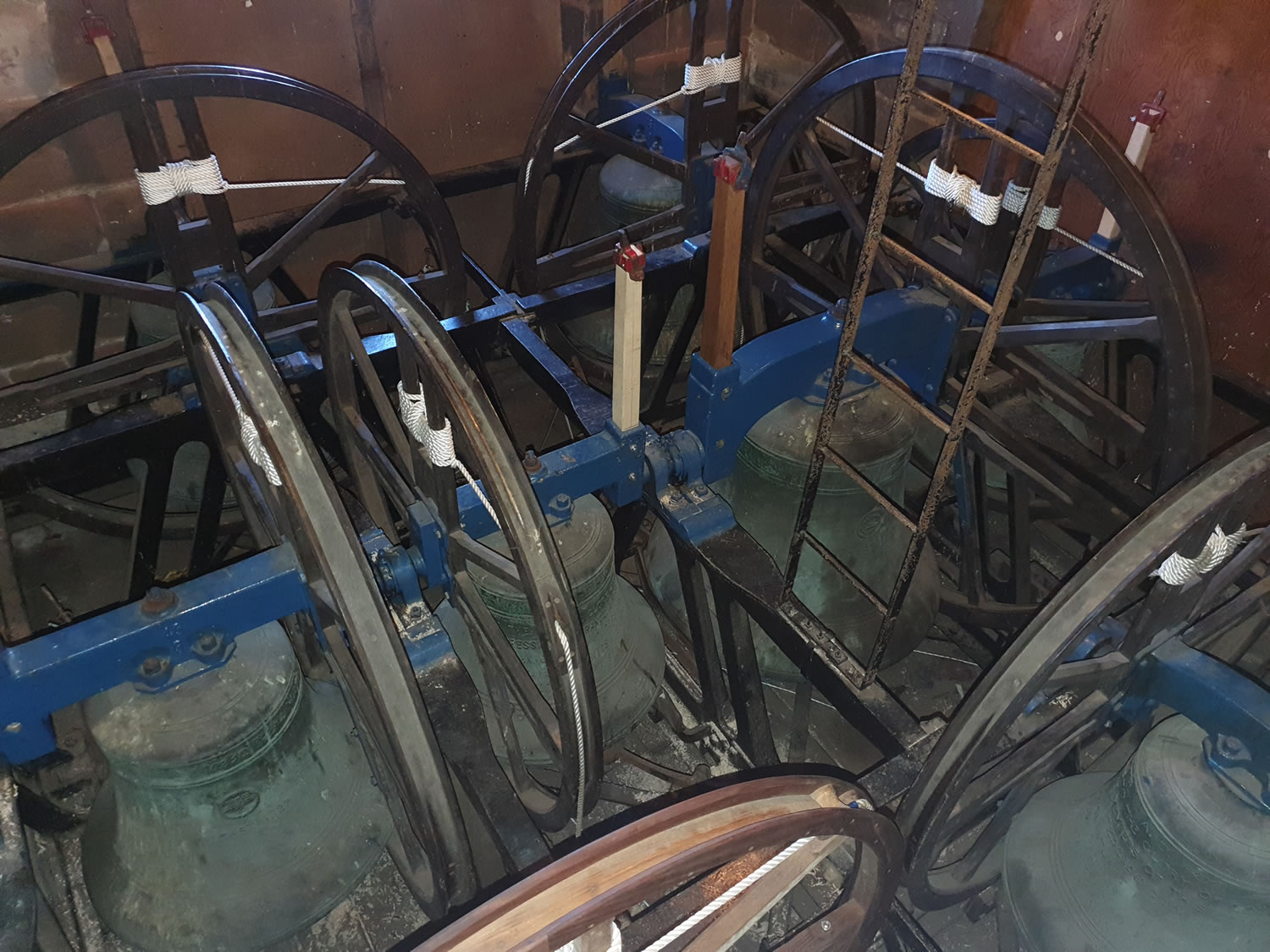
The ring was recast in 1927 and hung in a single level lowside cast iron frame and fittings Taylors. None of the bells have been turned and all were cast with flat tops. The recasting was reported in The Ringing World of April 22nd 1927:
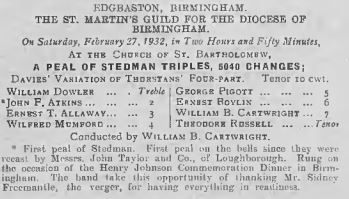
The first peal on the ring of 8 was rung in 1932:

These bells, which sound and ring well, form the home ring of the Birmingham University Society of Change Ringers
The then record peal of Glasgow S Major was rung here in 1967 and was fully reported in The Ringing World of December 15th that year:
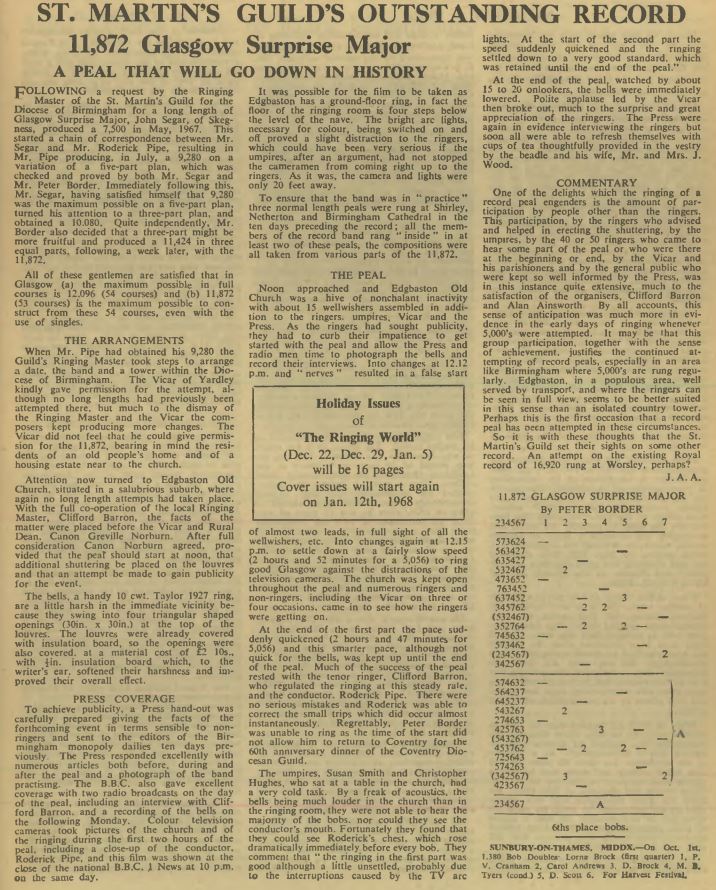
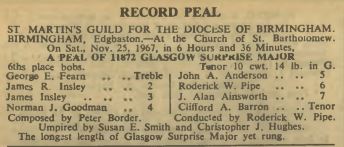
Their joy was short lived! A band rang a peal just one course longer at Accrington on January 6th the following year, just 6 weeks later. The Accrington peal caused some controversy, as 7 days notice had not been given in The Ringing World, only 2, and the composition was the same as was rung here, but with a pair of half-lead singles added. It was claimed as the longest length in the methods, but not the record peal! That “record” stood until 2012 when a band at Spitalfields did the decent thing and beat the record by about half a peal-length!
Details of the Bells
1 John Taylor & Co, Loughborough 1927 4-1-06 25.00″ 1607.0Hz (G+43c)
2 John Taylor & Co, Loughborough 1927 4-3-02 26.00″ 1515.0Hz (F#+40c)
3 John Taylor & Co, Loughborough 1927 4-1-22 27.00″ 1348.5Hz (E+39c)
4 John Taylor & Co, Loughborough 1927 4-1-24 28.00″ 1202.0Hz (D+40c)
5 John Taylor & Co, Loughborough 1927 4-2-26 29.50″ 1071.0Hz (C+40c)
6 John Taylor & Co, Loughborough 1927 5-2-00 31.00″ 1001.5Hz (B+24c)
7 John Taylor & Co, Loughborough 1927 7-1-16 34.00″ 901.0Hz (A+41c)
8 John Taylor & Co, Loughborough 1927 10-0-14 38.50″ 802.5Hz (G+40c)
Inscriptions
| Treble | A.D. 1927 TO THE GLORY OF GOD GIVEN IN LOVING MEMORY OF WILLIAM McCANDLISH ILIFFE BY HIS WIFE FLORENCE ILIFFE. |
| 2 | A.D. 1927 TO THE GLORY OF GOD GIVEN BY MEMBERS OF THIS CONGREGATION. “ADESTE FIDELES” CANON STUART BLOFELD, VICAR. JOHN BAYLIS J. STALEY GOOD CHURCHWARDENS SIDNEY FREEMANTLE, SEXTON. |
| 3 | CAST BY T. PYJE BRIDGWATER 1781 RECAST 1927 |
| 4 | CAST BY CHARLES CARR LIMD SMETHWICK OCTR 1898 RECAST 1927 TO THE GREATER GLORY OF GOD CRESWELL STRANGE. VICAR JOHN CHARLES HOLDER. BART. ELKANAH MACKINTOSH SHARP CHURCHWARDENS GEORGE STREET. SEXTON |
| 5 | MATTHEW BAGLEY MADE MEE 1685 RECAST 1927 |
| 6 | HENRY BAGLEY MADE MEE 1685 RECAST 1927 |
| 7 | MATTHEW BAGLEY MADE MEE 1685 RECAST 1927 |
| Tenor | FEARE GOD AND HONOUR THE KING 1985 RECAST 1927 |
Details of the Ring of 6
1 Charles Carr, Smethwick 1898 4-1-10 27.625″ 1439.0Hz F+51c
2 Charles Carr, Smethwick 1898 4-3-32* 28.00″ 1273.0Hz Eb+39c
3 Matthew Bagley I, Chacomb 1685 4-1-01 28.325″ 1143.0Hz Db+53c
4 Matthew Bagley I, Chacombe 1685 4-3-25 30.00″ 1076.0Hz C+48c
5 Matthew Bagley I, Chacombe 1685 5-2-05 31.50″ 944.0Hz Bb+22c
6 Matthew Bagley I, Chacombe 1685 7-2-26 35.00″ 850.0Hz Ab+40c
Carr quoted the weights of the trebles as 4-1-10 and 4-3-23 respectively. These are scrapping weights.
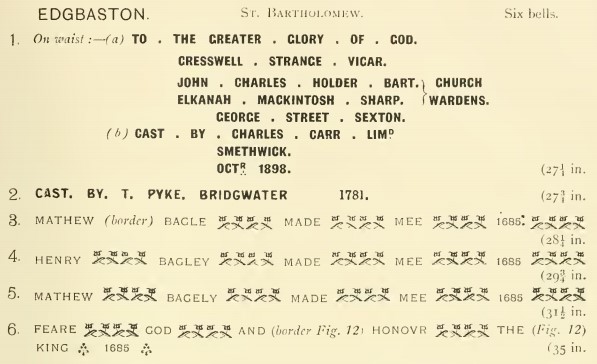
Photo Gallery |
|
 |
 |
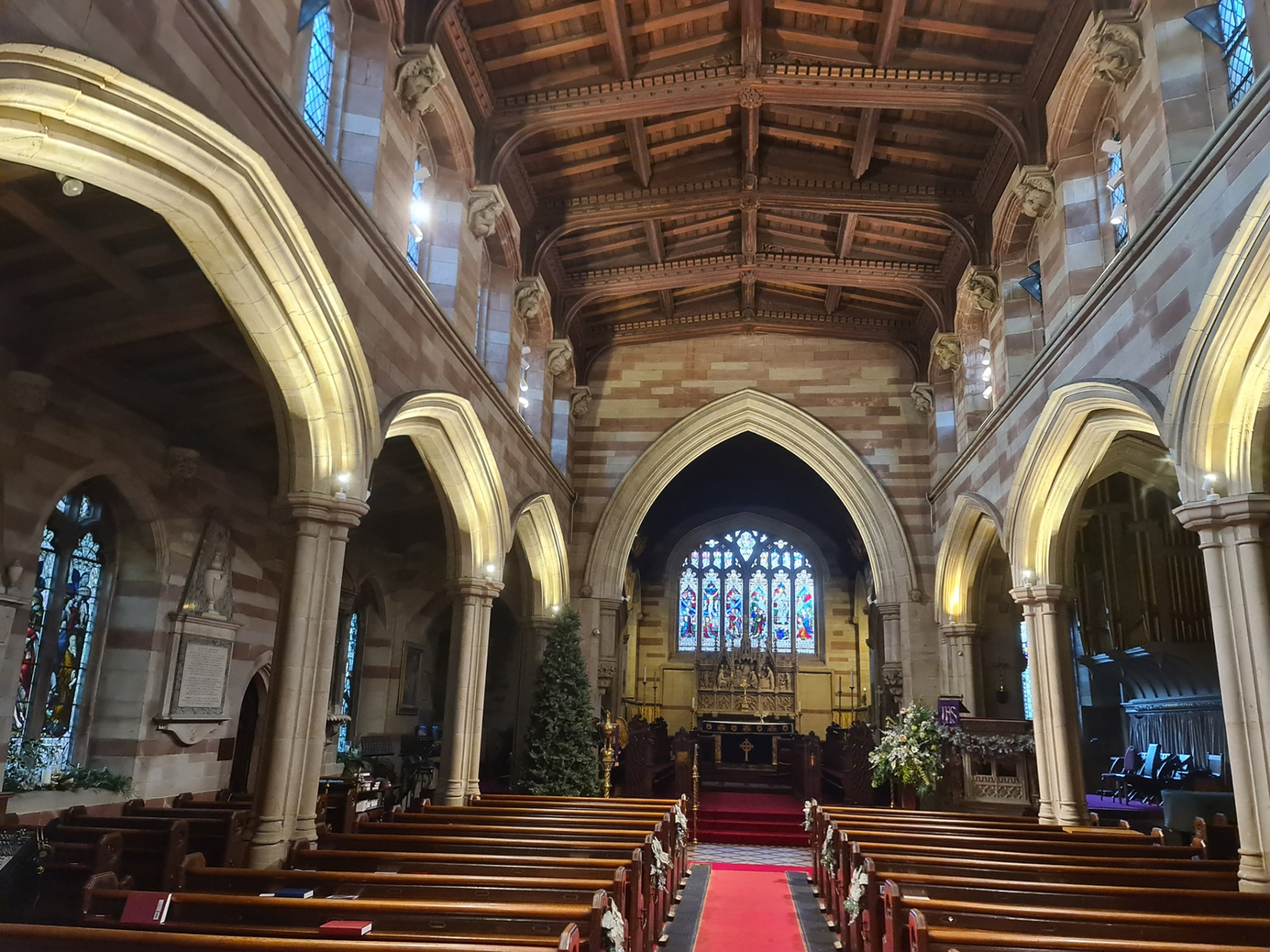
| The church – looking east | The Church – looking south |
 |
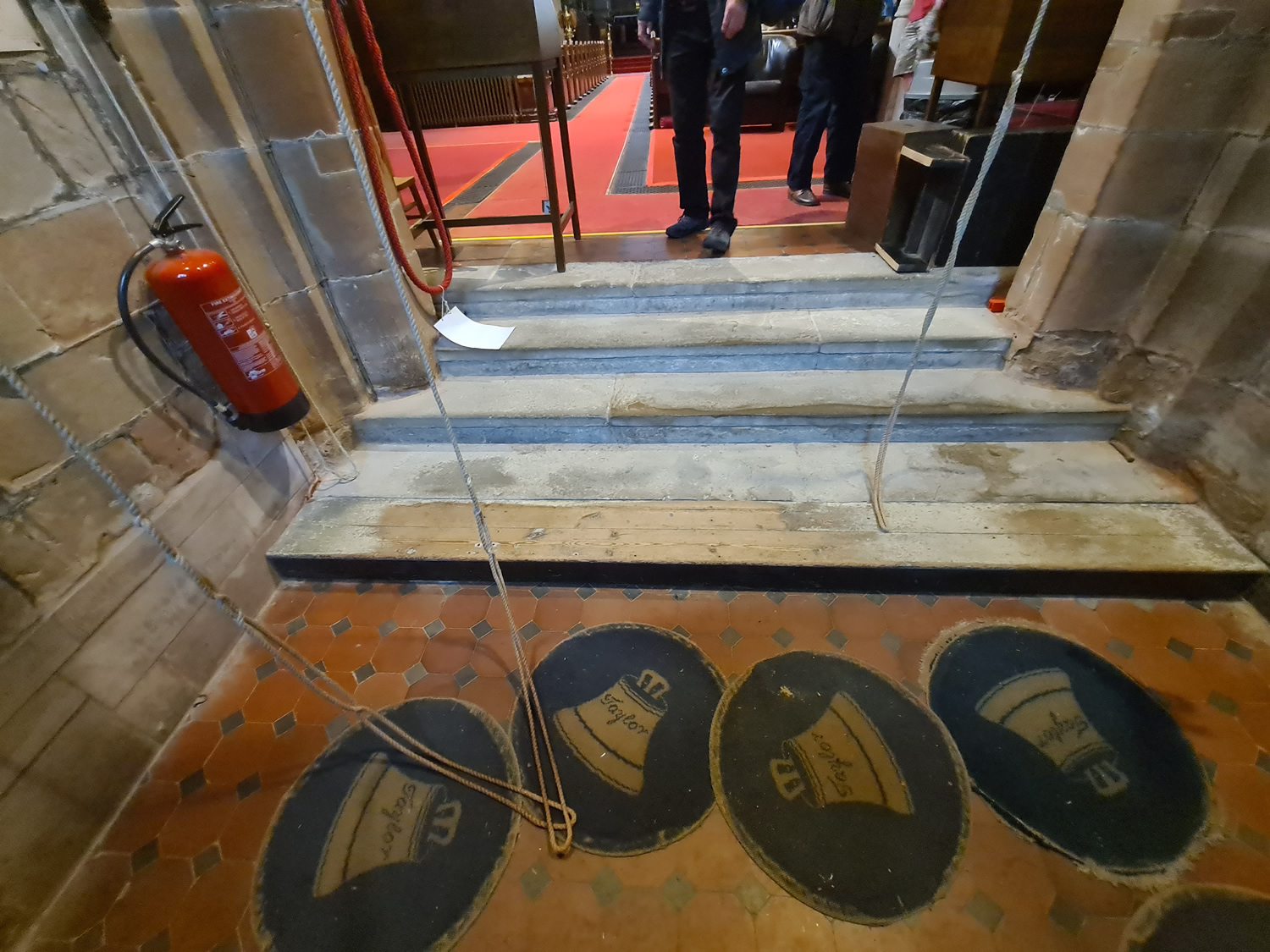 |
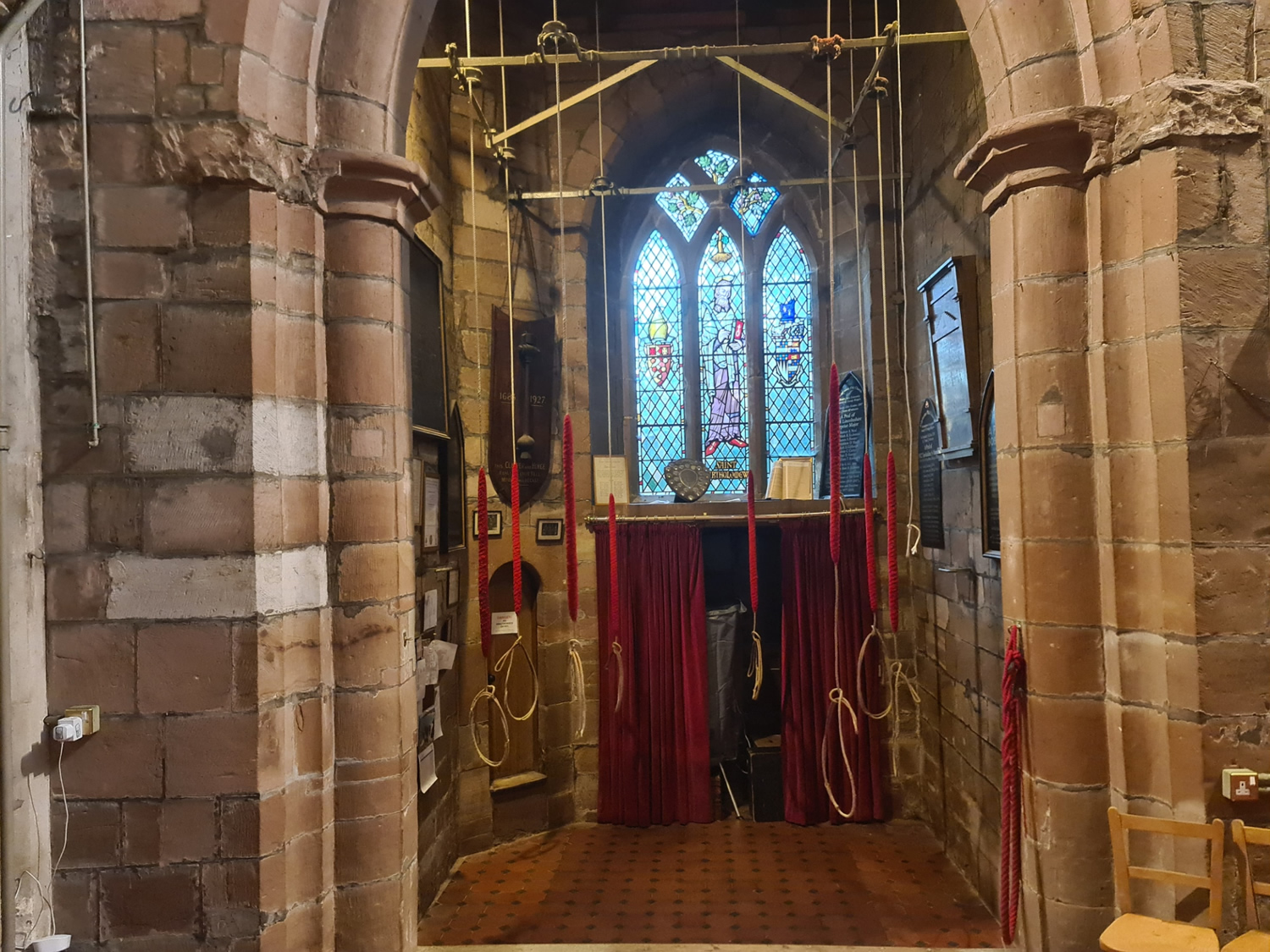
| The Ringing Chamber | The step on which the treble and tenor ringers have to stand. |
 |
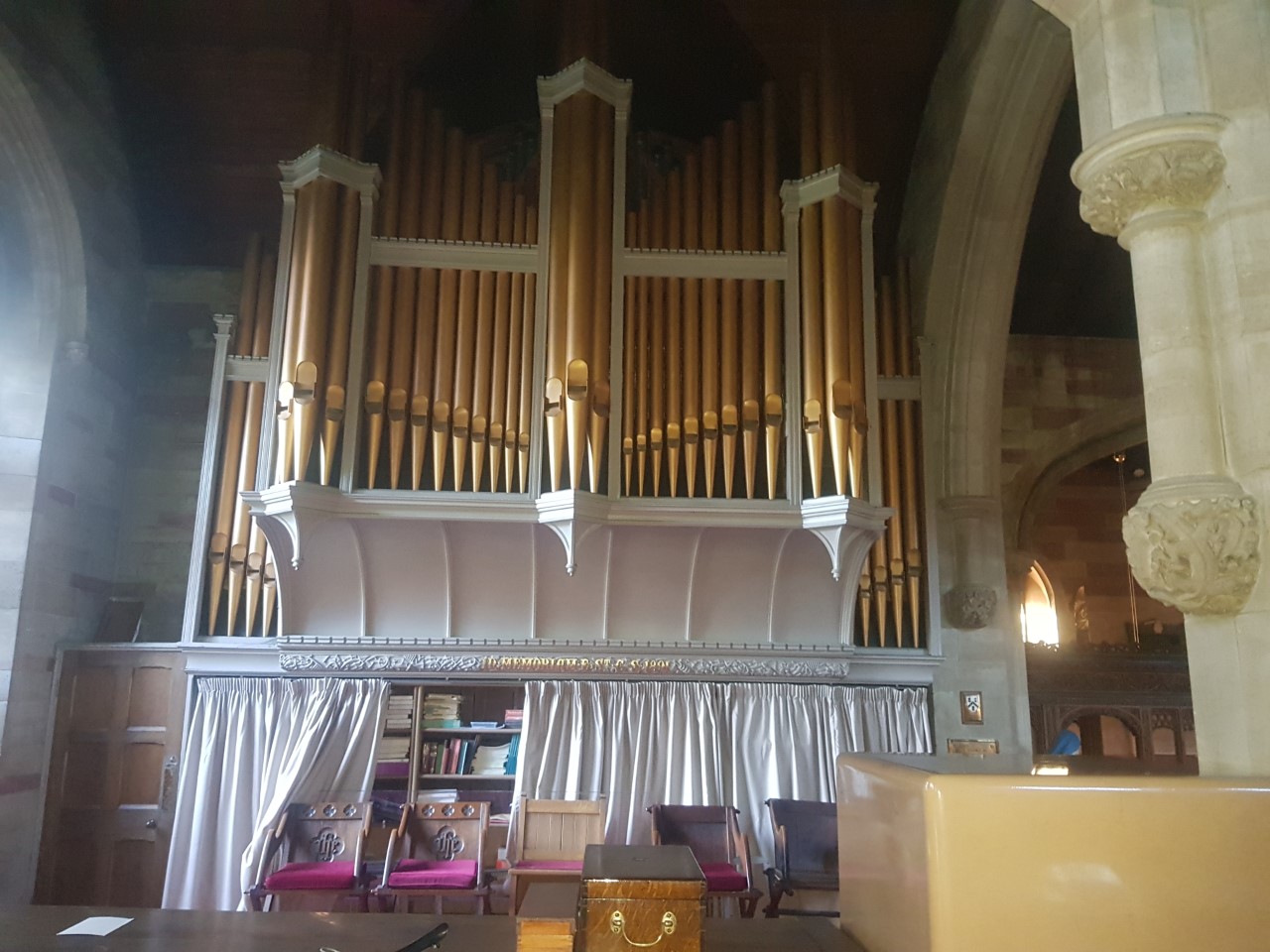 |
| The Bells | The Fine Organ |
 |
|
| The frame layout | |