
Cathedral Church of St Philip 12, 31-0-21 in D
| Grid Reference | 139/070870 | 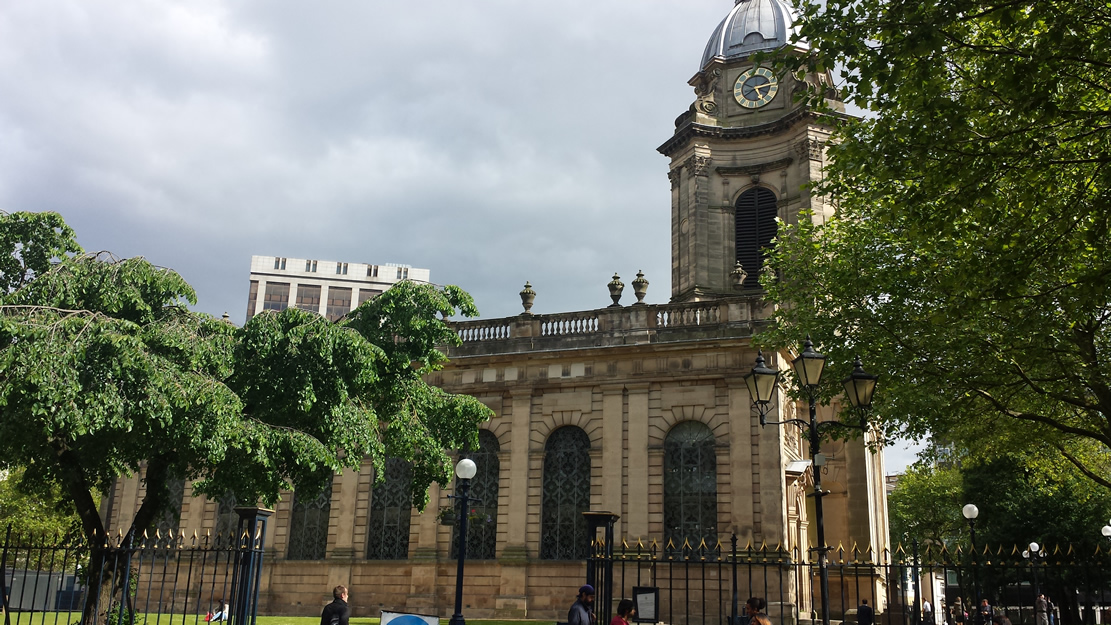 |
| Postcode | B3 2QB | |
| Affiliation | St Martin’s Guild | |
| Peals | Felstead Database | |
| Sunday | 0830-0900 (all) 1015-1045 (2 & 4) | |
| Practice | None | |
| Guild Website Entry | ||
History
In the early 18th century the population around St Martin’s church grew to the point where it was felt that there was a need for another church in the central area of Birmingham. St Philip’s was initially built between 1711 and 1715, being finished later in 1725 when the tower was completed. It is a fine example of church building in that period. With the increase in population in Victorian times it was decided that there was a need for a new diocese in the area and this church was made the Cathedral Church of the new Diocese of Birmingham in 1905, it being formed out of the Diocese of Worcester.
The early history of the bells here is unsure. A small bell, of perhaps 2cwt was bought from Smith of Edgbaston between 1711 and 1715. Another bell was purchased, weighing about 20cwt in 1725/6.
In 1727, the vestry gave various orders regarding bells for the church. On 3 April “it was agreed that Joseph Smith shall receive the mettle from Mr. Bradburne in order to Cast a Bell for the parish church of St. Phillips in Birmingham to be done with all expedition”. On 13 June it was “ordered that a Frame of good Timber be erected & fixed in the Steeple of the New Church for Hanging of Eight Bells, & that the Two Bells already made be hung there with all convenient speed”.
What exactly was carried out is unclear, but there was certainly a ring of bells here in 1737/8, when the vestry ruled that public ringing should take place at St. Martin’s and St. Philip’s alternately “as great ill Conveniences have attended the Ringing of State days & Holydays at Both Churches”
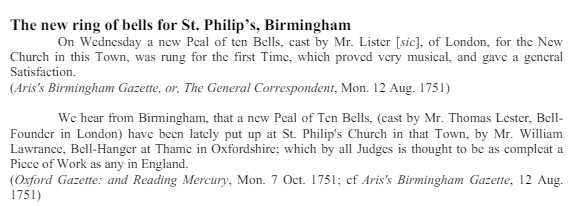
It seems likely that there was a ring of 10 here by 1750/1 with a tenor of around 26cwt. At this point Thomas Lester cast a new ring for St Philip’s with a tenor of 29-0-18 in Db. It is likely that a ring of 8 was installed in the frame, which was then adapted to take 10.
The installation was recorded in the newspapers of the day:
The bells were hung on one level in a wooden frame. Sketch plans of the frame taken in the 1930s suggest that it was originally built for eight bells but later adapted to take ten.
Subsequently, the 5th and tenor were recast by Pack and Chapman in 1772; possibly the 6th in the third quarter of the century; The first Thomas Mears certainly recast the 6th in 1796 and Thomas Mears II the 8th in 1823.
The first peal on the bells is known: Plain Bob Major on 16th September 1755.
Two peals of Grandsire Caters are reported as being rung here in 1773


The first peal of Treble Bob Major in Birmingham was rung here in 1787.

Barwell of Birmingham rehung the bells in 1893. They provided new fittings, but the old frame was reused.
There was a series of articles in “Bell News” about rings of bells around the country and this was said about St Phillips in the edition of June 21st 1902:
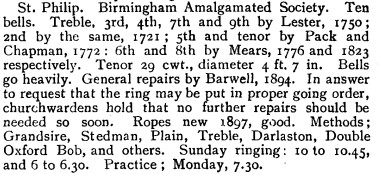
There was a revival in the ringing at St Philips at this time. However, the tower was declared unsafe in 1906. Writing in 1908 H.B. Walters noted “the tower is said to be in an unsafe condition and the bells are no longer used for ringing”. He also described the bells as “very grimy and encrusted with accumulated deposits which largely obscure the lettering”.
The inscriptions of the bells as they were in c.1910 are given in Tilley and Walters’ book, “The Church Bells of Warwickshire

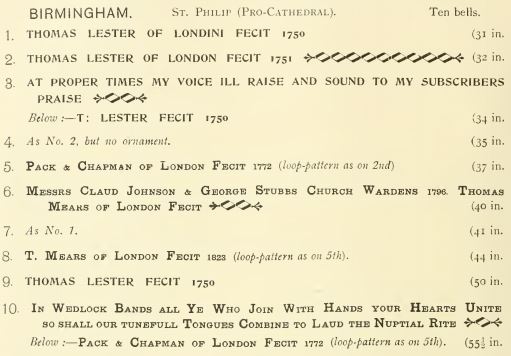
With the exception of only a couple of rings in 1914, the bells were next rung in 1921, though they were thought to be an inferior ring. An article about these bells was published in The Ringing World on April 23rd 1915, and is an interesting read:
 |
  |
| (Click to enlarge) | |
In The Ringing World of April 15th 1921 it was noted: The bells at St. Philip’s Cathedral, Birmingham, are now open for Sunday service ringing- They have been silent for years on these occasions, but by the efforts of St. Martin’s Guild, this reproach has now been removed. Ringing took place on Sunday evenings, March 20th and 27th, and the bells will be rung as often as possible. There will be ringing next Sunday at 5.30 p.m., and visitors may rely upon a band meeting for service on every third Sunday in the mouth at this hour. The Cathedral authorities welcome the new step, and have provided new ropes.
This appeared in the edition of February 20th 1925, “The ten bells at the Cathedral, Birmingham, are to be broadcast from 7.45 to 8 p.m. on Sunday. It has been suggested that they need recasting before broadcasting, but there is not time for that before next Sunday evening.” – the latter part being something of a statement of the obvious! There were still pleas for their restoration being made some years later, including at the Henry Johnson Dinner of 1930.
One of the first signs that something was to be done appeared in The Ringing World of August 21st 1936:


(Click to enlarge)
By the end of November of that year the project was funded and was to go ahead, as reported in The Ringing World of November 30th:
“BIRMINGHAM CATHEDRAL BELLS.
RESTORATION FUND GUARANTEED.
The appeal of the Provost and churchwardens of St. Philip’s Cathedral Church, Birmingham, for funds for the repair of the bells in time for the Coronation has been assured of success. In a letter to the Press last week the Provost and wardens announce the promise of Sir Charles Hyde to make up the balance of subscriptions to the £1,000 needed, and they express the hope that the work may be completed before the Coronation.”
Within a fortnight The Ringing World reported that the contract had been given to Gillett & Johnston for the recasting of the bells. The old ring was removed from the tower in December 1936, as reported in The Birmingham Post:


The first bells were cast in February 1937, as reported in The Ringing World of February 12th:

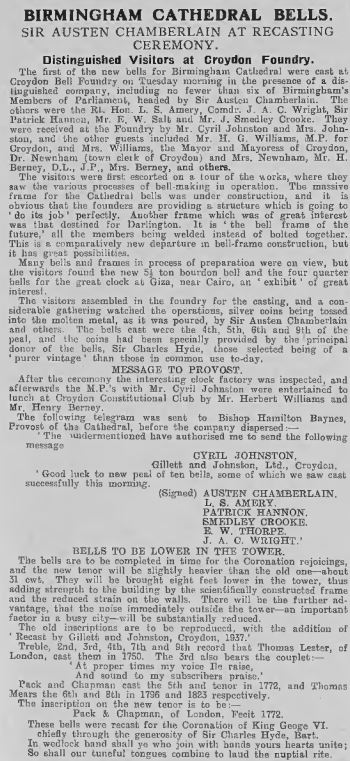
The new bells were dedicated on May 1st 1937 and reported in that week’s edition of The Ringing World.
  |
  |
The first quarter peal and peal followed soon afterwards
  |
 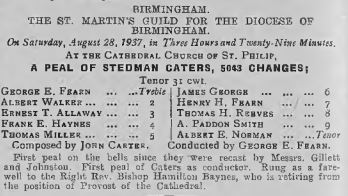 |
The following appeared in The Ringing World on October 1st 1948:
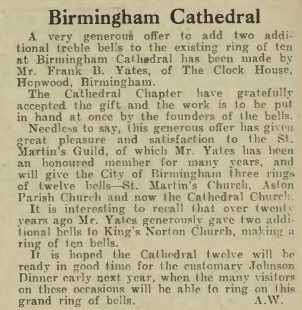
The new ring of 10 was augmented in 1949. Bells 7, 8 & 9 hang in an upper frame, curiously leaving an empty pit in the main frame; though meaning there is a better rope circle. The front four bells have button tops and the rest were cast with flat tops. The dedication was reported in The Ringing World of March 4th 1949:
“Birmingham Cathedral’s New Treble Bells
A FINE RING OF TWELVE.
The new treble bells to complete the ring of twelve were dedicated by the Lord Bishop of Birmingham on February 12th.
The ten bells were installed in 1937 to commemorate the Coronation of King George VI., and the present scheme was made possible by the generosity of Mr. Frank B. Yates, a highly respected member of St. Martin’s Guild.
For the sake of audibility, and to allow the ropes to fall into a good circle, it was decided to hang the seventh, eighth and ninth (of the twelve) in a separate frame, above the existing one, and to move the smaller bells round so that the new trebles occupy the pits previously filled by the trebles of the ten. This involved considerable work — new headstocks and fittings were required for the bells moved into larger pits. The work was carried out in an exemplary manner by Messrs. Gillett and Johnston, the founders of the existing ten bells.
In an address, the Bishop regretted that Mr. Yates was unable, through illness, to be present. He was not going to praise the generous gift, as the donor would be sufficiently rewarded by the knowledge that his gift had been gladly received. As the centuries pass, said the Bishop, may the church and tower stand safe. May the bells, the ring of twelve, ring often on occasions of peace, but never for war. If war should come may they be silent like men stricken with plague.
Immediately after the service a touch of Stedman Cinques was rung by A. Walker 1, H. H. Fearn 2. T. H. Reeves 3, E. C. Shepherd 4, W . C. Dowding 5, G. W . Critchley 6, A. D. Cook 7, J. Pinfold 8, S. O’C. Holloway 9, F. E. Haynes 10, A . Paddon Smith 11, G. E Fearn 12.
The critical listeners outside heard the full beauty of the bells and passed appreciative comments upon them. The new bells blend very nicely with the former ten, and are a credit to the Croydon founders, who were represented by Messrs. M. Howard, F. C. W . Stevenson, B. Newson and others.”
The first peal on the 12 was rung almost immediately:

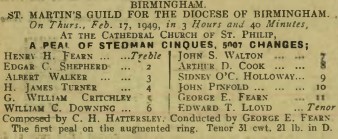
The church tower needed extensive restoration by the mid-1950s and the bells were not able to be rung for about 2 years from 1957. There were no peals rung here in 1957 or 1958 and the first one afterwards was rung in July 1959. This appeared in The Ringing World of June 26th 1959:
“BIRMINGHAM CATHEDRAL
Repairs to the tower of Birmingham Cathedral, which cost over £30,000*, are now nearing completion and, after a silence of two-and-ahalf years, the bells will soon be heard again.
In view of the large quantities of brick dust which had fallen inside the tower, it was deemed inadvisable to resume ringing before the bearings were examined by a bell-founder.
Messrs. Taylor and Co. were consulted, and as a result have removed the clappers for rebushing, and are to repaint the bell-frame and replace any worn fittings.”
(*c.£600,000 at today’s values.)
An historical article, written by Edgard Shepherd, was published in The Ringing World during 1962:

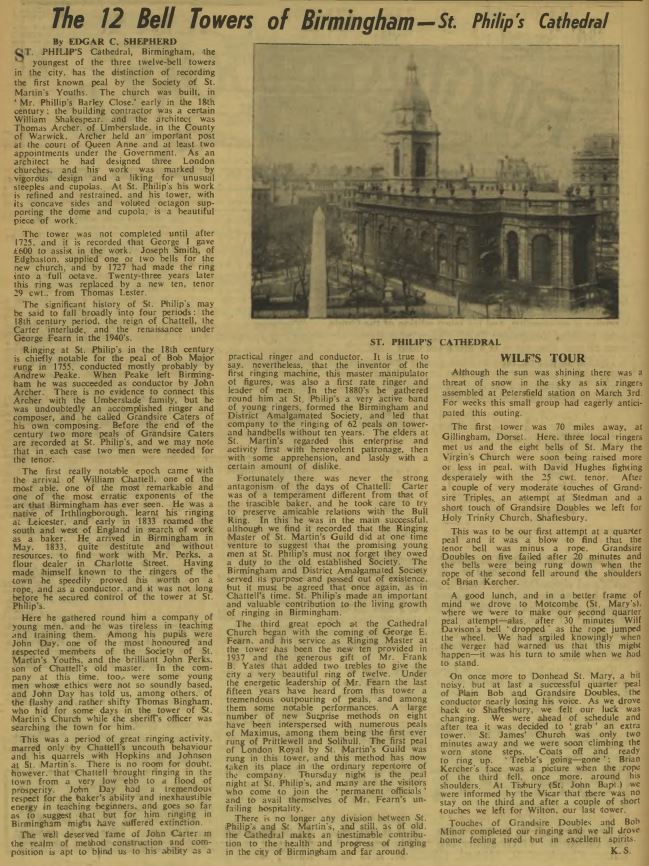
(lick to enlarge)
The 1978 the Cathedral became the first set of bells in a church to reach 1000 peals and an article about this was published in The Ringing World of January 12th 1979:
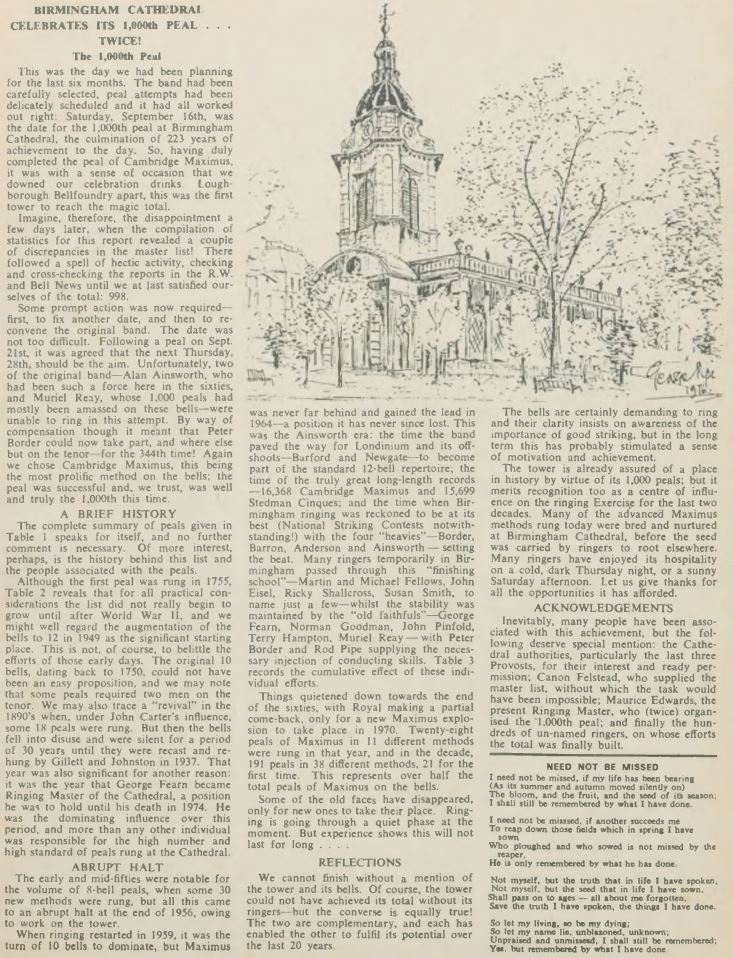
(Click to enlarge)
They are a fine ring and are the most often pealed bells in a church, after Meldreth, Cambridgeshire. The city-centre ringers are rightly proud of their tradition of excellent ringing in recent decades. There is no actual official practice night. However, there is one most weeks, it being often at bit over three hours long, and usually on a Monday!
(Most of the bell information is quoted directly (with permission) from the research notes of Chris Pickford)
Details of the Bells
1 Gillett & Johnston, Croydon 1949 5-3-20 26.75″ 1740.0Hz (A-20c)
2 Gillett & Johnston, Croydon 1949 5-3-16 27.50″ 1546.0Hz (G-24c)
3 Gillett & Johnston, Croydon 1937 5-3-01.5 28.25″ 1450.0Hz (F#-35c)
4 Gillett & Johnston, Croydon 1937 6-0-25 29.50″ 1304.0Hz (E-19c)
5 Gillett & Johnston, Croydon 1937 6-2-09 31.00″ 1160.0Hz (D-22c)
6 Gillett & Johnston, Croydon 1937 6-3-18.5 32.00″ 1088.0Hz (C#-33c)
7 Gillett & Johnston, Croydon 1937 8-0-20 34.50″ 967.0Hz (B-37c)
8 Gillett & Johnston, Croydon 1937 10-1-10 37.625″ 870.0Hz (A-20c)
9 Gillett & Johnston, Croydon 1937 13-2-26 41.50″ 773.0Hz (G-24c)
10 Gillett & Johnston, Croydon 1937 15-3-24 43.50″ 725.0Hz (F#-35c)
11 Gillett & Johnston, Croydon 1937 21-3-20 48.50″ 652.0Hz (E-19c)
12 Gillett & Johnston, Croydon 1937 31-0-21 54.625″ 580.0Hz (D-22c)
Inscriptions
| 1 | THIS RING OF BELLS WAS INCREASED TO 12 BY THE ADDITION OF TWO TREBLES THE GIFT OF FRANK B. YATES, 1949Opposite: GILLETT & JOHNSTON FOUNDERS LONDON |
| 2 | THE GIFT OF FRANK B. YATES, 1949 GEORGE E. FEARN RINGING MASTEROpposite: GILLETT & JOHNSTON FOUNDERS LONDON |
| 3 | THOMAS LESTER OF LONDINI FECIT 1750
Waist: |
| 4 | THOMAS LESTER OF LONDON FECIT 1750
Waist: |
| 5 | T. LESTER FECIT 1750
Waist: Opposite: |
| 6 | THOMAS LESTER OF LONDON MADE ME 1750
Waist: |
| 7 | PACK & CHAPMAN OF LONDON FECIT 1772
Waist: |
| 8 | THOMAS MEARS OF LONDON FECIT / 5755
Waist: Opposite: |
| 9 | THOMAS LESTER OF LONDINI FECIT 1750
Waist: |
| 10 | T. MEARS OF LONDON FECIT 1823
Waist: |
| 11 | THOMAS LESTER FECIT 1750
Waist: |
| 12 | RECAST BY GILLETT & JOHNSTON, CROYDON, 1937.
Waist: Opposite: |
Details of the Ring in 1937
1 Thomas Lester, London 1750 5-3-22 29.00″
2 Thomas Lester, London 1751 6-1-14 30.00″
3 Thomas Lester, London 1750 7-0-10 31.75″
4 Thomas Lester, London 1751 7-2-13 32.752
5 Pack and Chapman, London 1772 9-0-13 35.50″
6 Thomas Mears, London 1796 11-0-11 38.25″
7 Thomas Lester, London 1750 13-2-18 41.25″
8 Thomas Mears, London 1823 16-2-09 44.25″
9 Thomas Lester, London 1750 21-0-13 48.75″
10 Pack and Chapman, London 1772 29-0-18 54.75″
Inscriptions
| 1 | THOMAS LESTER OF LONDINI FECIT 1750 |
| 2 | THOMAS LESTER OF LONDON FECIT 1751 |
| 3 | AT PROPER TIMES MY VOICE ILL RAISE AND SOUND TO MY SUBSCRIBERS PRAISE T : LESTER FECIT 1750 |
| 4 | THOMAS LESTER OF LONDON FECIT 1751 |
| 5 | PACK & CHAPMAN OF LONDON FECIT 1772 |
| 6 | MESSRS CLAUD JOHNSON & GEORGE STUBBS CHURCH WARDENS 1796. THOMAS MEARS OF LONDON FECIT |
| 7 | THOMAS LESTER OF LONDINI FECIT 1750 |
| 8 | T. MEARS OF LONDON FECIT 1823 |
| 9 | THOMAS LESTER FECIT 1750 |
| 10 | IN WEDLOCK BANDS ALL YE WHO JOIN WITH HANDS YOUR HEARTS UNITE SO SHALL OUR TUNEFULLTONGUES COMBINE TO LAUD THE NUPTIAL RITE PACK & CHAPMAN OF LONDON FECIT 1772 |
Photo Gallery |
 |
| The Interior – Looking East |