
St Martin (The Bull-Ring): 16, 39-1-19 in C
| Grid Reference | 139/073866 |  |
| Postcode | B5 4BW | |
| Affiliation | St Martin’s Guild | |
| Peals | Felstead Database | |
| Sunday | 1010-1100 | |
| Practice | Tuesday 1930-2100 (1, 3 & 5) | |
| Guild Website Entry | ||
History
This is the church in the famous Bull Ring – recently developed with the old Debenhams Building almost dominating to the left of the photograph.
A church here was documented in 1263, but it has undergone much restoration over the centuries. The tower reached its current appearance in 1853-55 and the church in 1873-5 when, apart from the tower, it was largely rebuilt. There is an unusual external pulpit at the base of the tower.
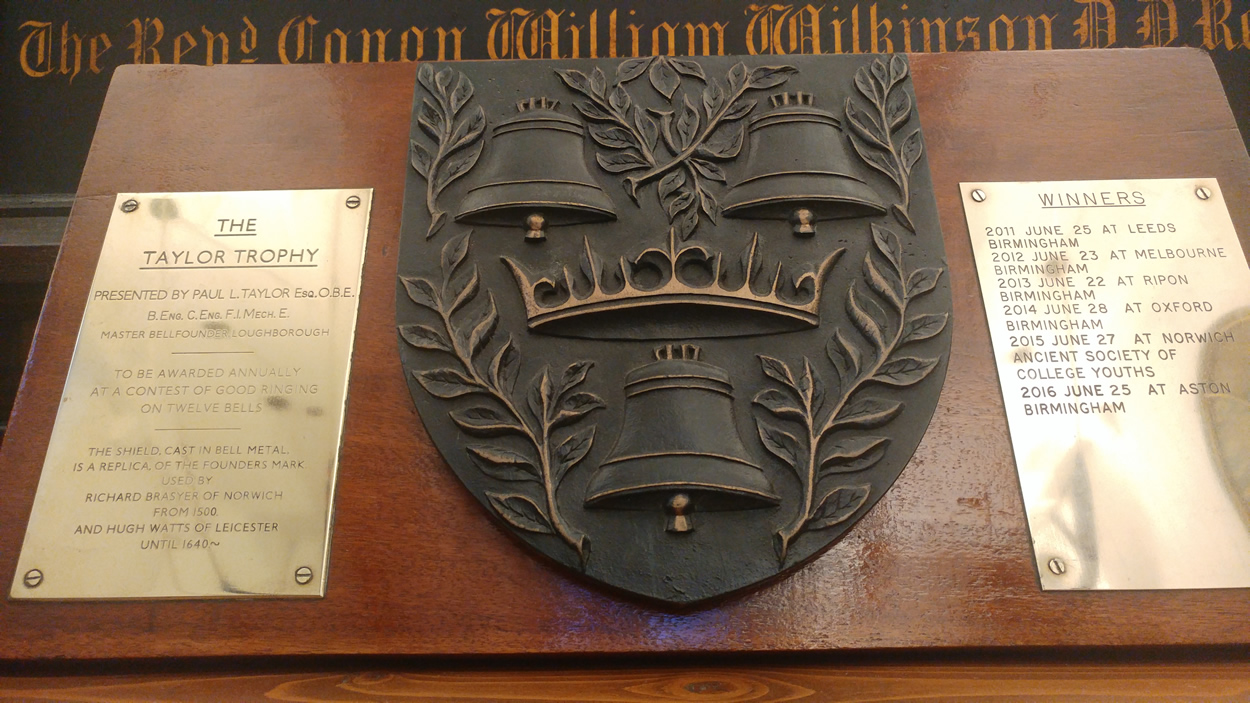
Entrance for ringers is from the west door. The ringers in the centre of Birmingham have a justified reputation for the superb quality of their ringing. The won the National 12-Bell Competition on 12 of the 15 occasions it was held between 2000 and 2014, including 5 years in a row.
The tower now contains the first ever ring of 16 bells, cast between 1988 and 1991, but has a much longer history. In 1552 there were “iij bells”. By 1682 there was a ring of 6, probably cast by Henry Bagley, with a tenor of 17-3-9, augmented to 8 in 1706. One of the two trebles is still in existence, at St. John’s Church in Wolverhampton. It was sold to them in 1760.
It is known that in 1745 when John Wesley preached in the Bull Ring these bells were rung in an attempt to drown his voice!
A “peal” was rung here in 1753, which subsequently proved to be false:

On 12 July 1757 the Vestry agreed “to recast the eight Bells and to encrease the weight of the Bells about 26 hundred”. The minute book contains a further order respecting the bells on 1 November 1757 when the Vestry agreed “to give orders to Messrs Lester & Pack to Cast for the use of the said Parish eight Bells and to be of the weight of St. George’s in the East, Middlesex which weight is 6T. 7C. 0q. 0l.”.
Thomas Lester cast a 30 cwt eight for St. George’s in 1751 and had provided the new ring of ten erected at St. Philip’s in Birmingham in 1751.
In the event, the parish adopted an even more ambitious scheme and in 1758 the old bells were replaced with a new ring of ten with a 35 cwt tenor. The opening was reported in Aris’s Birmingham Gazette of 24 July 1758:
On Tuesday last a Peal of ten bells, cast by Mr. Lister (sic) of Whitechapel, London, for St. Martin’s Church in this Town, were rung for the first Time, which gave the highest Satisfaction, and are thought not to be inferior to any Bells in England
The weights of these bells were:
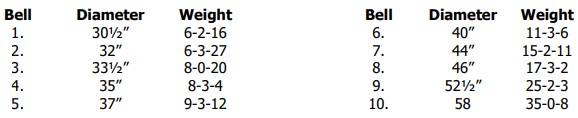
Two of the bells were hung above the other eight.
The first true peal here, Grandsire Caters, was rung on these bells on 19th November 1758, the same year as the ring of 10 was installed.
A long peal of Grandsire Caters was rung on Sunday, 28th August 1768:
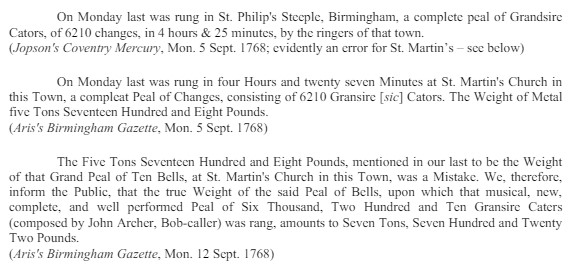
The fourth and ninth required recasting in 1769, also carried out by the Whitechapel foundry. They were 4. 8-2-12, 35.375″ and 9. 27-3-6, 53.0″
The article reporting this mentions the desire to augment to a ring of 12 bells.
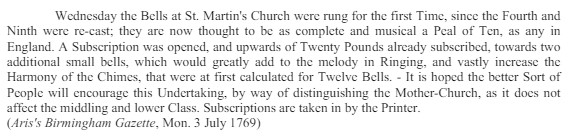
These two trebles were added in 1771/2. making St Martin’s only the 7th ring of 12 in existence.

A peal on November 5th, 1773 was reported thus: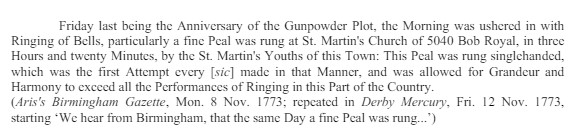
Quickly followed by:

There was a controversy over a supposed plan to remove the two trebles reported in 1774:
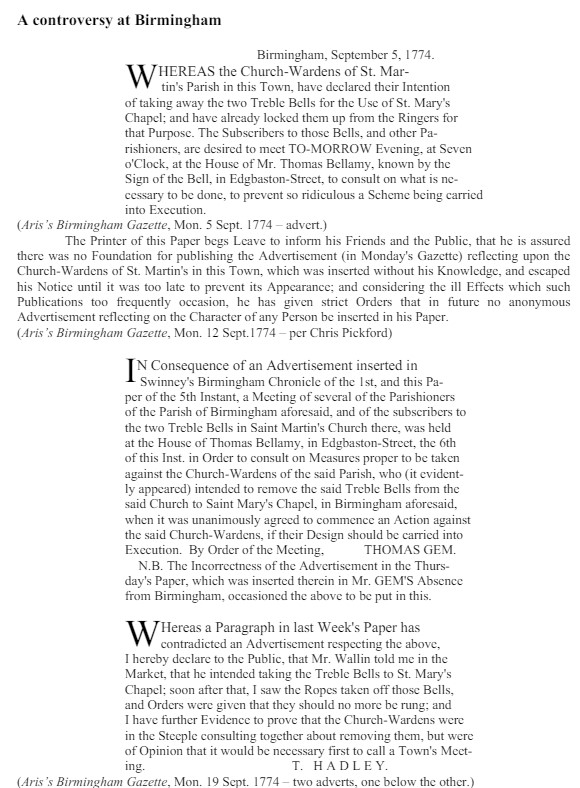
The bells were not removed.
A hoax long peal of Oxford TB Royal was reported in 1779:

Why, and by whom, is not known.
A peal of Treble Bob Royal was, however, rung in 1782:

A gallant loss of a peal by the visiting College Youths in 1786 was reported in the newspapers
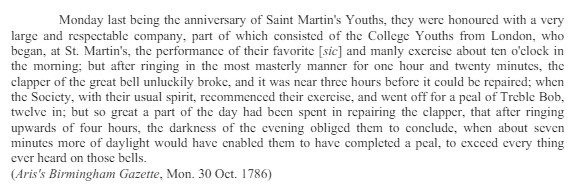
The second ever peal of Grandsire Major was rung here in 1788

The 9th was recast in 1790, again the work was done by the Whitechapel foundry. The new bell was 44.25″ in diameter and weighted 15-1-17.
The ninth peal of Oxford TB Maximus was rung here in 1793

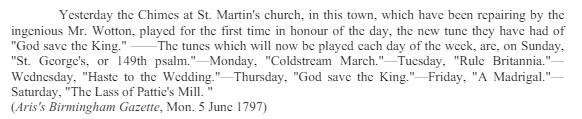
The clock chimes were repaired in 1797
The first peal of Kent Treble Bob Maximus was rung here in 1820 and is commemorated on a peal board. They did it in style, by ringing a 7,200!:

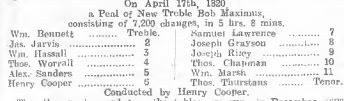
The bells were rehung in 1825 by Charles Oliver (Snr) of Whitechapel, but not entirely successfully. Further work was necessary in 1844 and again in 1858.
Disaster struck in 1868, with two of the bells being damaged within a short space of each other. This was reported in a contemporary newspaper article of 25 December 1868:
Accident to St. Martin’s Bells. We are sorry to learn that its fine peal of bells have been rendered useless for some time to come. On Christmas Day as the ringers were ringing in honour of the occasion in the afternoon, one of the gudgeons that carried the eleventh bell, which weights more than 27 cwt broke short off at the end of the stock, and the bell fell into the pit where it remains. The bell itself is not injured, but a worse calamity has happened to the fifth bell. On Sunday afternoon as the ringers were ringing the rifle corps out of church, this bell became fractured, and must be recast before it can be used again. The whole peal is said to require immediate attention.
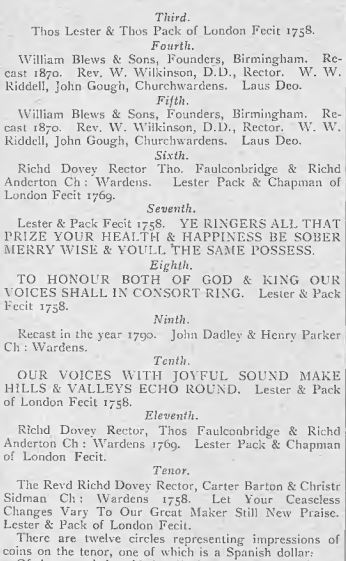
In 1870 Blews recast the 4th and 5th and rehung the bells in a new wooden frame, four above eight. This was more longer lasting and, with strengthening, survived until the 1991 replacement ring was installed. Further work on the fittings was carried out in 1886 and 1902. The inscription of the bells as they were in 1910 are given in Tilley and Walters’ book, “The Church Bells of Warwickshire”:
 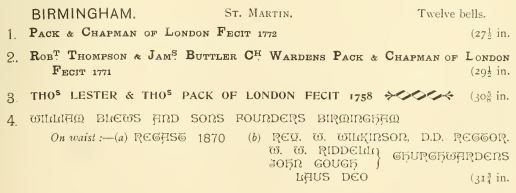 |
 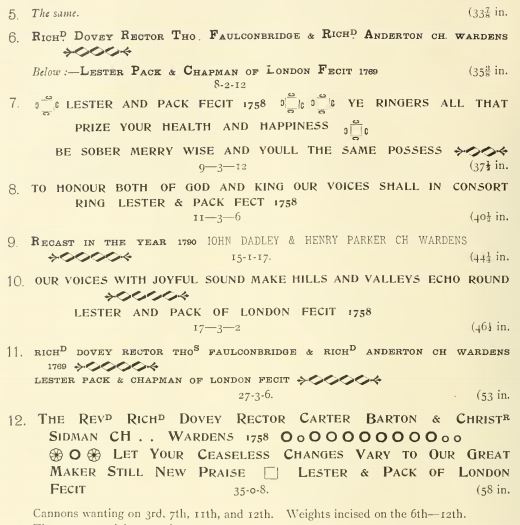 |
This was said about St Martin’s in a series of articles about rings around the country that were published in “Bell News”, this in the edition of June 21st 1902:
“St. Martin. St. Martin’s Guild. Twelve bells. All except 4th and 5th (Blews, 1869), by Lester and Pack; treble, 2nd, 11th, 1772; 3rd , 6th, 7th, 8th, 10th, and tenor, 1758 ; 9th, 1798. Tenor 35 cwt., diameter 4 ft. 9 in. Timber frame. Bells go well. Tenor rehung and various repairs by Barwell. All in fairly good condition, but some of the soundbows worn. Ropes new 1898, good. Methods: Grandsire, Stedman, Plain and Treble Bob, occasionally others. Sunday ringing: 3rd in month and on festivals, 9.30 to 10.45. Practice : Tuesday, 8. There’s an endowment to furnish bell-ropes,”
On Boxing Day 1912 Miss Edith Parker was the first lady to call a peal on 12 bells by calling one of Stedman Cinques here. It is charmingly, if a little condescendingly, reported in The Ringing World of January 3rd 1913:
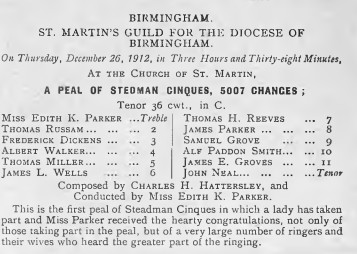
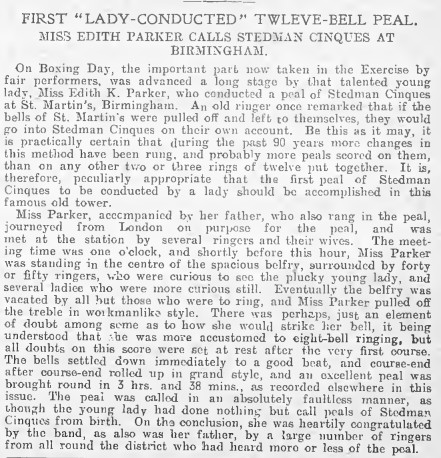
The second bell was recast by James Barwell in 1913. The reason for the need to recast the second was given in a letter read out at the Henry Johnson dinner of 1913 by the Rector of Birmingham, as reported in The Ringing World of March 7th 1913:
ST. MARTIN’S SECOND BELL.
Before concluding, the Rector said he had received a letter from their valued secretary, Mr. Paddon Smith, in which he wrote: “ It occurs to me that this is a favourable moment to bring to your notice the fact that the second bell of the twelve at St. Martin’s, the smallest but one, is badly out of tune, and it is considered the only blot on our otherwise magnificent peal. Somewhere about a century ago it was clumsily handled by a workman connected with a London firm who were rehanging the bells. This intelligent man finding that the bells and frame had been placed too close together to permit the mouth of the bell to pass, cut away so much of the frame as he thought could be done with safety, and then actually proceeded to operate on the bell itself. He removed portions from both sides of the lip, and this, of course, left the bell hopelessly flat. The only remedy is recasting, and as the cost of this would not be heavy, probably under £25,. I earnestly hope that you and the churchwardens will agree to the improvement being made. In the opinion of experts, we should then have in Birmingham a ring of twelve second to none in the country.
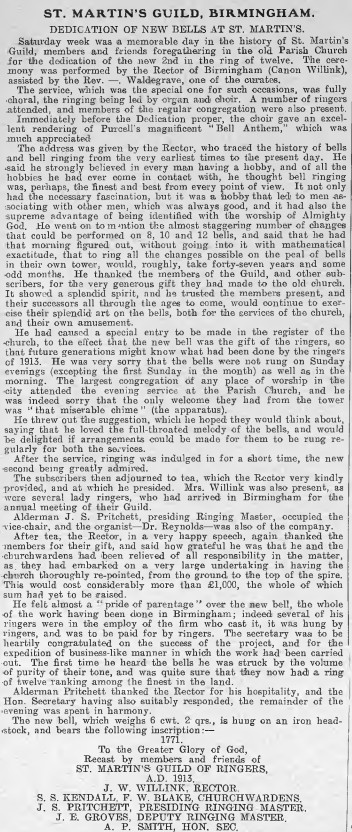
The rededication of the bells is reported in The Ringing World of May 23rd 1913:
There were good testimonials for this bell and the excellent “splice” it made to the peal – but it would only last for 15 years.
At the Henry Johnson Dinner held in February 1927 it was noted by some speakers that the bells were in need of rehanging. It was later stated that no peal could be rung on the bells until they had been restored. Thje following appeared in The Ringing World of March 23rd 1928:
BELLS OF ST. MARTIN’S, BIRMINGHAM.
A NEW PEAL OF TWELVE FOR THE BULLRING.
The contract has now been placed with Messrs. Mears and Stainbank, of the Whitechapel Foundry, for the recasting of the bells of St. Martin’s, Birmingham. The famous church in the Bull Ring is to have a new Simpson-tuned peal of 12 bells, with a tenor about 37 cwt., slightly heavier than the present tenor, The old wooden frame, which is in an excellent state of preservation, is to he retained.
By this decision of the church authorities the old bells will go back to the foundry whence they came, for they were, nearly all of them, cast by Lester, Pack and Chapman. There were six bells in the tower from i682 to 1758, when Lester and Pack supplied a new peal of ten, and in 1771 two trebles were added to make a ring of twelve.
For the purposes of its bells, St. Martin’s is exceedingly fortunate. It is recorded th at ‘ Jno. Billingsley, a.d . 1629, left a croft of land to provide bell ropes.’ This croft is now situated in one of the busiest thoroughfares in Birmingham , and having been built upon and duly appreciated in value, St. Martin’s bells have never been silent for want of ropes, while in these days there is a bumping surplus which has enabled the present recasting scheme to be undertaken.
The magnificent tower, with its lofty spire 220 feet high, is a nobly proportioned structure, and was built about the year 1690.
Later in 1928 the whole ring was recast by Whitechapel. The tenors were replaced the following year, though still dated 1928. The departure of the old bells was reported in The Ringing World of August 3rd. The tenor was in the key of C – (517.5Hz – C-19c)


A brief history of the bells and some details of the dedication were published in the edition of November 9th


(Click to enlarge)
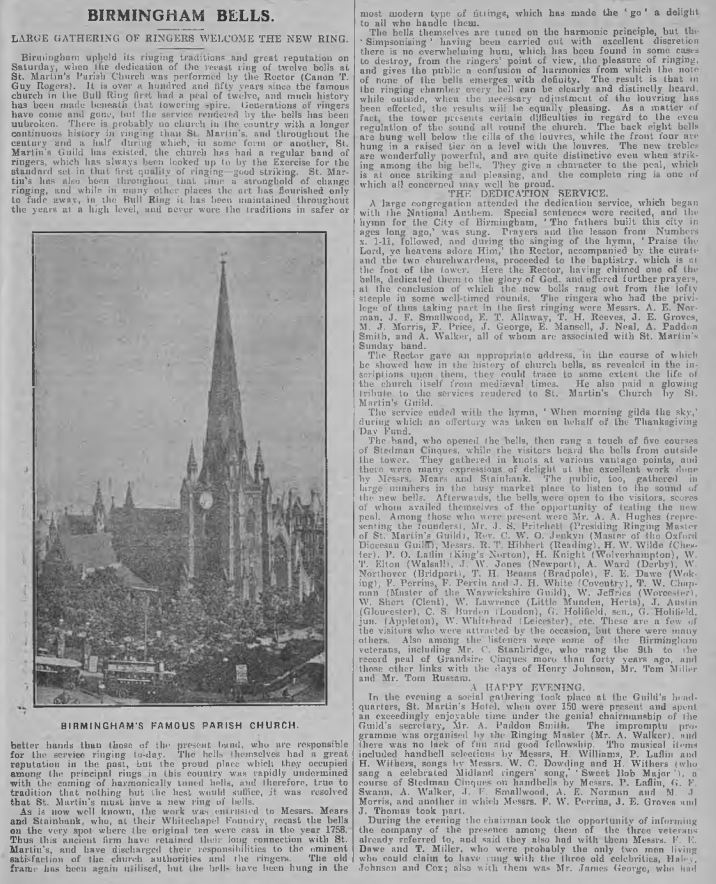
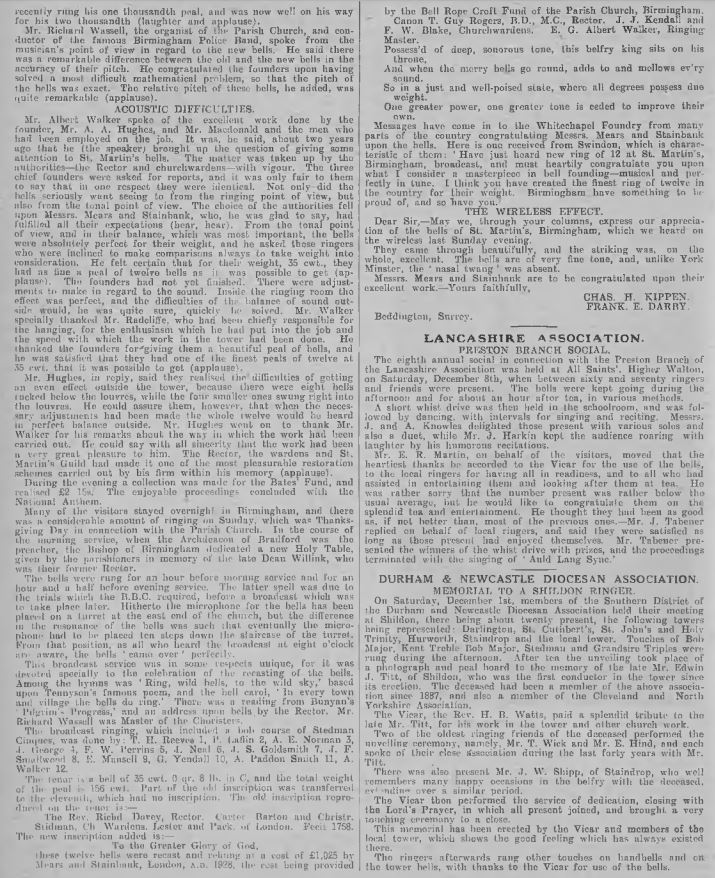
The dedication was reported in detail in the edition of December 14th:
  |
  |
| (Click to enlarge these images) | |
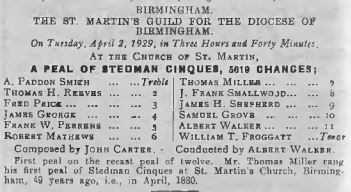
The first peal on the new ring was rung in 1929

A flat 6th was added in 1954, cast in 1953 by Whitechapel and weighing 7-3-12, though not rung until 1955. The dedication of this bell was reported in The Ringing World of June 17th 1955:
“A NEW BELL AT ST. MARTIN’S, BIRMINGHAM
The new bell in the tower at St. Martin’s Church, Birmingham, has been in position for some time, but it has been the wish of the Rector that it should not be rung until complete success had been achieved in the £100,000 appeal for church restoration and extension. The amount asked for has now been fully subscribed, and on Thursday, June 2nd, the bell was rung for the first time.
The service of dedication was held in the ringing chamber, and was conducted by the Rector, Canon Bryan Green, assisted by the senior curate, the Rev. G. C. Potts. In the course of the service prayers were offered for ringers and their work, and the Rector expressed his appreciation of the ceaseless labours of his ringers as office bearers in the church.
The Master of St. Martin’s Guild, Mr. Albert Walker, thanked the Rector for his constant interest in the belfry, after which Canon Green rang the new bell. A bob course of Stedman Triples and a course of Cambridge Major were then rung on the new eight.
The bell, which is in B flat, weighs 8 cwt., and bears the inscription: ‘ I was first rung on the completion of the appeal for £100.000 for the restoration of St. Martin’s Church.’ It adds a flat sixth to the existing twelve, and gives a fine octave in F with a tenor of about 14 cwt. It is expected to provide a useful light eight, both for general purposes and for the training of beginners.
The Master has pointed out that on Tuesday nights at 6.30 there is a special practice for beginners in various stages, and it is hoped that more aspirants will take advantage of this opportunity to benefit by the help and advice of more experienced practitioners.
A. W.”
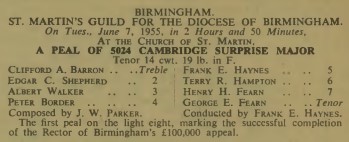
The first peal on “the light-8” was rung very shortly afterwards:

An historical article, written by Edgard Shepherd, was published in The Ringing World during 1962:


The 9th was recast by Taylors in 1975, at 16-3-5 and 45″ as there were plans to remodel the ring and this bell would become the 10th of the new ring. This scheme was never enacted. There are a number of “interesting” letters on the subject in The Ringing World. Perhaps the best comment was made in a letter from R William Willans, published on April 26th 1974; “I do not wish to comment on Mr. Rigby’s unnecessarily vituperative manner, nor on the fact that his remark about Wrington bells, if made in good faith , indicates that Mr. Rigby has an ear like the proverbial whelk.” The installation of the new 9th bell was reported in The Ringing World of February 13th 1976:

It was announced publicly that there was to be a ring of 16 here in The Ringing World of November 18th 1988:


By May 1989 things had moved on and a decision needed to be taken with some urgency as to where the current ring of bells would be transferred to, if anywhere – see RW P472/1989. However, progress was noted in the edition of October 19th 1990, by which time the first bells had been cast. Interestingly, it was noted that the intended destination for the current ring at this time was Toronto:
  |
  |
These bells were removed in early 1991, to be replaced by the ring of 16. The removal of the old ring was reported in The Ringing World of May 24th 1991:

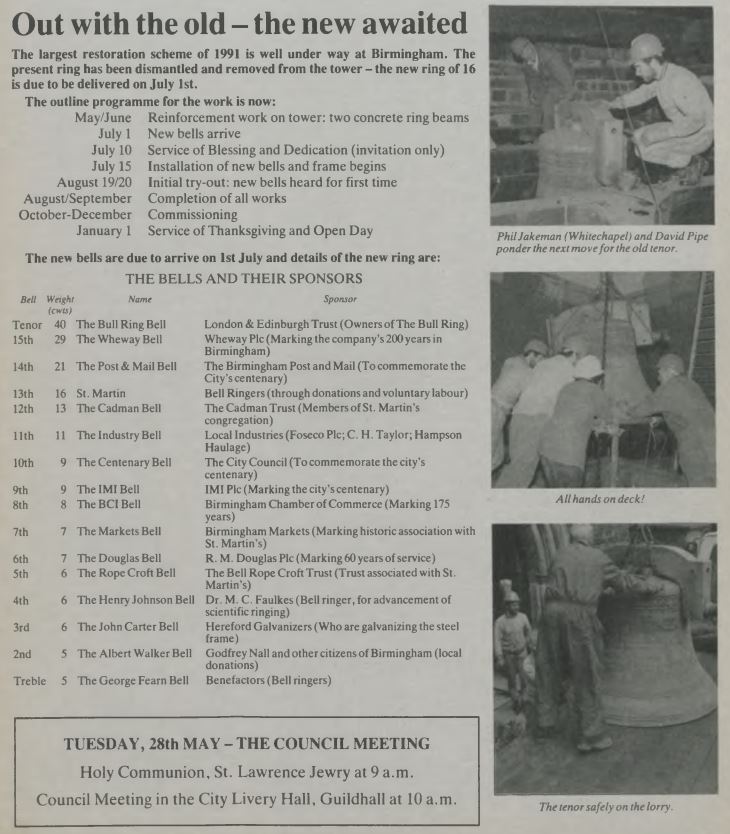
(Click to enlarge)
Plans to hang the bells in Toronto, York, Newquay, Chichchester, Bloemfontein, etc., did not work as had hoped. After getting quite close to being scrapped, the existing ring of 12 were subsequently installed at Escrick, North Yorkshire in 1996. The bells were stored for a number of years, at Taylors before being tuned at Whitechapel. These weights are given below.
The bells of the new ring of 16 were dedicated with them on the floor of the church on July 10th 1991, as reported in The Ringing World of August 16th:
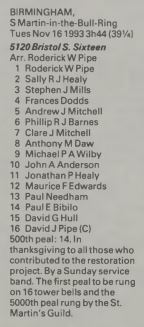
The first peal on the new ring was rung in 1993:
 Bells 3, 4, 8, 12 & 14 are hung above the rest of the bells in a two tier frame.
(Most of the above information is quoted directly (with permission) from the research notes of Chris Pickford)
Details of the Bells
1 Whitechapel Bell Foundry, London 1991 5-3-22 24.88″ 2359.0Hz (D+7c)
2 Whitechapel Bell Foundry, London 1991 5-3-09 25.44″ 2100.4Hz (C+6c)
3 Whitechapel Bell Foundry, London 1991 5-3-05 26.00″ 1981.8Hz (B+5c)
4 Whitechapel Bell Foundry, London 1991 6-1-11 27.50″ 1764.7Hz (A+5c)
5 Whitechapel Bell Foundry, London 1990 6-1-21 28.50″ 1571.3Hz (G+4c)
6 Whitechapel Bell Foundry, London 1990 7-1-09 30.25″ 1399.0Hz (F+3c)
7 Whitechapel Bell Foundry, London 1990 7-1-11 30.36″ 1320.4Hz (E+2c)
8 Whitechapel Bell Foundry, London 1991 8-1-01 32.44″ 1175.6Hz (D+1c)
9 Whitechapel Bell Foundry, London 1990 8-2-23 33.81″ 1046.5Hz (C+0c)
10 Whitechapel Bell Foundry, London 1989 8-3-20 34.94″ 986.4Hz (B+0c)
11 Whitechapel Bell Foundry, London 1991 10-1-01 37.06″ 880.0Hz (A+0c)
12 Whitechapel Bell Foundry, London 1990 12-3-07 40.56″ 784.1Hz (G+0c)
13 Whitechapel Bell Foundry, London 1991 17-2-01 45.06″ 698.5Hz (F+0c)
14 Whitechapel Bell Foundry, London 1990 20-0-26 47.44″ 659.2Hz (E+0c)
15 Whitechapel Bell Foundry, London 1990 28-3-03 53.56″ 587.2Hz (D+0c)
16 Whitechapel Bell Foundry, London 1990 39-1-19 59.94″ 523.2Hz (C-0c)
Inscriptions
| 1 | THE GEORGE FEARN BELL 1991
THE GIFT OF THE RINGING FAMILIES |
| 2 | THE ALBERT WALKER BELL 1991
GIVEN JOINTLY BY GODFREY NALL AND |
| 3 | THE JOHN CARTER BELL 1991
GIVEN BY HEREFORD GALVANIZERS LTD. |
| 4 | THE HENRY JOHNSON BELL 1991
GIVEN BY DR. M. C. FAULKES TO ENCOURAGE |
| 5 | THE ROPE CROFT BELL 1990
THE GIFT OF THE BELL ROPE CROFT TRUST FOUNDED BY JOHN BILLINGSLEY IN 1629. |
| 6 | THE DOUGLAS BELL 1990
PRESENTED BY THE DOUGLAS GROUP |
| 7 | THE MARKETS BELL 1990
GIFT OF BIRMINGHAM CITY COUNCIL COMMERCIAL SERVICES COMMITTEE & THE BULL RING & FLEA MARKETS TRADERS. |
| 8 | THE B C I BELL
MARKING 175 YEARS OF BIRMINGHAM CHAMBER OF INDUSTRY & COMMERCE 1988 AND SIR ADRIAN CADBURY’S PRESIDENCY. |
| 9 | THE I M I BELL
PRESENTED BY I M I PLC TO COMMEMORATE THE CENTENARY OF THE CITY OF BIRMINGHAM. |
| 10 | THE CENTENARY BELL
PRESENTED BY BIRMINGHAM CITY COUNCIL TO COMMEMORATE THE CENTENARY OF THE CITY OF BIRMINGHAM |
| 11 | THE INDUSTRY BELL
FOSECO, C.H. TAYLOR, HAMPSON HAULAGE AND OTHER MIDLAND COMPANIES JOINTLY GAVE THIS BELL. |
| 12 | THE CADMAN BELL 1990
GIVEN BY THE CADMAN FAMILY IN MEMORY OF HENRY ROBERTS CADMAN 1900-1980. |
| 13 | SAINT MARTIN JOHN G. WESSON, RECTOR 1991
SUBSCRIBED BY MANY RINGERS AND THROUGH THE LABOURS OF MEMBERS AND FRIENDS OF THE ST. MARTIN’S BAND. |
| 14 | THE POST & MAIL BELL
PRESENTED BY THE BIRMINGHAM POST & MAIL LTD. TO COMMEMORATE THE CENTENARY OF THE CITY OF BIRMINGHAM. |
| 15 | (Wheway logo) THE WHEWAY BELL (Wheway logo)
PRESENTED BY WHEWAY PLC TO COMMEMORATE THE BICENTENARY OF ITS ASSOCIATION WITH THE WEST MIDLANDS |
| 16 | THE BULL RING BELL
PRESENTED BY LONDON & EDINBURGH TRUST PLC TO THE CITY AND PEOPLE OF BIRMINGHAM, NOVEMBER 1990. |
Details of the Whitechapel Ring
“Whitechapel “Escrick
weight” weight”
1 Mears & Stainbank, London 1928 7-0-17 29.625″ 6-3-07
2 Mears & Stainbank, London 1928 7-0-00 30.00″ 6-0-05
3 Mears & Stainbank, London 1928 7-0-18 30.875″ 6-1-26
4 Mears & Stainbank, London 1928 6-3-15 31.875″ 6-2-07
5 Mears & Stainbank, London 1928 7-2-16 32.875″ 6-3-19
6 Mears & Stainbank, London 1928 7-2-17 33.75″ 7-0-20
7 Mears & Stainbank, London 1928 8-1-06 35.875″ 7-3-26
8 Mears & Stainbank, London 1928 11-1-11 39.50″ 11-0-11
9 Mears & Stainbank, London 1928 13-0-19 42.625″ 16-1-23(Recast Taylors 1975)
10 Mears & Stainbank, London 1928 18-2-09 46.25″ 17-0-14
11 Mears & Stainbank, London 1928 26-1-07 52.25″ 23-3-24
12 Mears & Stainbank, London 1928 36-3-26 59.00″ 34-0-10
6b Mears & Stainbank, London 1953 7-3-12 35.375″ 7-3-17
Details of the Ring at the Time of the Whitechapel Recast
1 Pack & Chapman, London 1772 5-2-01 37.50″
2 James Barwell & Co, Birmingham 1913 6-0-09 29.00″
3 Lester & Pack, London 1758 6-1-21 30.625″
4 William Blews, Birmingham 1870 6-3-21 31.75″
5 William Blews, Birmingham 1870 7-3-21 33.875″
6 Lester, Pack & Chapman, London 1769 8-2-15 35.375″
7 Lester & Pack, London 1758 9-2-09 37.50″
8 Lester & Pack, London 1758 11-2-01 40.50″
9 Thomas Mears & Son, London 1790 13-3-21 44.25″
10 Lester & Pack, London 1758 17-0-26 46.50″
11 Lester, Pack & Chapman, London 1769 26-1-24 53.00″
12 Lester & Pack, London 1758 33-1-05 58.00″
(These are the weights “as received” at Whitechapel and vary from those given when the bells were installed)
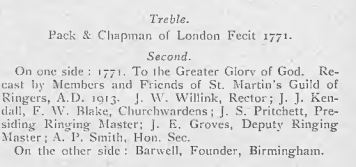
Inscriptions
  |
  |
Details of the Bagley Ring
1 Henry Bagley, Chacombe 1682 6-3-05
2 Henry Bagley, Chacombe 1682 7-1-02
3 Henry Bagley, Chacombe 1682 8-3-23
4 Henry Bagley, Chacombe 1682 10-0-08
5 Henry Bagley, Chacombe 1682 12-1-24
6 Henry Bagley, Chacombe 1682 17-3-09
Photo Gallery |
|
 |
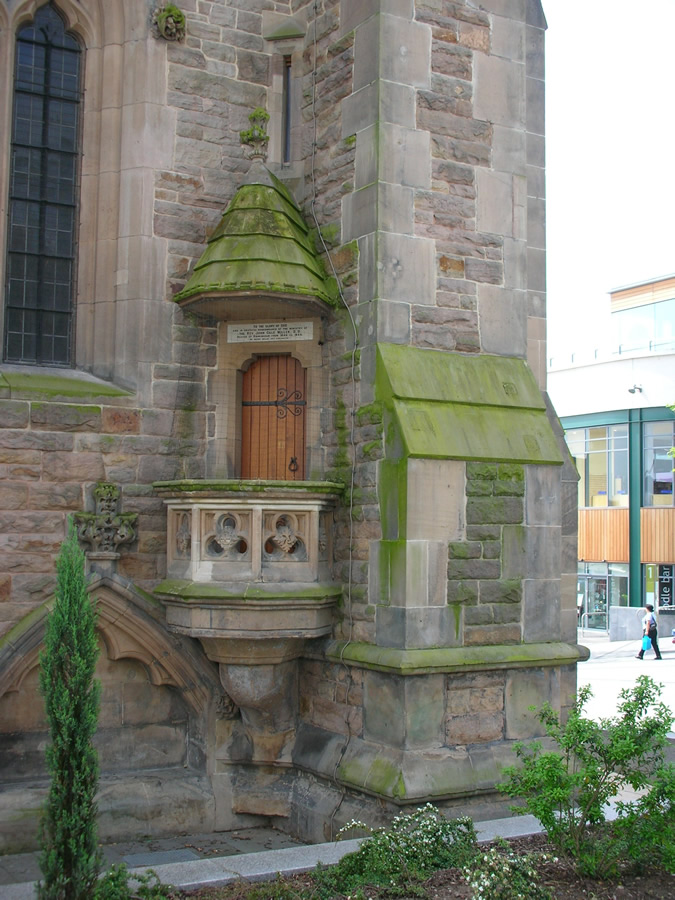 |
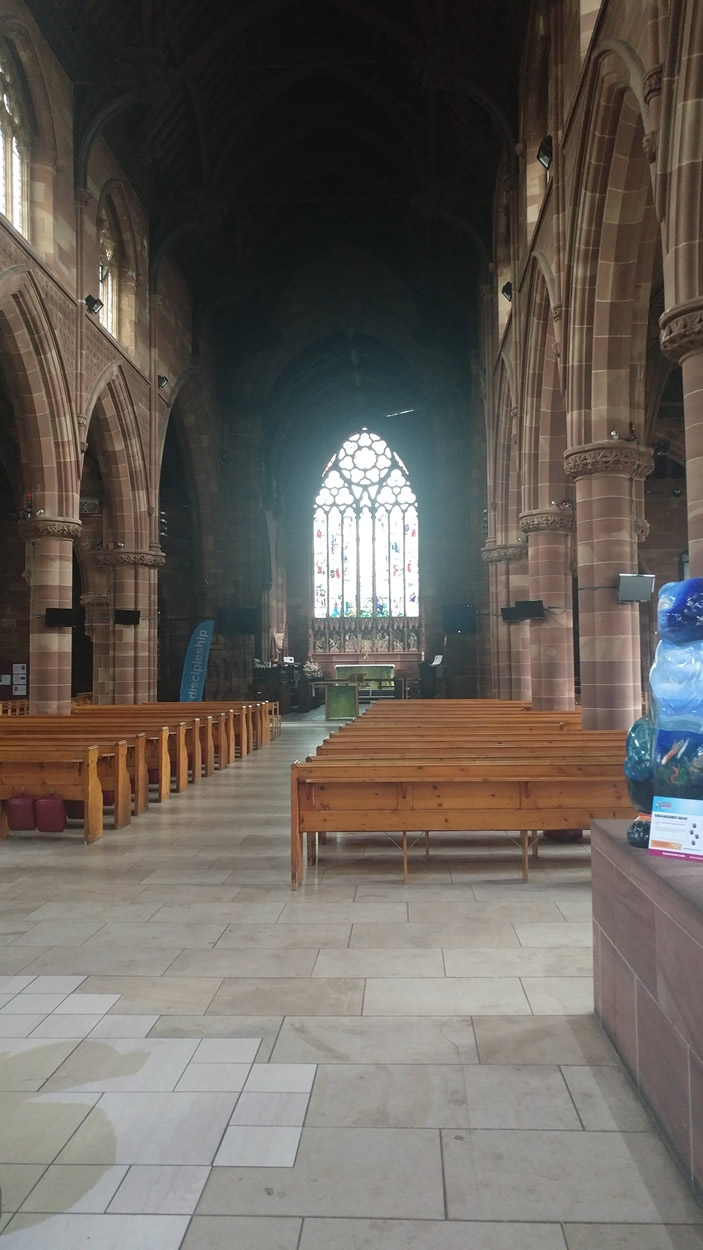
| The Interior – Looking East | The External Pulpit |
 |
|
| The National 12-Bell Trophy in the Ringing Chamber | |
 |
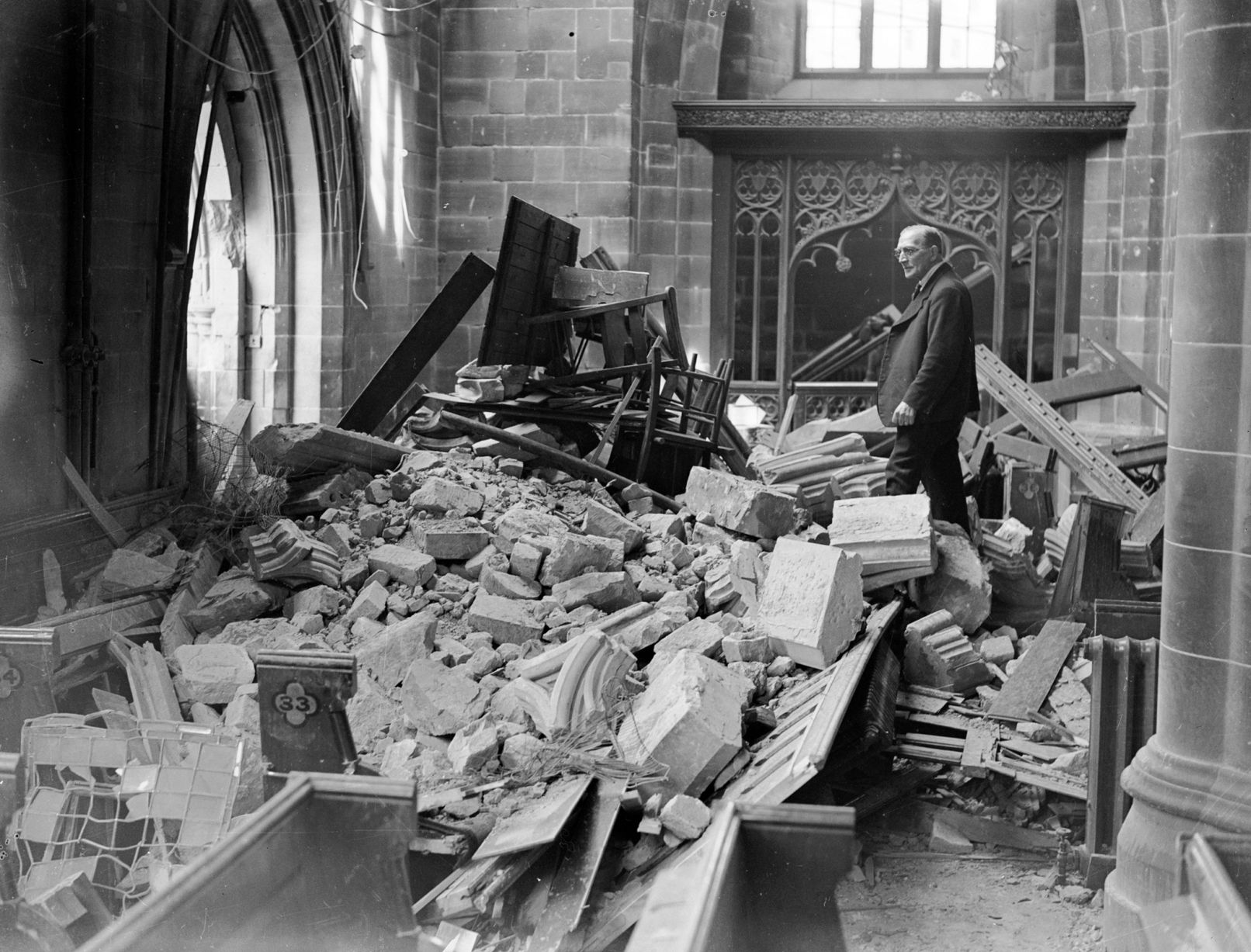 |
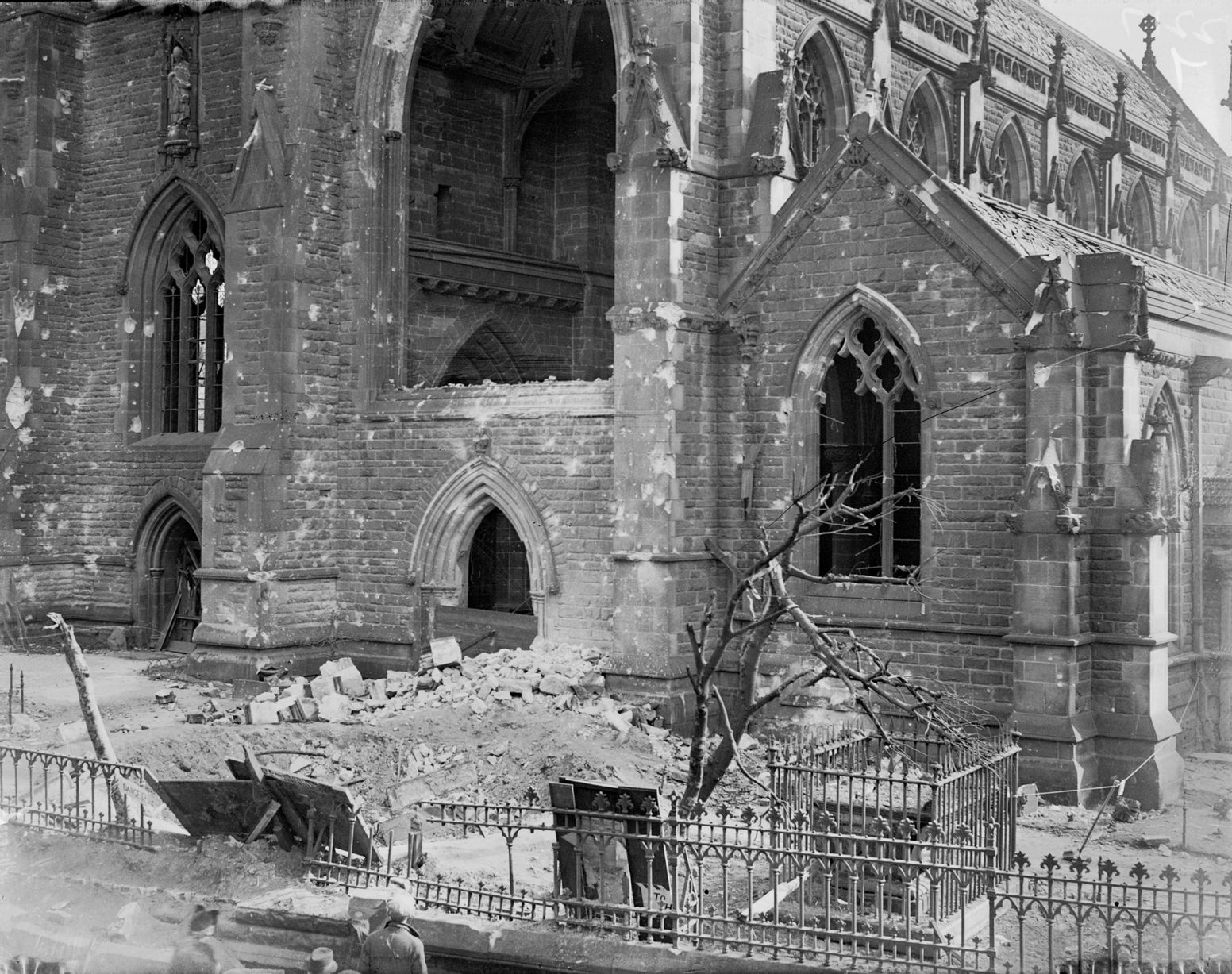
| Damage caused to St Martins in the Birmingham Blitz | |