
Cathedral Church of St Michael 12: 33-3-6 in C# (+6b)
| Grid Reference | 140/335790 | 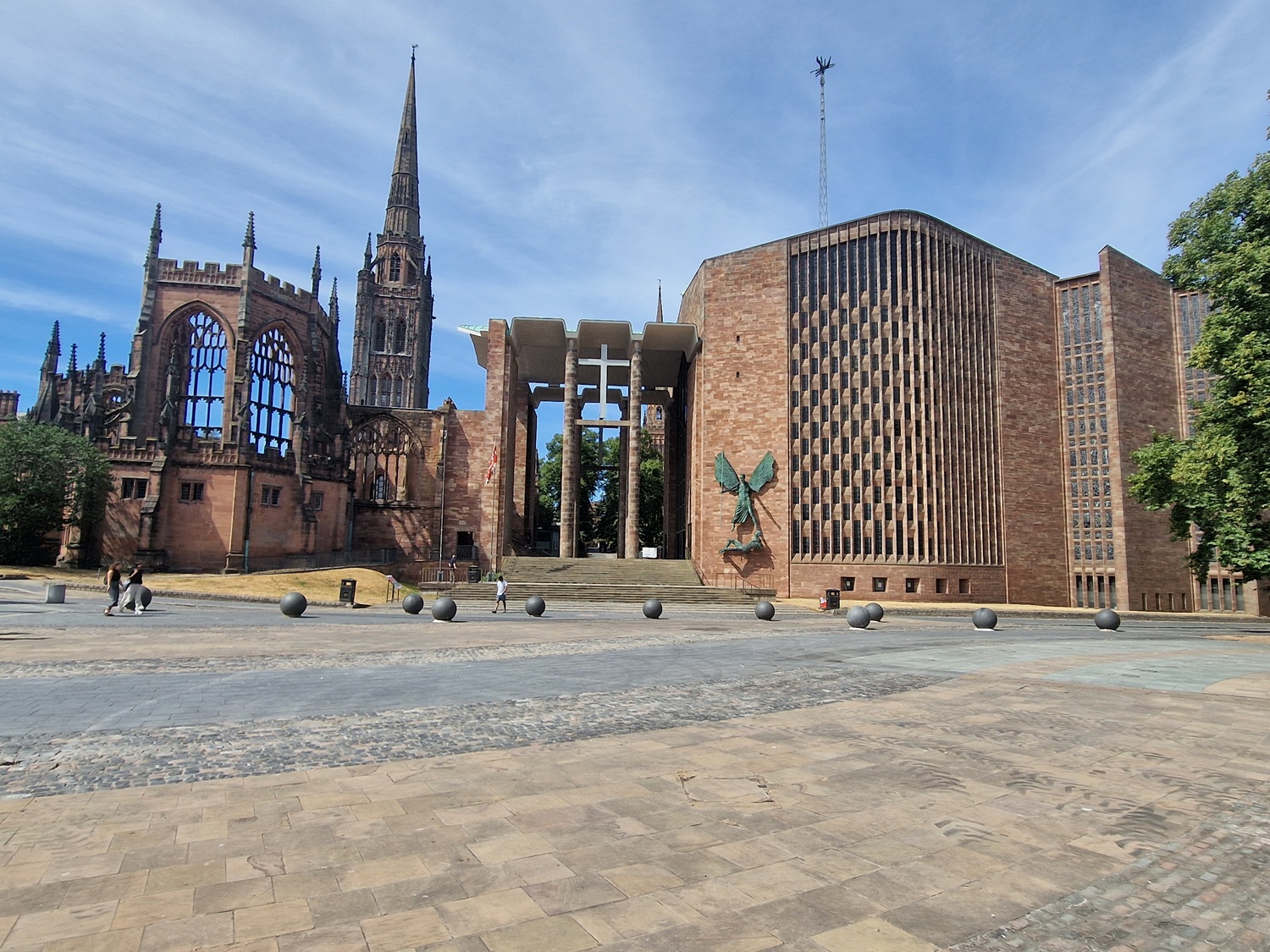 |
| Postcode | CV1 5RJ | |
| Affiliation | Coventry DG | |
| Peals | Felstead Database | |
| Sunday | c.1130 (after main service) | |
| Practice | Thursday 1930-2100 | |
| Other Information | Cathedral Website | |
| Guild Website Entry | ||
History
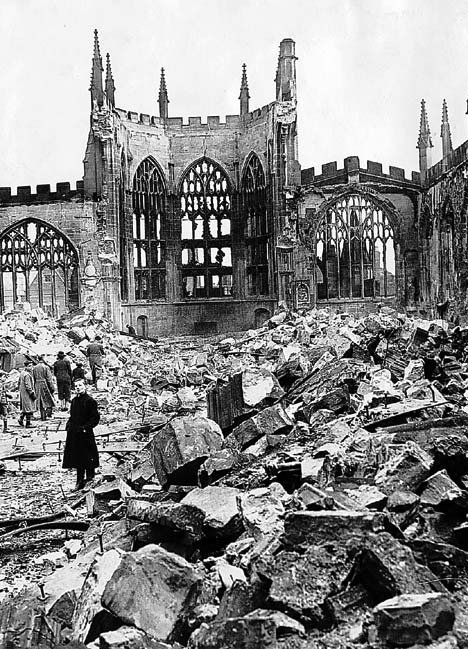
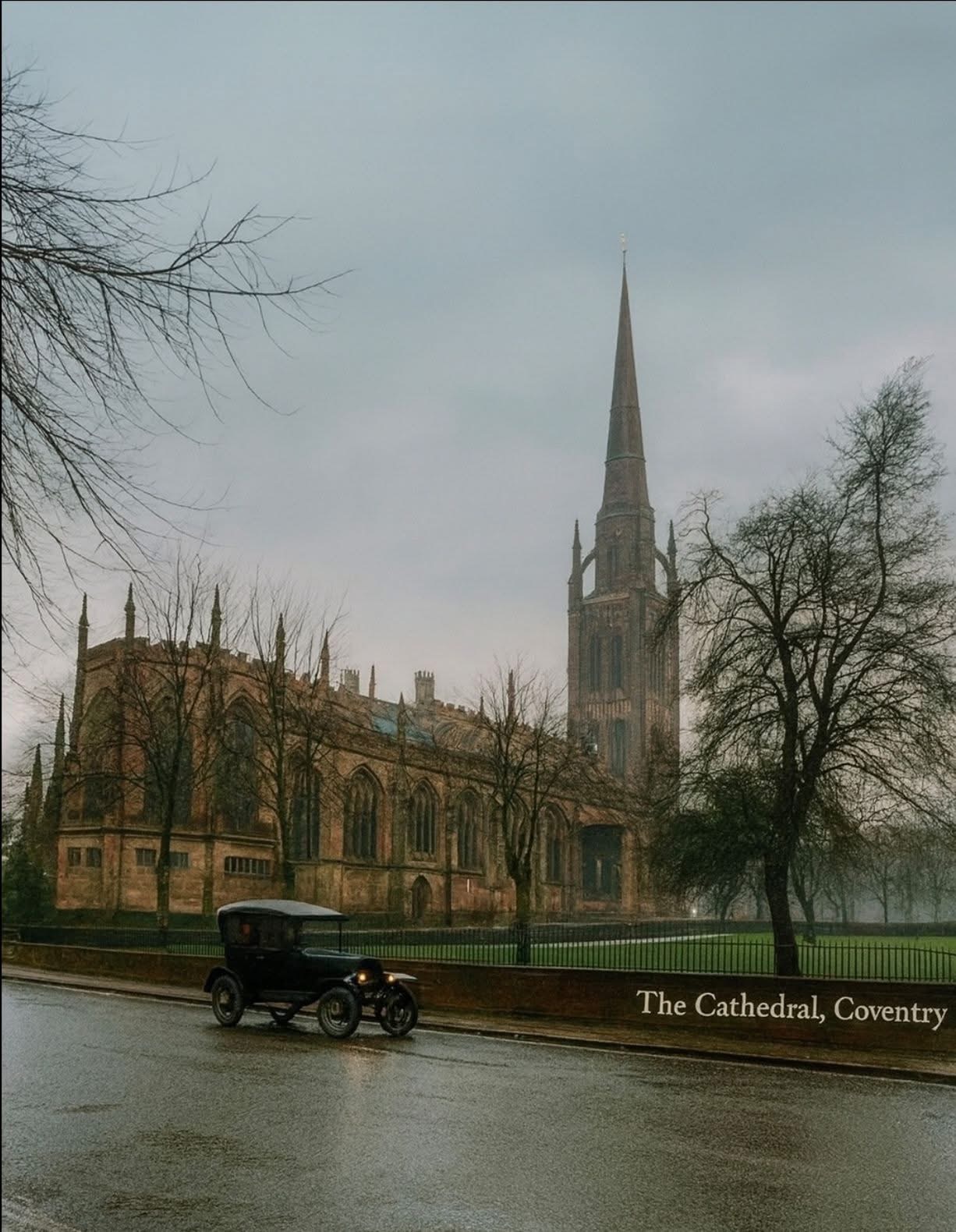
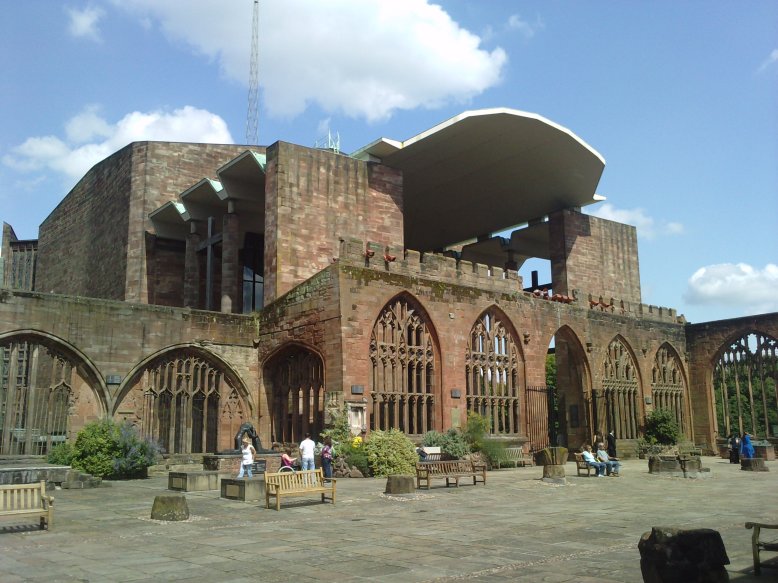
This is one of the most well known of England’s Cathedrals. This is mainly due to the fact that it was fire-bombed in November 1940 during “The Coventry Blitz” and, apart from the tower, largely destroyed. The outside walls, except the clerestory, and the tower are all that remain. Despite some original thoughts of a rebuild based on the floorplan of the current cathedral, new cathedral was built at right angles to the old one and therefore runs North-South instead of East-West. Of modern design, it provokes either like or dislike amongst visitors, but rarely apathy!
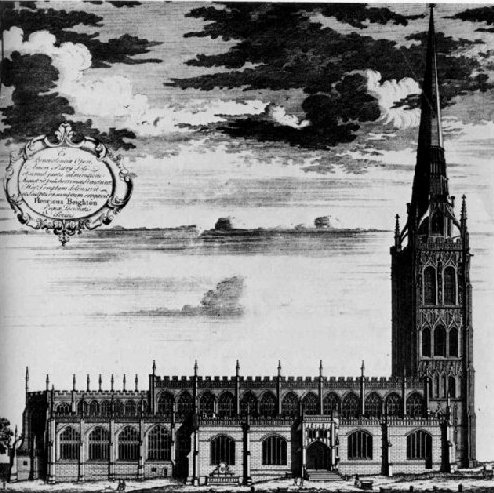
St Michael’s Church, as it was originally known, is largely late-14th century to early-15th century in date and is in the “Gothic” style of architecture. Side Chapels were added in the 16th century. Until it was raised to Cathedral status in 1918 it was one of the largest parish churches in the country – its spire rises to 295 feet.
The power struggle between the Earl and the Priory can be seen by the very close proximity of Holy Trinity church to St Michael’s. Holy Trinity would be considered to be a large church in many places, but it is located very close to one that is even larger! This church once had a ring of 8 bells (q.v.)
Bells were installed in the tower in 1429, probably replacing some earlier bells. There is definitive evidence of there being bells in the Court Leet in 1468, which required that both here at at Holy Trinity that the “Clerkes of both churchis” should, “ryng both day-bell & Curfew in due tyme & that the clock be duly kept, upon the peyne of ijd at every default to be restayned of their wagis”
In 1488 at great bell called the “Jesus Bell”, weighing over a ton and a half, was added to the tower. It is said that it is a thanksgiving for the restoration of peace after “The Battle of Stoke”. said to be the last battle of The Wars of the Roses, the previous year. (This took place near East Stoke, Nottinghamshire and not in the part of Coventry called Stoke)
The Edwardian Inventories for Coventry no longer exist between 1497, when there were apparently 5 bells in the tower and 1674, when there were 6 bells and therefore little is know of their history. The sermon bell was recast in Leicester in 1569, probably by Thomas Newcombe II. The third and fourth bells were apparently recast, again in Leicester, in 1607, again probably by the Newcombe foundry
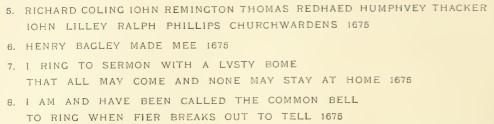
In 1675 we know that the tower contained a heavy ring of 6 bells, with a tenor of 30-1-5. It was agreed by the Vestry on 18th March 1674/5 that these bells were to be recast into a ring of 8 by Henry Bagley I and his son Henry. The tenor now weighing in at 25-0-12.
The bells were taken down from the tower starting on 26th Mary 1675. The new bells are said to have been cast only 3 days later. This suggests that they were likely to have been cast locally in a temporary foundry and not at Chacombe, where the Bagley foundry was based. Elsewhere, the date of casting is given as 26th June, but, even so, this hardly leaves enough time to take the metal of the old bells the 30 miles or so to the foundry and the have the new ring returned to the city. What we can say is that the job was completed successfully in a remarkably short space of time.
These were only the second ring of 8 in a Warwickshire church. Their inscriptions are given in Tilley and Walters’ book, “The Church Bells of Warwickshire”:
 |
 |
There are only a few references to the bells in the Vestry minutes in the succeeding decades. On 19th August 1731, it was ordered that the bells and frame should be repaired “where needful”, and that the cracked third bell should be recast. It is not known who carried out this work.
The first peal on the bells was rung in 1737 and was reported thus:
“On the 15th Instant the whole Peal of Grandsire Tripples, containing 5040 Changes, was rung by the Society of Ringers at St. Michael’s in Coventry, in three Hours and nine Minutes; which was the first Time it ever was rung in that City.
(Reading Mercury: Or, London Spy, Mon. 21-28 Nov. 1737; also Northampton Mercury, Mon. 21 Nov. 1737)”
There was a sad death the next year
“We are inform’d from Coventry, that on Monday Morning last one William Leigh going to ring the Bell at Four O’clock, as usual, at St. Michael’s Church, unfortunately fell out of the Steeple upon the Leads, and was so terribly bruised, that he died in a short Time.
(Northampton Mercury, Mon. 13 Nov. 1738)”
A peal was reported as being rung in November 1739

Another peal was reported in 1772

And another the following year
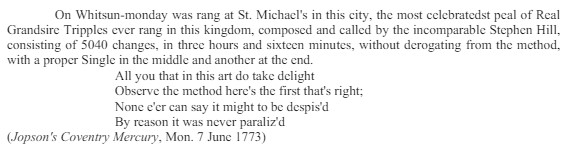
A further peal was reported to be rung here in February 1774

The condition of the bells was brought to the attention of the Vestry at a meeting on 4th April of the same year. It was reported that one of the bells was cracked. It was agreed to recast the bells to about the same weight and to add two trebles to make a ring of 10. The old frame was to be altered to take the new ring.
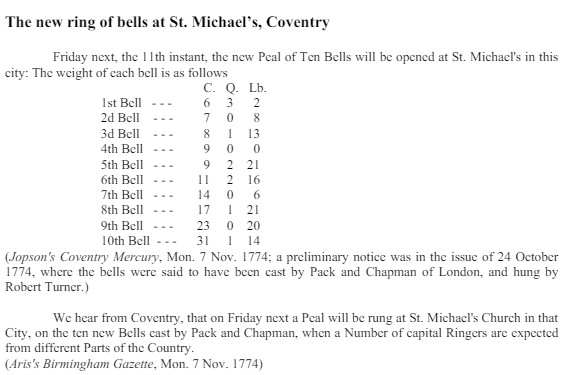
Such was the enthusiasm, that it was quickly agreed to incur additional expenditure and to increase the weight of the ring. Contracts were signed on 29th May 1774 and work to remove the existing ring started two days later and these bells were recast into a ring of 10, tenor 31-1-14, by Pack & Chapman of London and hung by Robert Turner of Whitechapel, who modified the existing frame.

They were opened on Friday 11th November 1774.
The new ring was reported in the newspapers of the time thus:
One of the bells, the old fourth, was found to fit the existing four bells at St John the Baptist’s church in the city and it was sold to them for £44/4/- to offset the cost of the additional metal that would now be needed for the ring of 10. This bell is still in existence.
The first peal on the ring of 10 was soon rung:

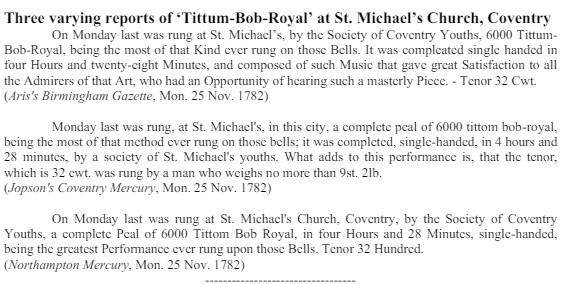
A peal of Plain Bob Royal was rung here in 1782:
However, the tower was soon giving cause for concern. It was said to be in a dangerous state in 1789. Work was done on the tower from the summer of 1793 and into 1794. As part of this work the bells were removed from the tower.
In considering the bells, it was felt that they had been hung too high in the tower and that putting them back at the same height would “be to the destruction of the tower”, We should remember that the then frame was designed for a lighter ring of 8.
As a result, in 1794 and the bells were rehung in a two tier wooden frame that rose from the ground. The frame design meant that the bells were hung at the level of the lower set of louvres, about 80 feet from the ground
The 6th cracked and was recast in 1799 by Thomas Mears. It was inscribed
MUSICK IS MEDICINE THO THE MIND. THOMAS MEARS OF LONDON FECIT 1799
In 1802 the tenor also cracked. A parish rate was proposed to rehang the bells
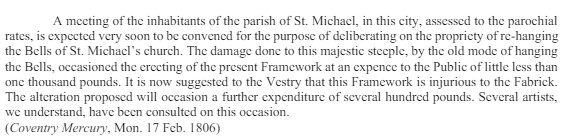
The bell was recast in 1805 by John Briant of Hertford, now weighing in at 32-0-9. The frame was rearranged to have all the bells on one level. They were “reopened” in 1807. Briant was assisted by Joh Over, of Rugby, who made several frames in the surrounding area around this time.

A peal was soon rung:

followed quickly by one of Plain Bob Major

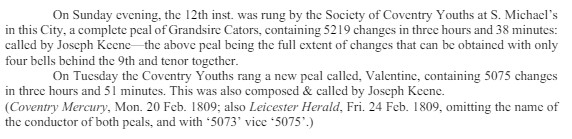
Two peals are reported in 1809
These bells had a very good reputation and were said by some to be on of the best ring of 10 in the country – as noted in early editions of Bell News.
Their inscriptions are also given in Tilley and Walters’ book:


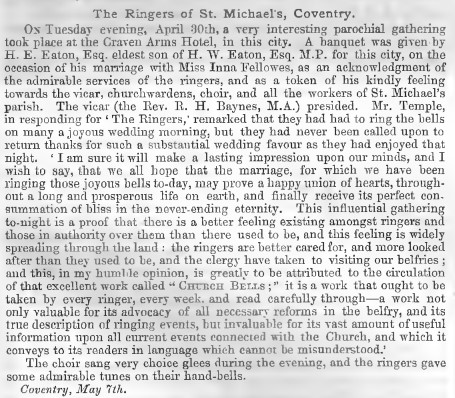
An article about the ringers here was published in “Church Bells” in their edition of May 25th 1872:
and again on January 4th 1873:
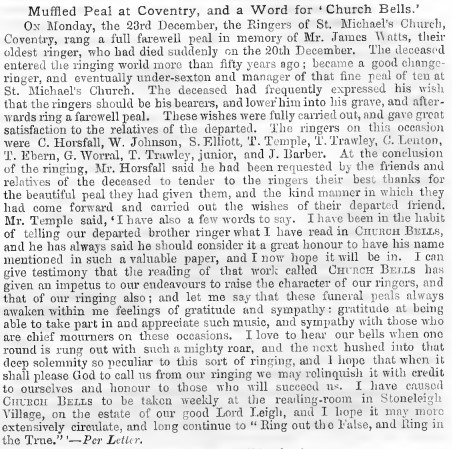
and again in the edition of April 26th 1873
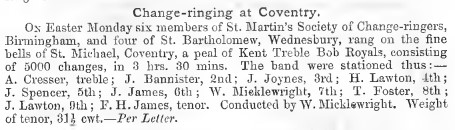
Details of peals that were recorded on pealboards in the tower at the time were published in “Church Bells” on April 25th 1874. These boards have been lost.
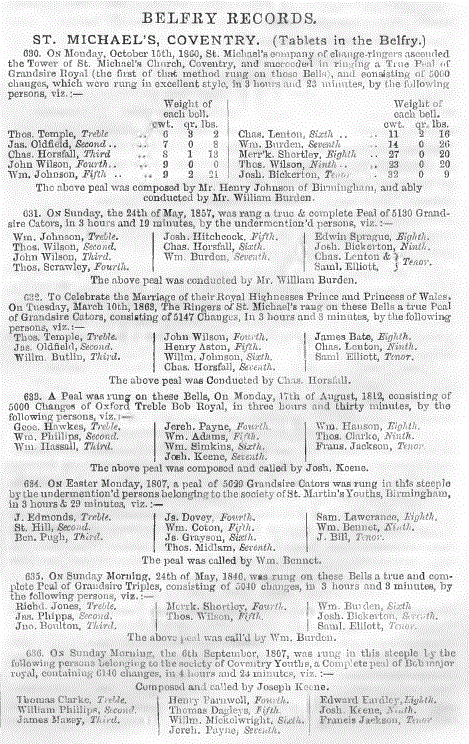
Before the end of the century the tower was again giving cause for concern. There was a huge restoration of the church in the 1880s and, as part of this, in 1885 the bells were hung dead in the octagonal part of the tower. The Bell News of 19th May 1883 noted, “The fine old church of St. Michael’s, Coventry, so well-known to our readers, having become obviously in need of restoration, the vestry have consulted Mr. J. O. Scott, who has presented a report upon the that a heavy, fall of snow might lead to a failure of the roof. The work state of the building. The chancel roof he describes as in a condition which, in Mr. Scott’s opinion, requires to be done to the church would, he estimates, cost some £12,000, while to properly restore and repair the tower and spire would cost £18,000 additional.” Even so, in the edition of 23rd June it was noted, “On Saturday, June 9th, a company of ringers from St. Martin’s, on the invitation of the Vicar and Churchwardens, visited St. Michael’s, Coventry, to attempt a peal on the far-famed bells, which until recently have been in a rather neglected condition, but have now been overhauled by a local bellhanger, and made pealable at an outlay of between £80 and £90”.
The St Martin’s Guild held their AGM here in 1884 and noted that £19,000 of the projected cost of £35,000 had already been raised. They did not express any concern about the fate of the bells and it must not then have been known what would come about in regards of them a couple of years later.
In the Bell News of 16th Mary 1885 it is stated,
“The Restoration of St. Michael’s, Coventry.— A meeting of the General Committee for the restoration of St. Michael’s, Coventry, has been held at St. Mary’s Hall. Lord Leigh presided. A discussion took place concerning the disposal of the peal of bells, which, if retained, would require the erection of a second tower. The monetary question was the difficulty in the way, and Mr. Woodcock (who is a subscriber of £10,000 to the restoration fund) said, assuming that a good tower could be put up for £8000, he was prepared to give half of it. It was resolved, in order to ascertain the money which would be required, to invite tenders for the work from Mr. Thompson, of Peterborough, and a sub-committee was appointed to select the stone. The Editor was not impressed that the bells were to be removed from the tower and he wrote a scathing editorial in the same edition!
Details of the last “peal” on the bells is given in a letter published in The Ringing World on June 7th 1940:
“COVENTRY BELLS.
To the Editor. Sir,— Sunday next, June 9th, is the 57th anniversary of the last peal rung upon the grand old bells at St. Michael’s, Coventry, and perhaps the particulars of it will interest some of your readers.
‘On Saturday, June 9th, 1883, the St. Martin’s Society, Birmingham, rang in 3 hours 33 minutes a peal of Stedman Caters, 5,063 changes: Henry Bastable 1, Job Joynes 2, Amos Cresser 3, Henry Johnson, sen. 4, John Dunn 5, Thomas Miller 6, John Buffery 7, Francis II. James 8, Henry Johnson, jun. 9, Thomas Reynolds 10. Conducted by Henry Bastable.’
Tom Miller is the last survivor of this band and also one of the few living ringers who have rung on Coventry old bells, which were destroyed in 1927.
Henry Johnson, sen., in speaking of this peal, referred to the “bells as ‘ that masterpiece of the founder’s art — the ring of ten at Coventry.’
INTERESTED”
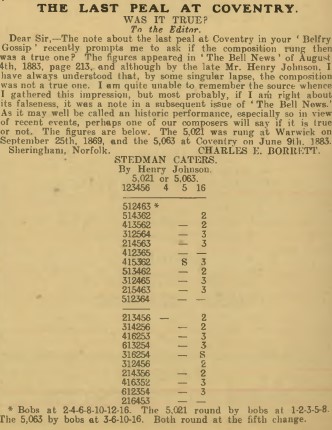
Sadly, this peal was later proved to be false. The last true peal on the bells was Grandsire Caters, rung on April 2nd 1877. Details of the false peal were given in a letter, published on June 27th 1941 and clarified in the Jul 11th edition – sadly, it would have been a true peal if the band had rung the shorter option:
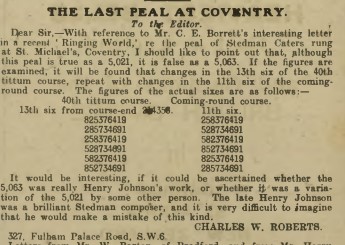
The bells were last rung for the final service before the church closed for restoration, held on June 29th 1885. The opening up of the tower arch to the church would have made the wooden structure holding the bells visible to the congregation and, perhaps, this might have been another reason for removing the bells as a ring?
The main proponent of building a new tower, Mr. George Woodcock died before anything could be done, not making any provision for his offer of half to cost in his will, and the tower was never built.
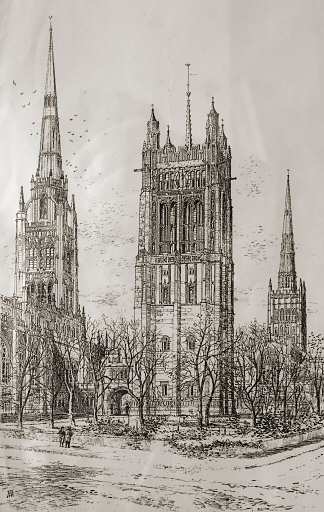
The Proposed Campanile, as it appeared in “The Builder”.
There are many letters and articles in “Bell News” of the time reporting on the arguments for and against rehanging the bells that are worth reading. Indeed, there is an editorial of July 26th 1890 that implies that the decision to build a campanile had been taken, but to no avail. The bells remained on the church floor for several years, apart from the treble, it being hung for chiming in a temporary campanile in the north-west corner of the church. The Bell News of 26th April 1894 notes that an estimate had been acquired for hanging them in the tower again, but as a chime. This produced a flurry of angry letters wanting the bells to be kept as a ring! The bells were finally hung for chiming by Taylors in 1896.
An article about the bells was published in The Ringing World of May 28th 1915 and is an interesting read:
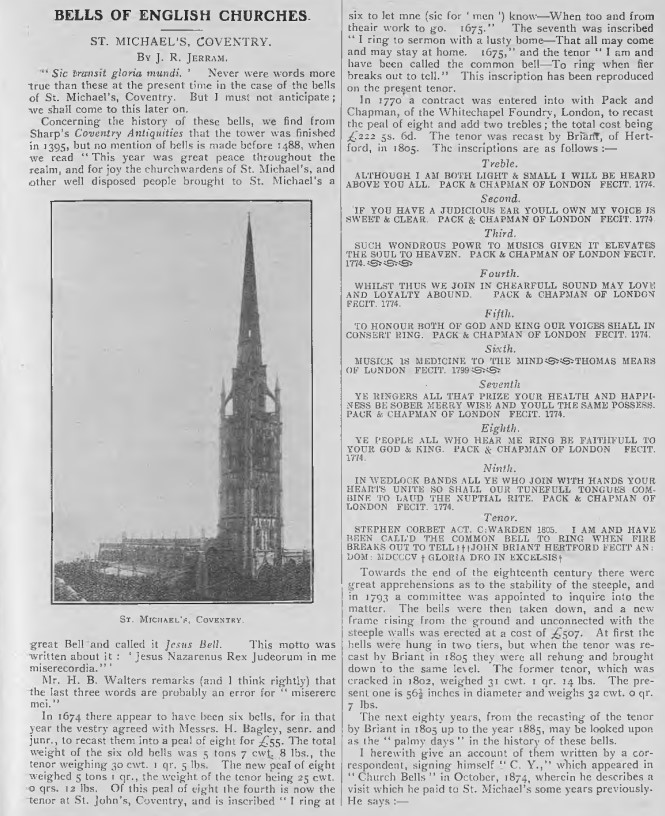
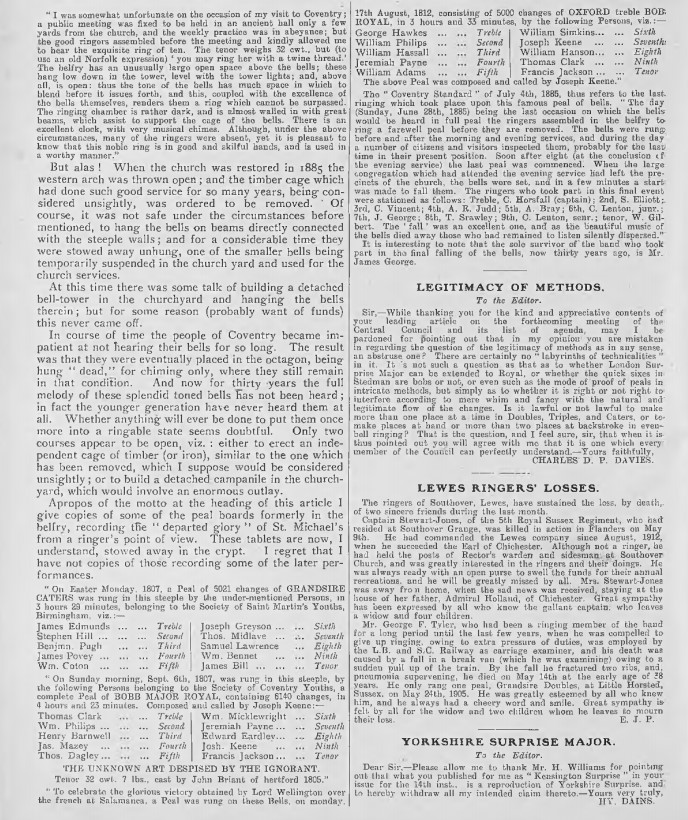
An educated guess as to how the bells might have sounded has been produced by Bill Hibbert from data taken from the old 10 prior to them being broken up. Bill notes thatA. A. Hughes wrote, “I consider they fully justify the good reputation they have so long enjoyed, and it is my firm opinion that there is no need for any re-casting.” It is an interesting read, (and listen!), and can be found here.
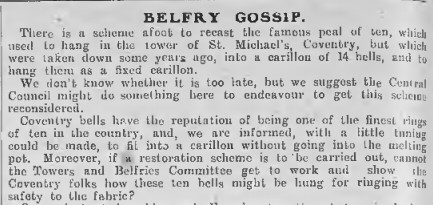
The first report I have found in The Ringing World about recasting the bells is from their “Belfry Gossip” section of June 12th 1925:
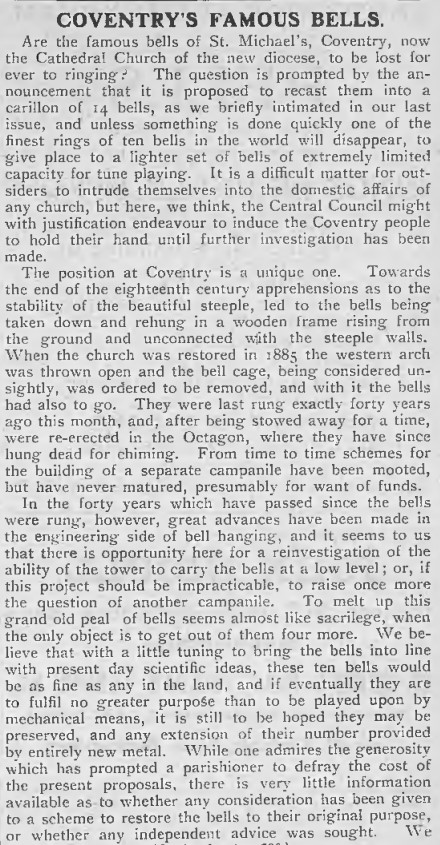
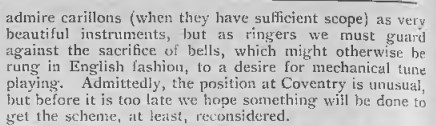
The following edition carried a front page editorial!:
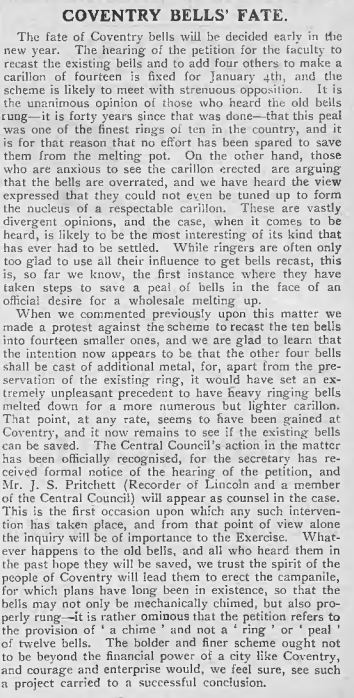
As series of letters were published supporting what the Editor had printed. I have collated just some of the articles and letters:
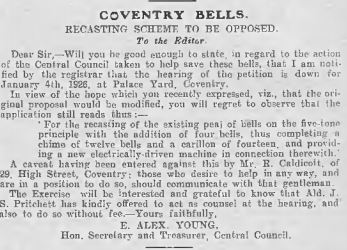
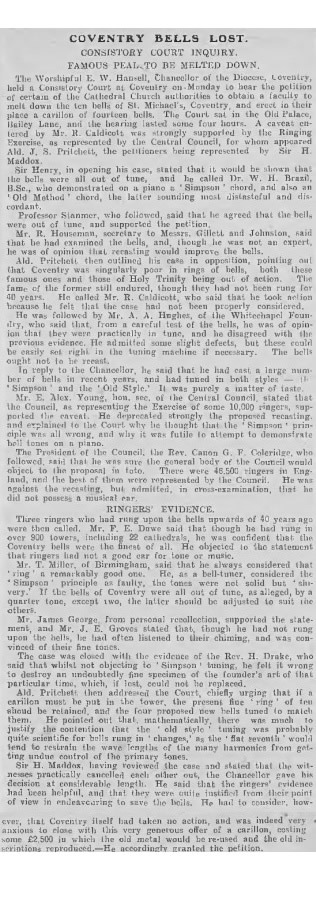
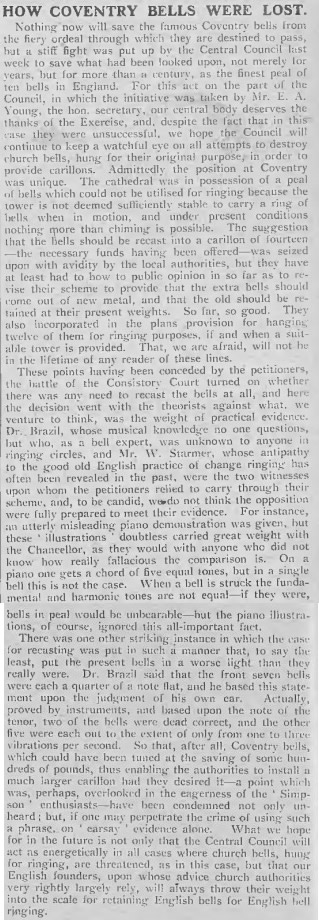
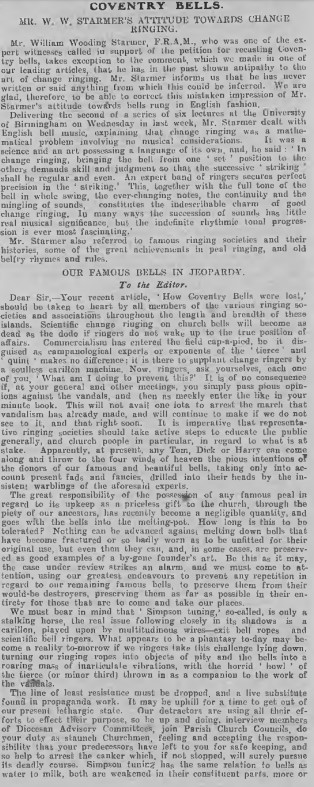
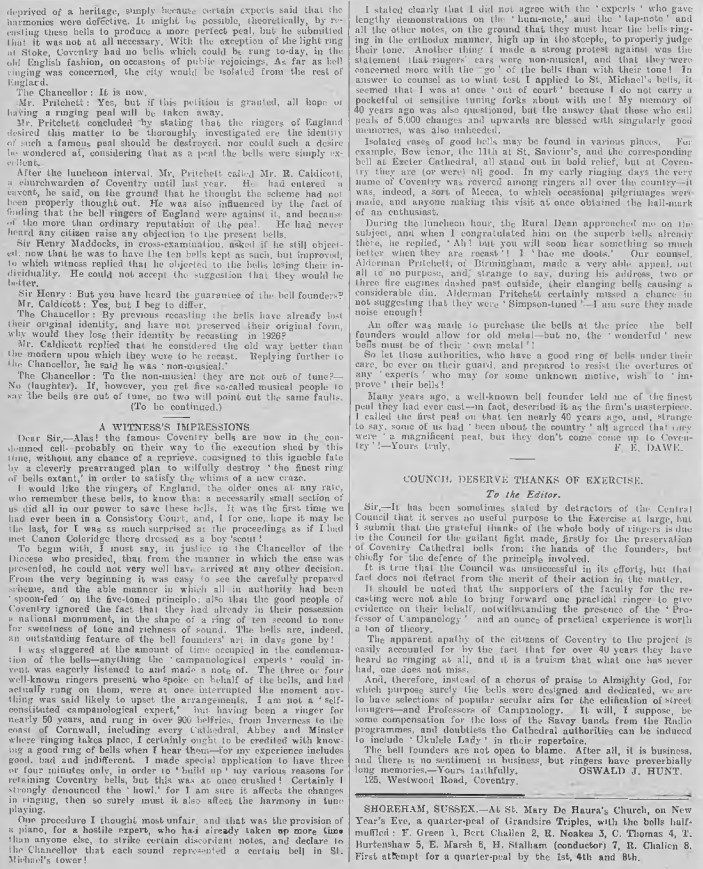
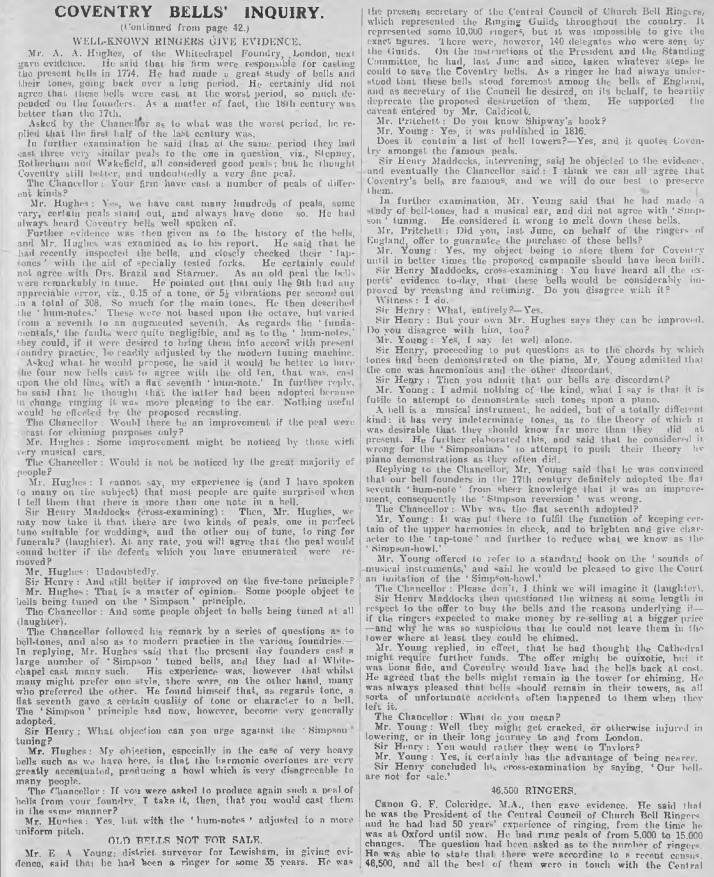
A detailed report of the Consistory Court was published in The Ringing World of January 22nd 1926 – as this is a long document, click on the images to enlarge them.
|
|
 |
  |
 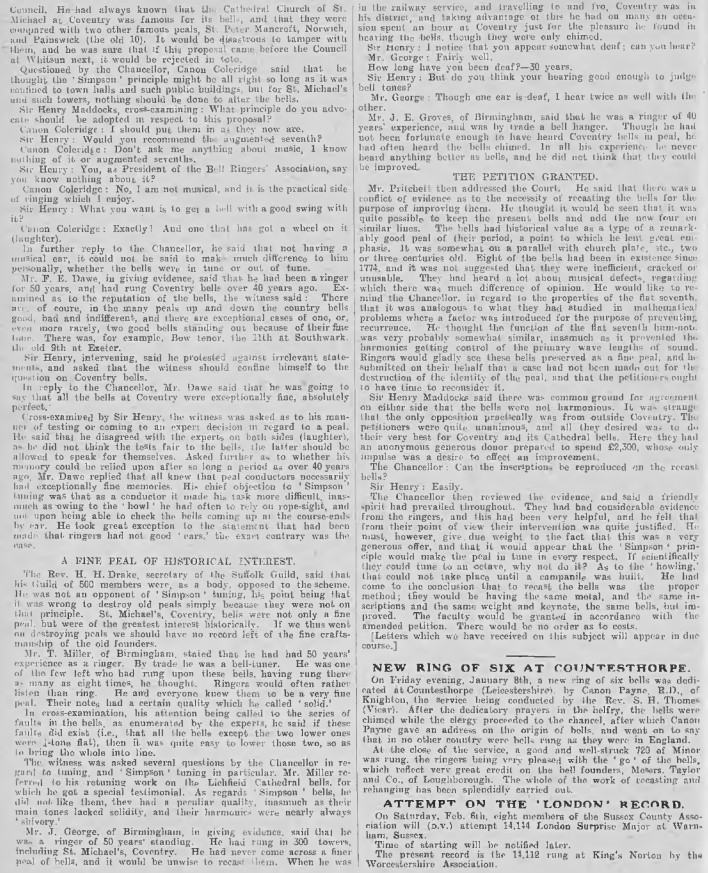 |
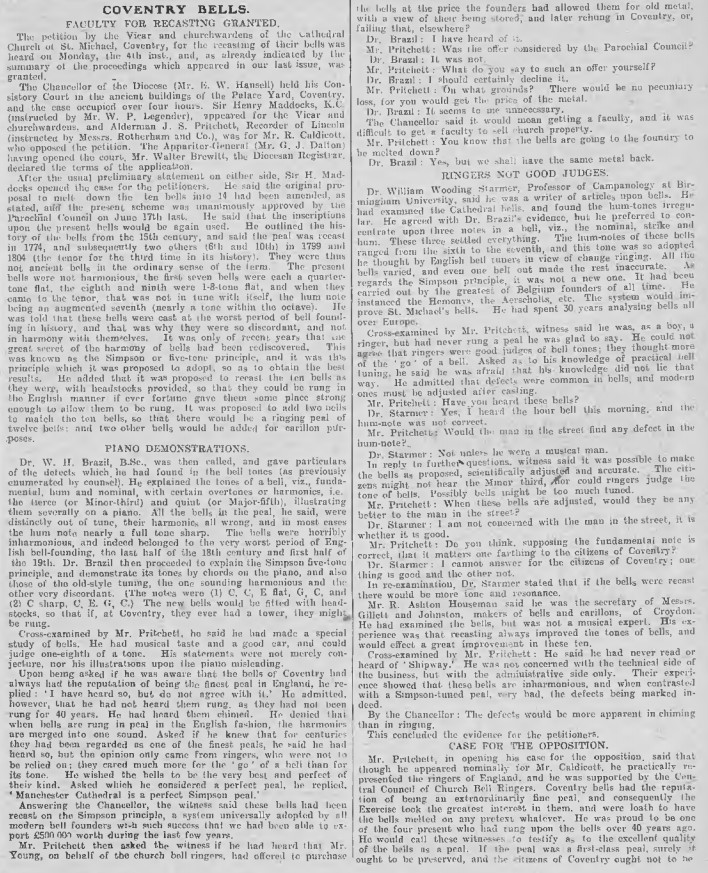
There followed a whole series of articles and letters about this – some arguing the case for and against Simpson Tuning – they are worth a read. I will leave the last word to Cyril Johnston himself. It is interesting to note that state that he put much effort into getting the bells hung for ringing, even after the order had been placed:

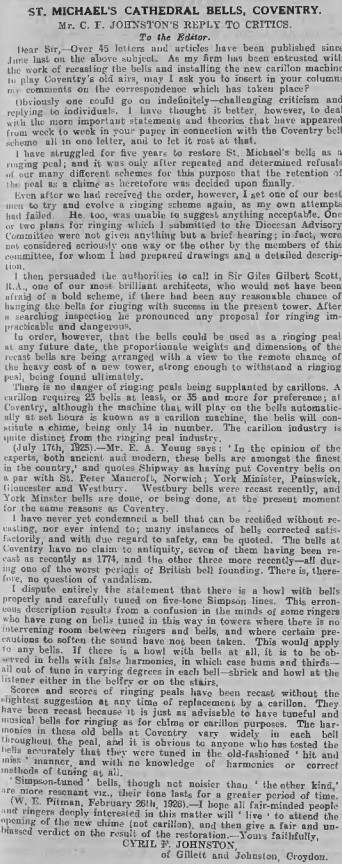
The Pack and Chapman bells were indeed recast by Gillett & Johnston in 1927, following the donation that is mentioned in the articles to cover the whole cost of a chime of 12 bells plus 2 semitones. E. H. Lewis, a witness mentioned here, was a great opponent of “Simpson” tuning and he spoke out vehemently against it at the Consistory Court hearing. The court’s decision was that the bells would be recast to ringing weights, just in case a new detached tower was ever built. While it never was, the story was not over.
The new bells were dedicated on Easter Eve, April 16th 1927 and reported in The Ringing World of April 29th:
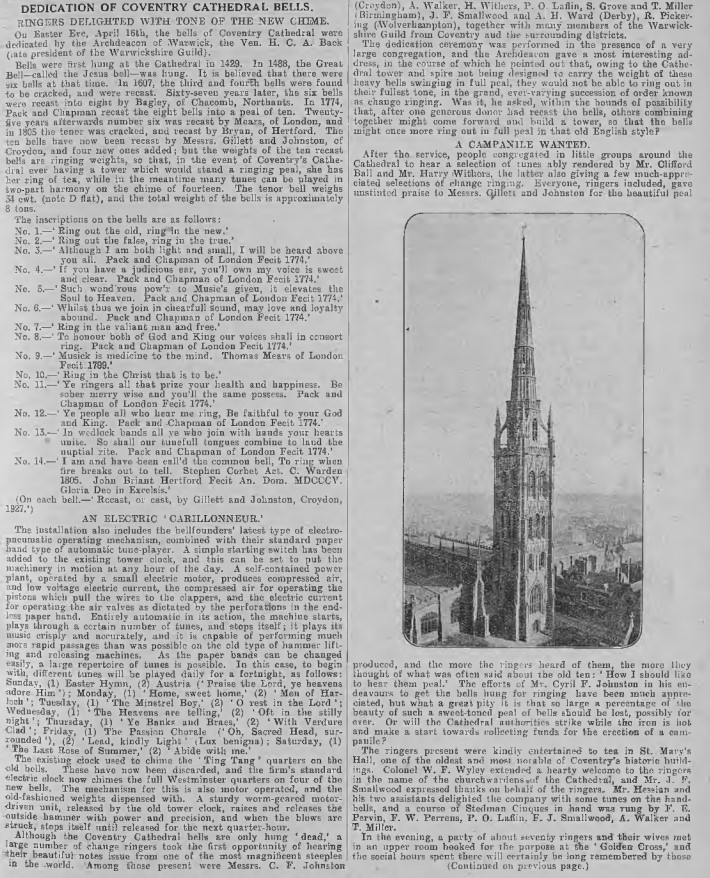
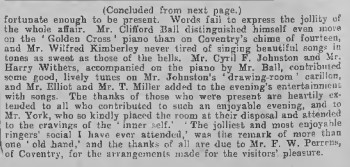
There were a few “false dawns” about getting the bells rehung for ringing. For instance, at the 1965 Guild Dinner the Provost is recorded as saying:
“…Replying, the Provost said that he thought the reason he had been invited to this dinner was to give him the opportunity of saying what was to happen to the bells of their Cathedral. The reason that nothing had been done was because of the many calls on their finances at this stage of the Cathedral development. He was now prepared to consider having the bells made in to a pealable ring once again, providing the necessary money could be raised, and suggested that the Guild might make itself responsible for raising it. He pointed out that one very important factor in having the bells ringing again was the question of noise control, as the Cathedral was surrounded by public buildings which were in constant use during the week. He had been assured that the noise could be controlled satisfactorily, and he trusted that this was so.
NATIONAL APPEAL
He said that he regretted that the bells could not have been hung for ringing in time for the consecration of the Cathedral, but he had so much to contend with at that time that he could not possibly face up to another project, although he realised that that was the right time to have had them done owing to the tremendous interest that was then being taken in the new Cathedral development. However, he was sure that if a national appeal was made the money would be forthcoming. He thanked them for inviting him and giving him the opportunity to address them.
Details of the carillon mechanism were given in The Coventry Herald and Observer in their edition of 28th September 1929
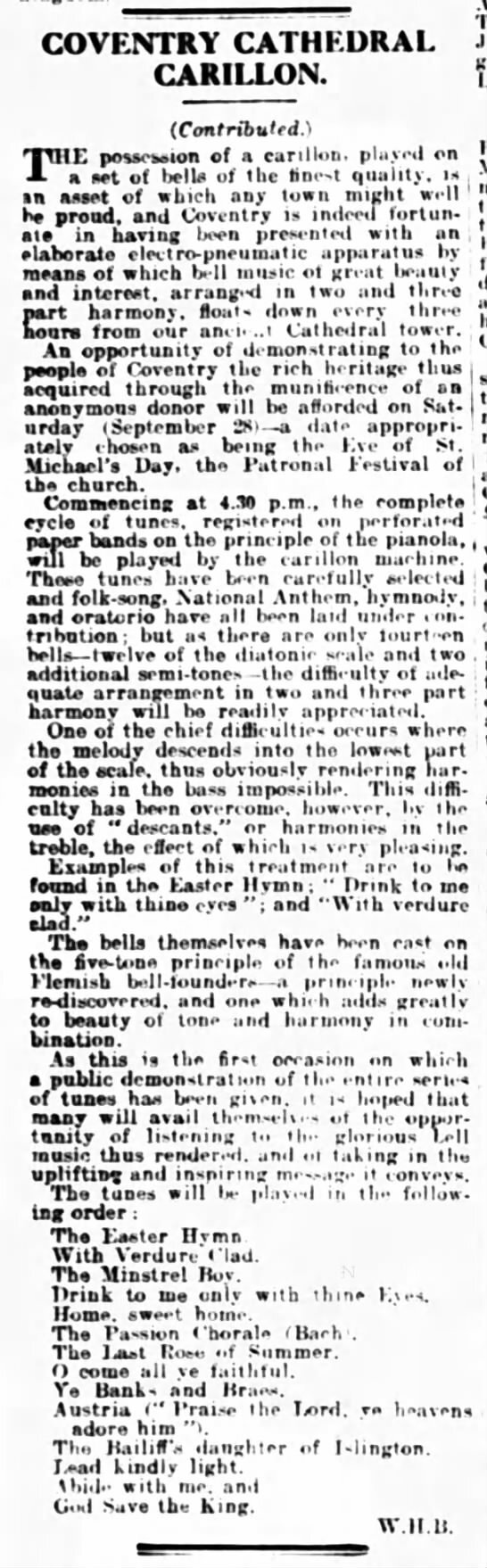
The Guild Secretary reported at a meeting in January 1966 that the Provost would support a scheme that did no damage to the tower, included sound control and which put no charge on the Cathedral. This did not happen and things drifted somewhat. The Guild expressed its disappointment that nothing was being done at the 1969 AGM.
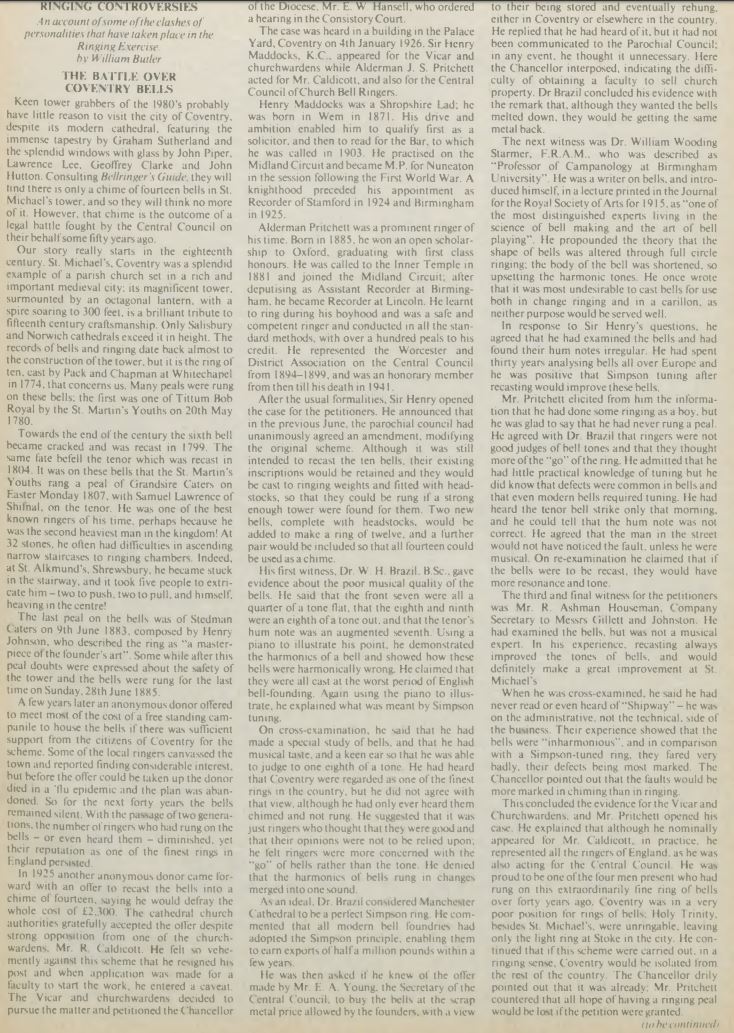
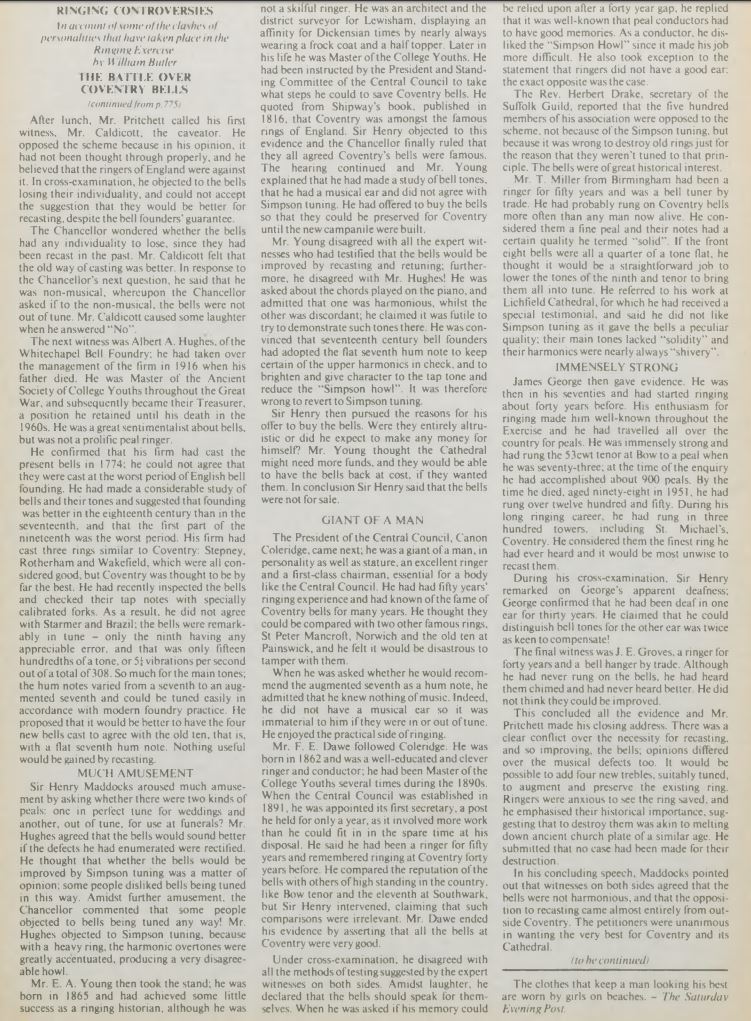
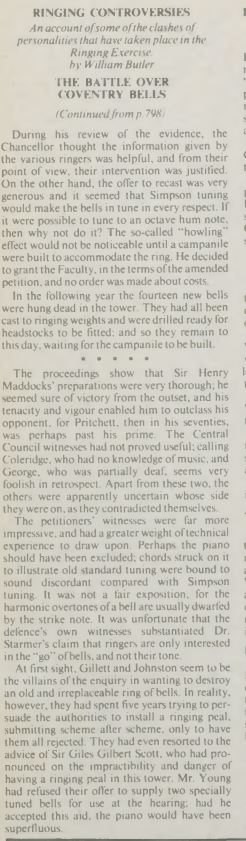
 A further report of the Consistory Court hearing in The Ringing World in September 1981
  |
 |
 |
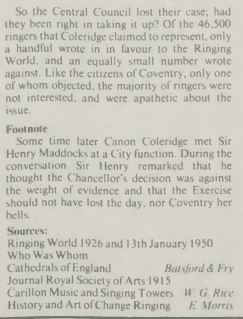 |
| (Click to enlarge) | |
This brought about an anonymous letter in the edition of October 16th 1981 suggesting that the Coventry DG get the bell hung for ringing and implied that the Guild was doing nothing about it. This provoked a response from the Guild and the Diocesan Secretary, himself a ringer, in the November 30th edition that revealed that the Guild had indeed been discussing this matter in the background with the Cathedral Architect.
The bells were again in the news in 1984, this being reported in the edition of February 24th;
“Peal plea
The Solihull Evening Mail noted the possibility of an anagram with the heading above – it was reporting on the Peterborough Cathedral appeal to provide a new peal of bells. The same paper also carried a report on the move to launch a £60,000 appeal to restore Coventry Cathedral’s bell tower and replace the bells. The aim is to have these bells back ringing by 1987 ready for the 25th anniversary celebrations of the building of the new Cathedral. (Coventry Cathedral was flattened during World War II but amazingly the bell tower came through the blitz unscathed).”
There are several further reports after this that things were moving in the right direction.
This article was published in The Ringing World of July 12th 1985. It shows that real thought was being put into exactly where the bells would be hung in the tower
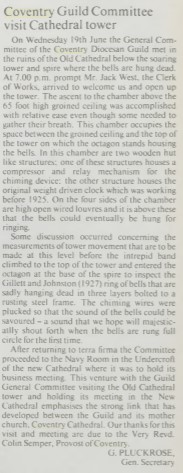
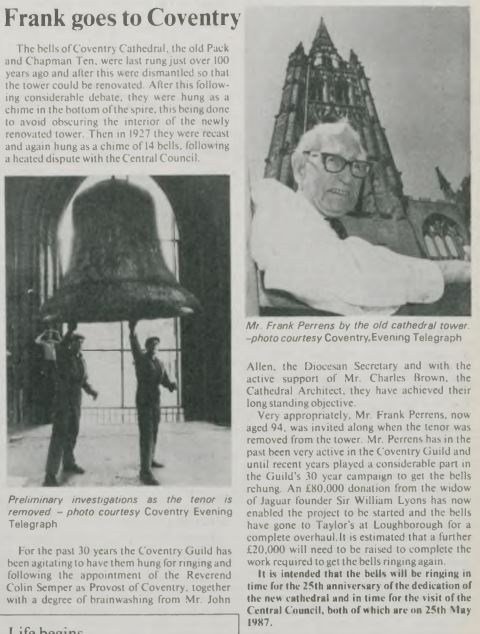
The Ringing World of July 25th 1986 reported that the chime of bells had been removed from the tower, starting the project to hang them for ringing full-circle. There was also an article about their removal published on August 15th 1986:

Progress was noted in the Foundry Focus Article that was published in The Ringing World of January 23rd 1987: “Coventry Cathedral, Warwickshire, where Taylors have been contracted to hang the 1927 Gillett & Johnston 12 for full-circle ringing. The plan is to house the ring of 12, plus a new flat sixth, in a cast-iron frame, whilst the original semitone bell – a sharp ninth – will be hung as a service bell. The weight of the tenor prior to any machining work is 33-3-12 – a few pounds different from the previously published weight.” (The “new” Flat 6th was actually an existing bell in the chime).
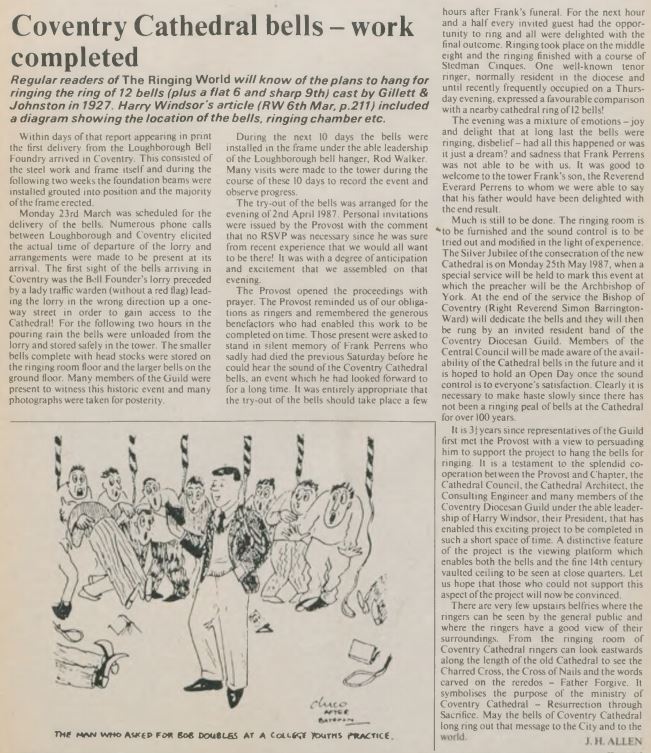
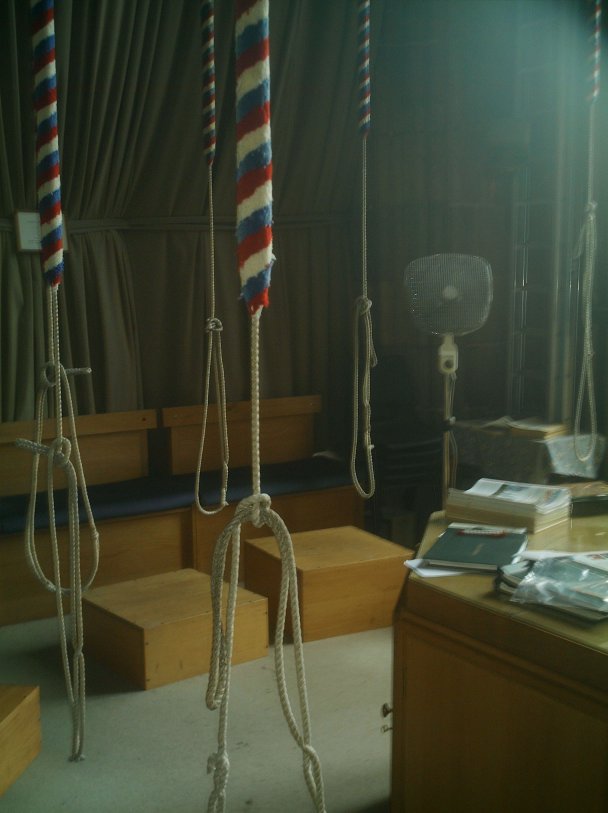
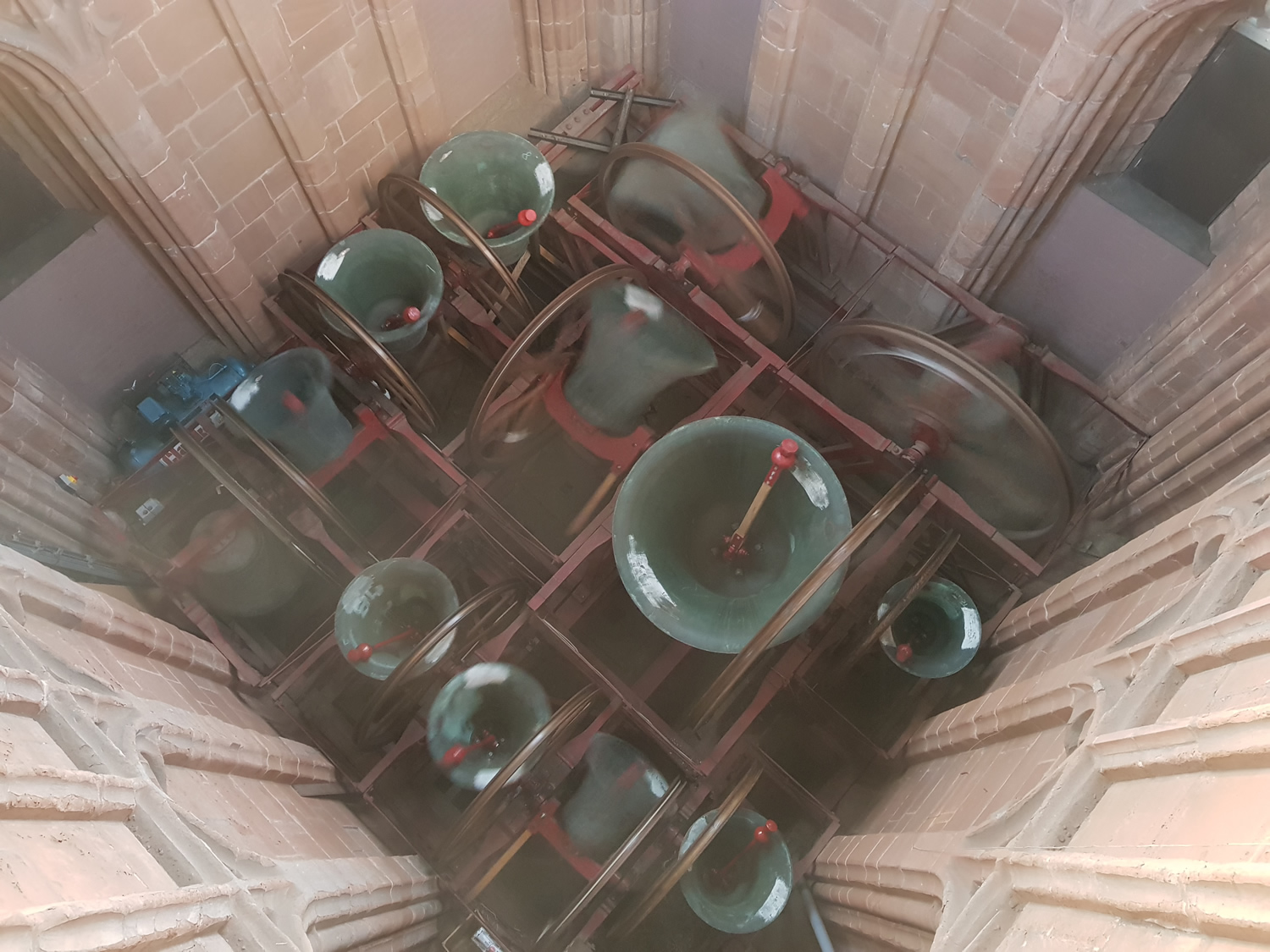
The bells were rehung ready for ringing in May of 1987, much lower in the tower than had been the ring of 10. They form a fine ring of 12 with a flat 6th. The hang in a cast iron “lowside” frame. A new ringing room was constructed, above a shop. Glass windows filling the eastern tower opening mean that the ringers can be seen from the ruins. Additionally, hung dead in corner of the frame, is a “sharp 9th” bell. From 1987 the bell was unused, but after a donation for the purpose it has been chimed electronically for services since 2008.
The announcement that the bells had been hung appeared in The Ringing World of May 8th 1987:

the rededication of the bells was reported in the edition of June 19th 1987:

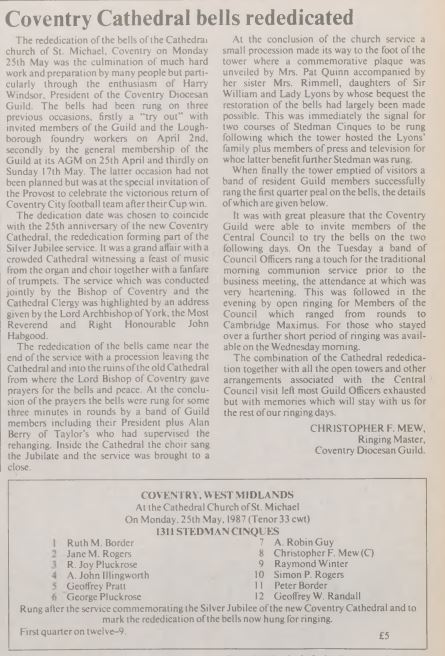
(Click to enlarge)
The first peal on the new ring was rung in 1988:

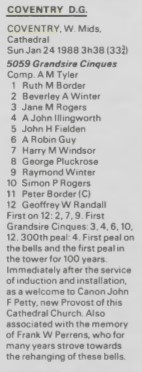
Shortly after the bells were installed, curtains were hung on three sides to reduce the amount of reverberation in the ringing room. These work well and this magnificent ring of bells are a joy to ring.
An analysis, by Bill Hibbert, an expert in the area of the sounds of bells, of the 12 can be found here. The frequency of the tenor equates to C#-18c. He has also made a detailed analysis of the old 10.
Visiting ringers of all experience are actively made welcome. Please do not be put off coming for a ring due to it being a Cathedral!
The entrance is via the gate to the left of the tower as you look at it from the west end of the old cathedral, (visible to the right of the tower on the photograph). If the tower gates are locked wait until the ringing has stopped and make yourself heard!
Details of the Bells
1 Gillett & Johnston, Croydon 1927 4-1-00 25.50″ 1638.0Hz (G#-24c)
2 Gillett & Johnston, Croydon 1927 4-3-24 27.00″ 1466.0Hz (F#-16c)
3 Gillett & Johnston, Croydon 1927 5-1-05 28.00″ 1379.5Hz (E#-22c)
4 Gillett & Johnston, Croydon 1927 5-2-16 29.375″ 1230.5Hz (D#-20c)
5 Gillett & Johnston, Croydon 1927 6-0-05 31.00″ 1097.0Hz (C#-18c)
6 Gillett & Johnston, Croydon 1927 6-1-22 32.00″ 1032.0Hz (B#-24c)
7 Gillett & Johnston, Croydon 1927 7-3-23 35.00″ 916.0Hz (A#-31c)
8 Gillett & Johnston, Croydon 1927 10-2-21 38.50″ 820.0Hz (G#-22c)
9 Gillett & Johnston, Croydon 1927 14-2-16 42.875″ 732.0Hz (F#-19c)
10 Gillett & Johnston, Croydon 1927 18-0-14 46.00″ 689.5Hz (E#-22c)
11 Gillett & Johnston, Croydon 1927 24-1-22 51.00″ 614.0Hz (D#-23c)
12 Gillett & Johnston, Croydon 1927 33-3-06 57.00″ 548.5Hz (C#-18c)
6b Gillett & Johnston, Croydon 1927 7-0-24 33.50″ 973.0Hz (B-26c)
9# Gillett & Johnston, Croydon 1927 12-1-17 40.50″ 773.0Hz (G-24c)
Bell on the north wall of the new cathedral, near the Chapel of Unity
Petit & Gebr. Edelbrock 1990 2–1–0 20.56″ 1543.5Hz (G-27c)
Inscriptions
The two trebles and the two semitones are inscribed “GILLETT & JOHNSTON CROYDON 1927 (foundry mark) / Border around bell”. The back 10 are inscribed “RECAST BY……” They then have a foundry bell number, then an inscription – the back 10 being a reproduction of the previous ring’s inscriptions, but not in fascimile, finally the number of the bell in the chime.
| 1 | RING OUT THE OLD, RING IN THE NEW |
| 2 | RING OUT THE FALES, RING IN THE TRUE |
| 3 | ALTHOUGH I AM BOTH LIGHT AND SMALL I WILL BE HEARD ABOVE YOU ALL. PACK & CHAPMAN OF LONDON FECIT 1774. |
| 4 | IF YOU HAVE A JUDICIOUS EAR YOU’LL OWN MY VOICE IS SWEET & CLEAR PACK & CHAPMAN OF LONDON FECIT 1774 |
| 5 | SUCH WOND’ROUS POW’R TO MUSIC’S GIVEN IT ELEVATES THE SOUL TO HEAVEN PACK & CHAPMAN OF LONDON FECIT 1774 |
| 6 | WHILST THUS WE JOIN IN CHEARFUL SOUND MAY LOVE AND LOYALTY ABOUND PACK & CHAPMAN OF LOONDON FECIT 1774 |
| 6b | RING IN THE VALIANT MAN AND FREE |
| 7 | TO HONOUR BOTH OUR GOD AND KING OUR VOICES SHALL IN CONSORT RING PACK & CHAPMAN OF LONDON FECIT 1774 |
| 8 | MUSIC IS MEDICINE TO THE MIND THOMAS MEARS OF LONDON FECIT 1799 |
| 9# | RING IN THE CHRIST THAT IS TO BE |
| 9 | YE RINGERS ALL THAT PRIZE YOUR HEALTH AND HAPPINESS BE SOBER MERRY WISE AND YOU’LL THE SAME POSSESS PACK & CHAPMAN OF LONDON FECIT 1774 |
| 10 | YE PEOPLE ALL WHO HEAR ME RING BE FAITHFUL TO YOUR GOD & KING PACK & CHAPMAN OF LONDON FECIT 1774 |
| 11 | IN WEDLOCK BANDS ALL YE WHO JOIN WITH HAND YOUR HEARTS UNITE SO SHALL OUR TUNEFULL TONGUES COMBINE TO LAUD THE NUPTUAL RITE PACK & CHAPMAN OF LONDON FECIT 1774 |
| 12 | I AM AND HAVE BEEN CALLED THE COMMON BELL TO RING WHEN FIRE BREAKS OUT TO TELL STEPHEN CORBET ACT. C. WARDEN 180 JOHN BRIANT HERTFORD FECIT AN ; DOM : MDCCCV. GLORIA DEO IN EXCELCIS. |
Details of the Ring of 10
1 Pack and Chapman, London 1774 6-3-02 33.00″ 1376.0Hz (E#-26c)
2 Pack and Chapman, London 1774 7-0-08 34.00″ 1244.0Hz (D#-1c)
3 Pack and Chapman, London 1774 8-1-13 36.00″ 1114.0Hz (C#+8c)
4 Pack and Chapman, London 1774 9-0-00 37.00″ 1044.0Hz (B#-4c)
5 Pack and Chapman, London 1774 9-2-21 38.00″ 928.0Hz (A#-8c)
6 Thomas Mears, London 1799 11-2-16 40.25″ 842.0Hz (G#-24c)
7 Pack and Chapman, London 1774 14-0-26 42.50″ 740.0Hz (F#-0c)
8 Pack and Chapman, London 1774 17-1-23 46.00″ 695.0Hz (E#-9c)
9 Pack and Chapman, London 1774 23-0-26 50.50″ 616.0Hz (D#-17c)
10 John Briant, Hertford 1805 31-1-14 56.50″ 558.0Hz (C#+11c)
Details of the Ring of 8
1 Henry Bagley I & II, Chacombe 1675 6-1-11 31.00″
2 Henry Bagley I & II, Chacombe 1675 6-2-26 32.00″
3 Henry Bagley I & II, Chacombe 1675 8-0-09 35.30″
4 Henry Bagley I & II, Chacombe 1675 9-3-21 37.50″
5 Henry Bagley I & II, Chacombe 1675 12-1-07 40.75″
6 Henry Bagley I & II, Chacombe 1675 14-0-14 43.00″
7 Henry Bagley I & II, Chacombe 1675 17-2-12 47.00″
8 Henry Bagley I & II, Chacombe 1675 25-0-12 52.50″
(Inscriptions are found on the back 10 of the current ring)
Details of the Ring of 6
1 10-3-09
2 11-1-00
3 1607 13-2-06
4 1607 17-3-14
5 23-1-02
6 30-1-05
Photo Gallery |
|
 |
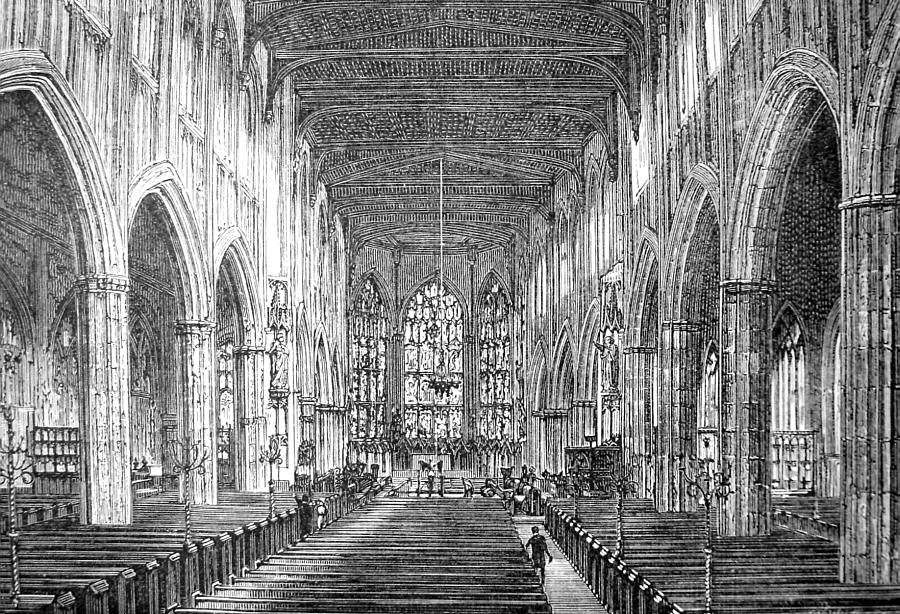 |
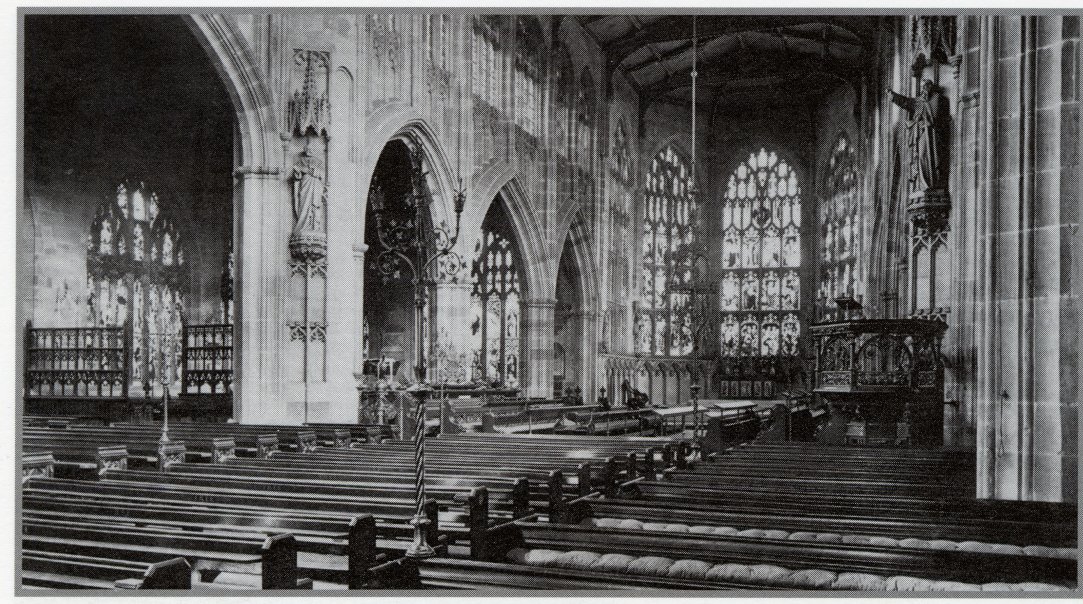
| The Church in 1730 | The Cathedral Interior c.1880 |
 |
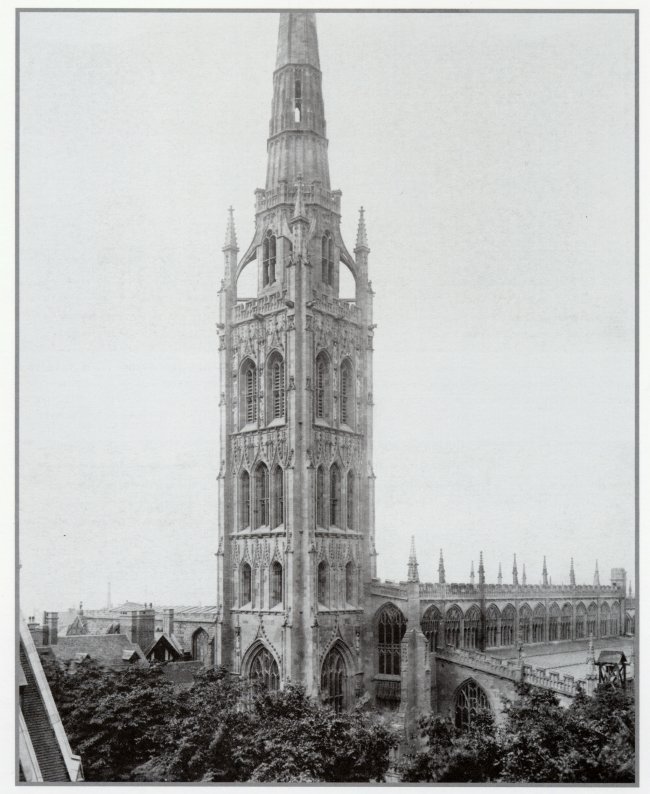 |
| The Interior in 1884 | The Church in 1892 |
 |
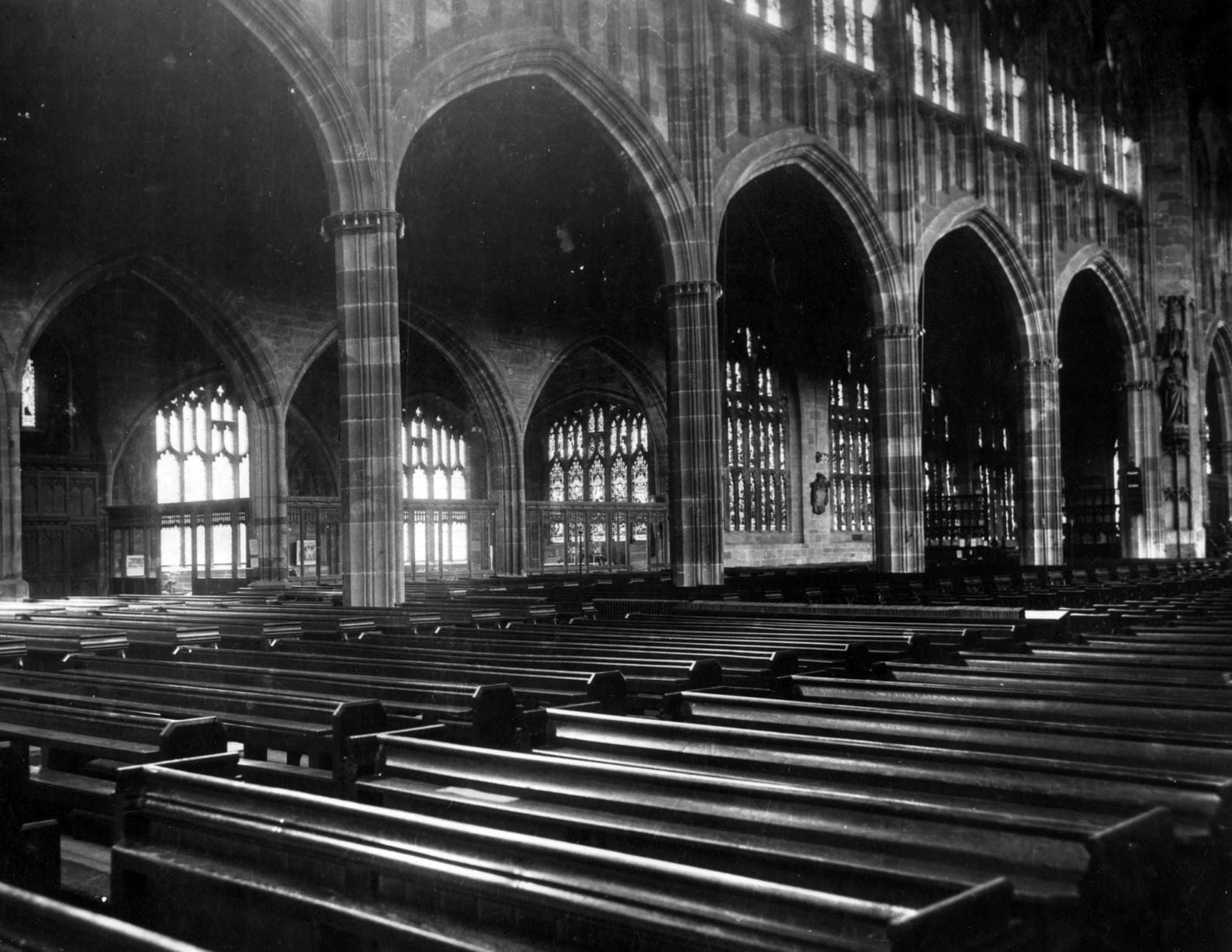 |
| The Interior in 1892 | The Interior |
 |
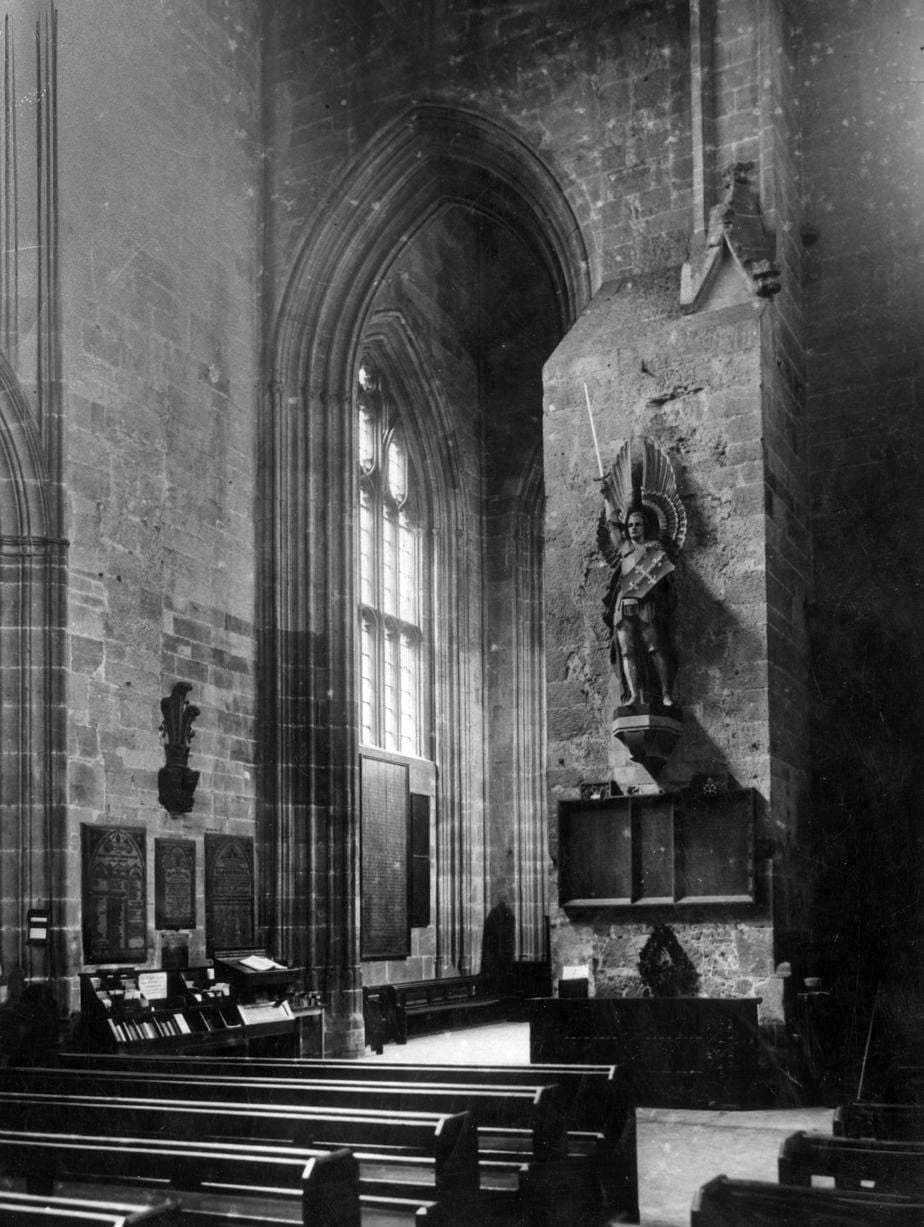 |
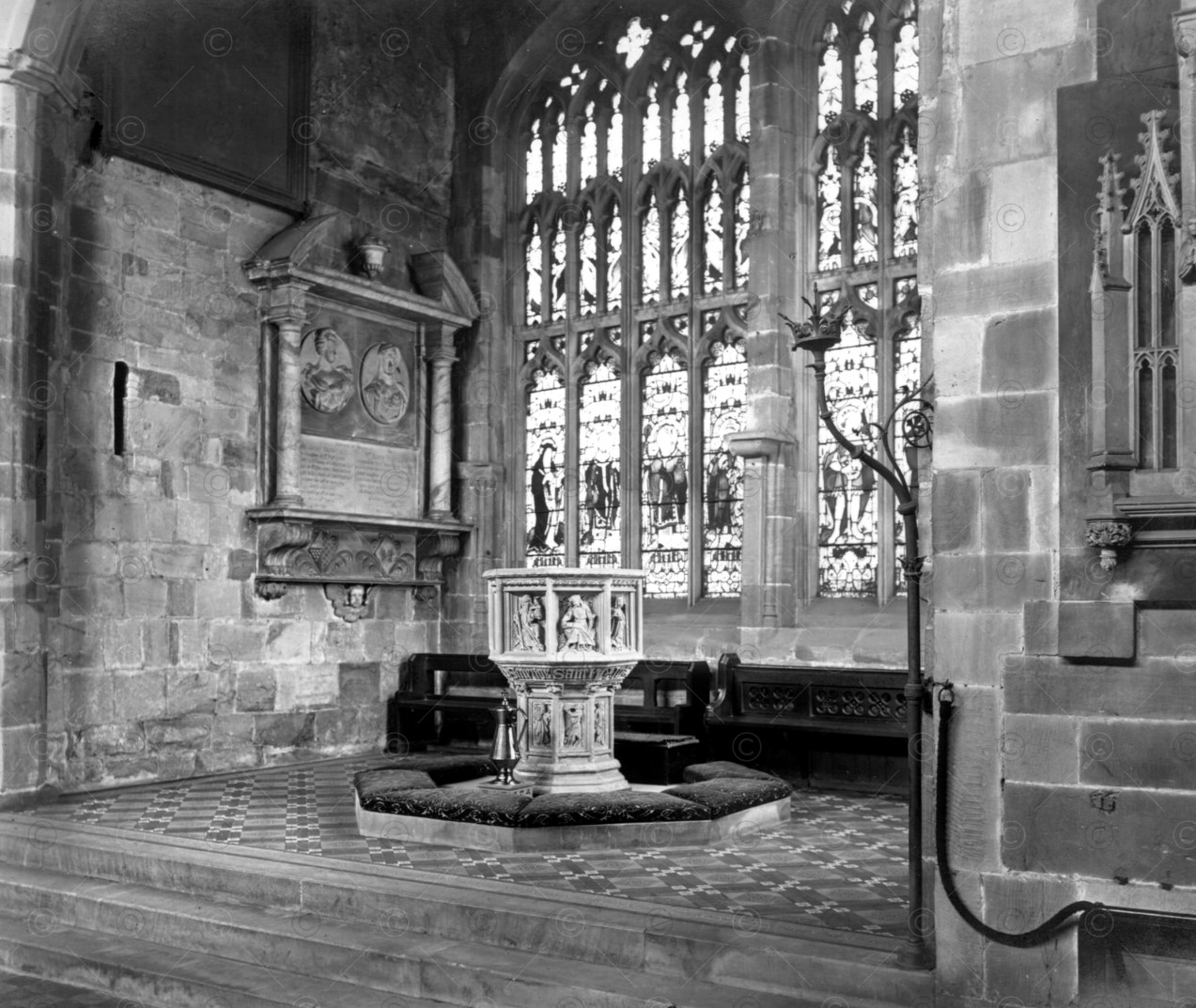
| The Dyer’s Chapel | The arch leading to the tower |
 |
|
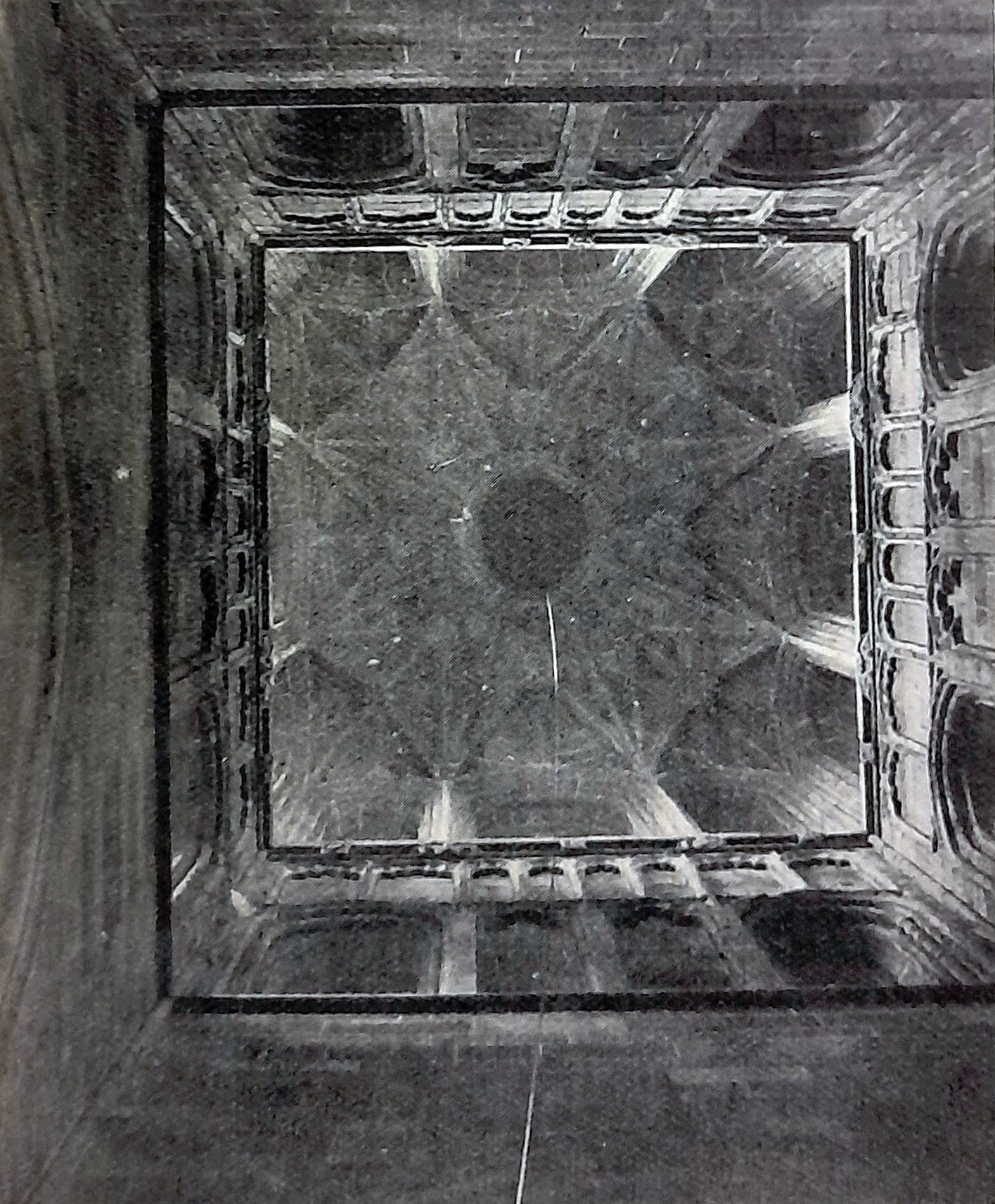
| Looking up the tower – the bells are now hung just below the bottom of this photograph. The original stone vault had been taken out when the Bagley 8 were installed. The tower was stripped out by Scott at the 1885 restoration, when the present vaulting was reinstated. It was open from then until 1987 for the view. |
|
 |
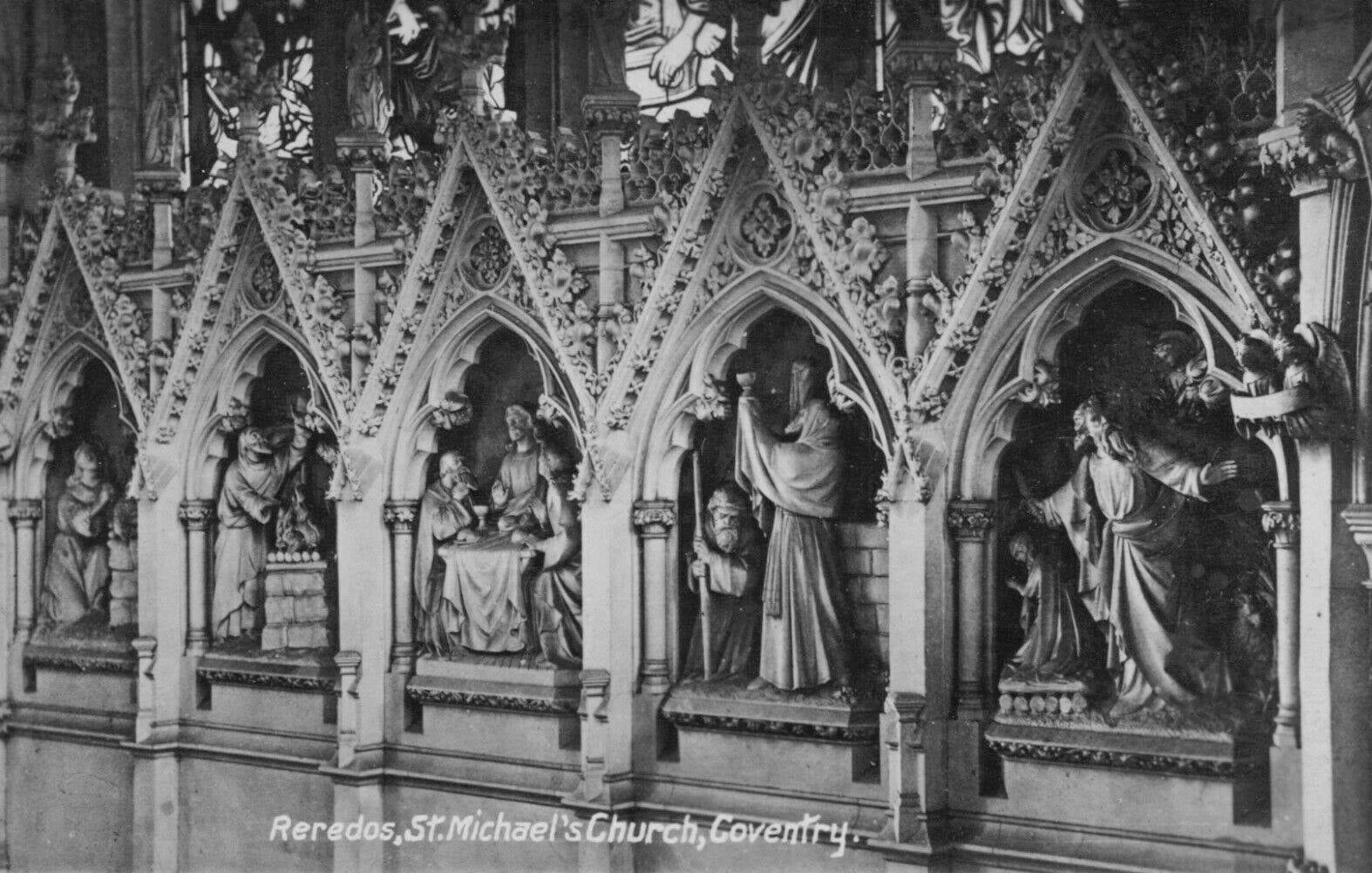 |
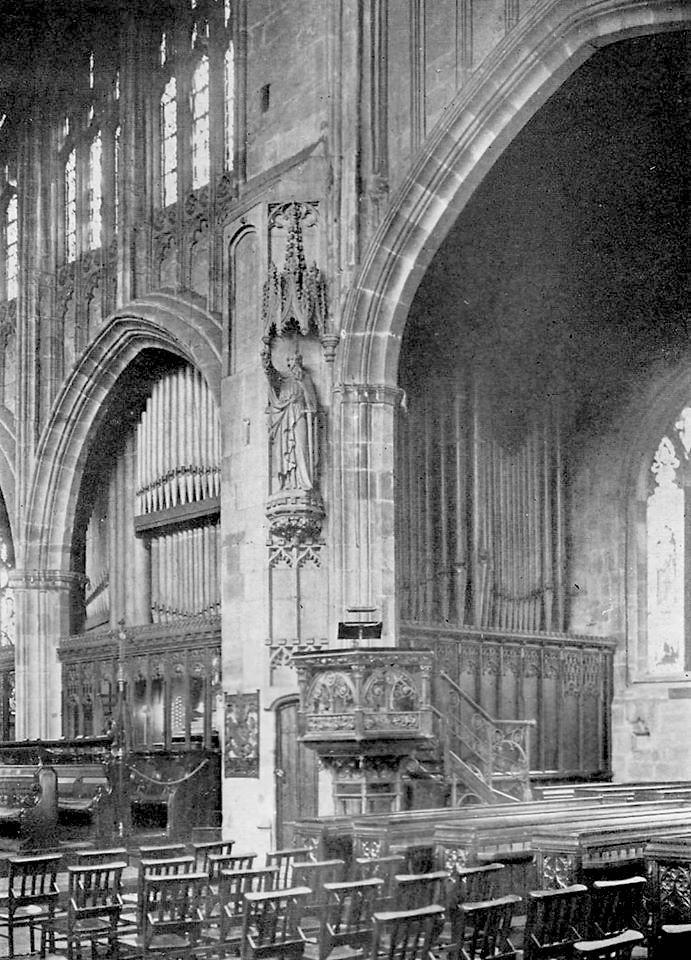
| The Organ | The Reredos |
 |
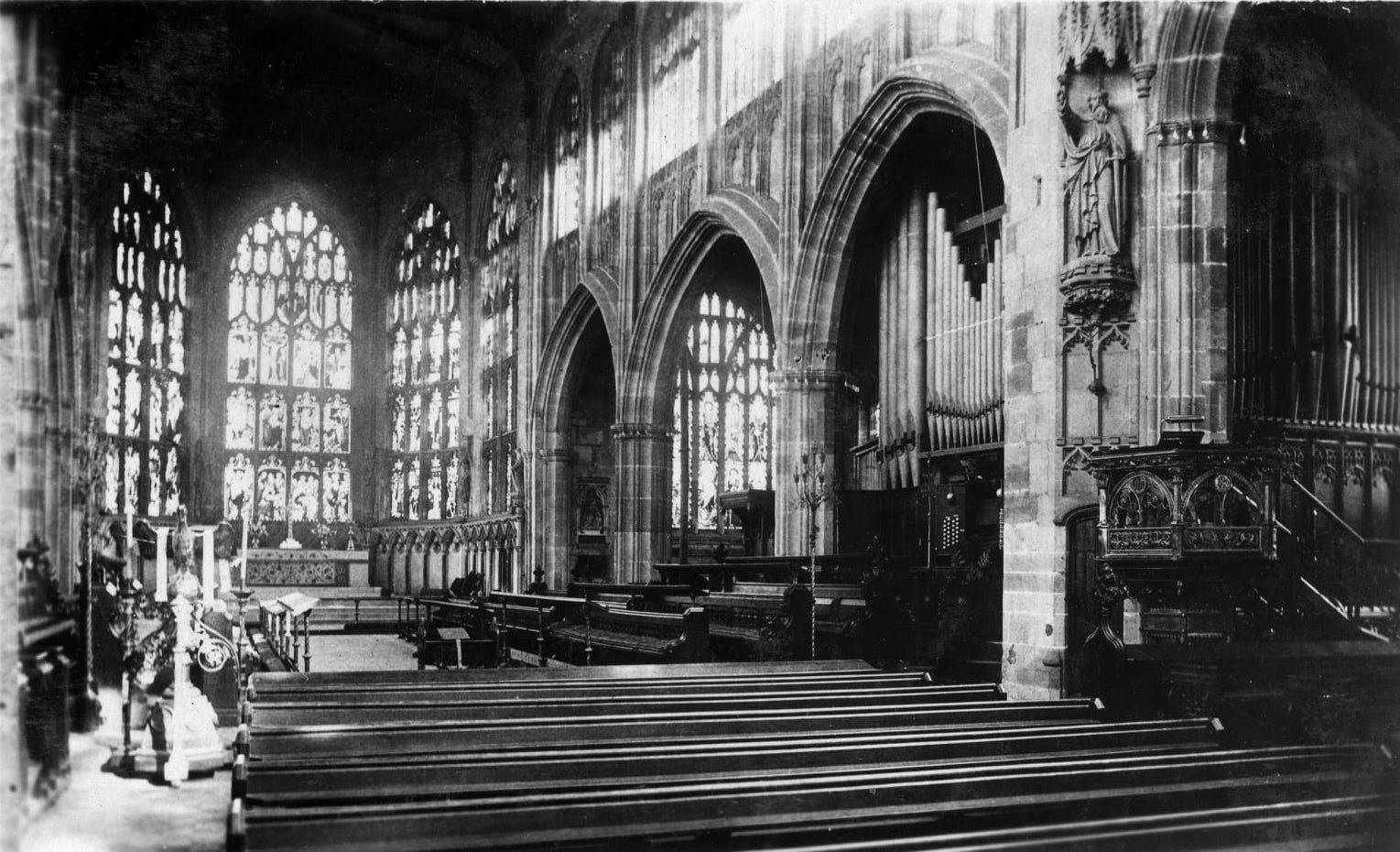 |
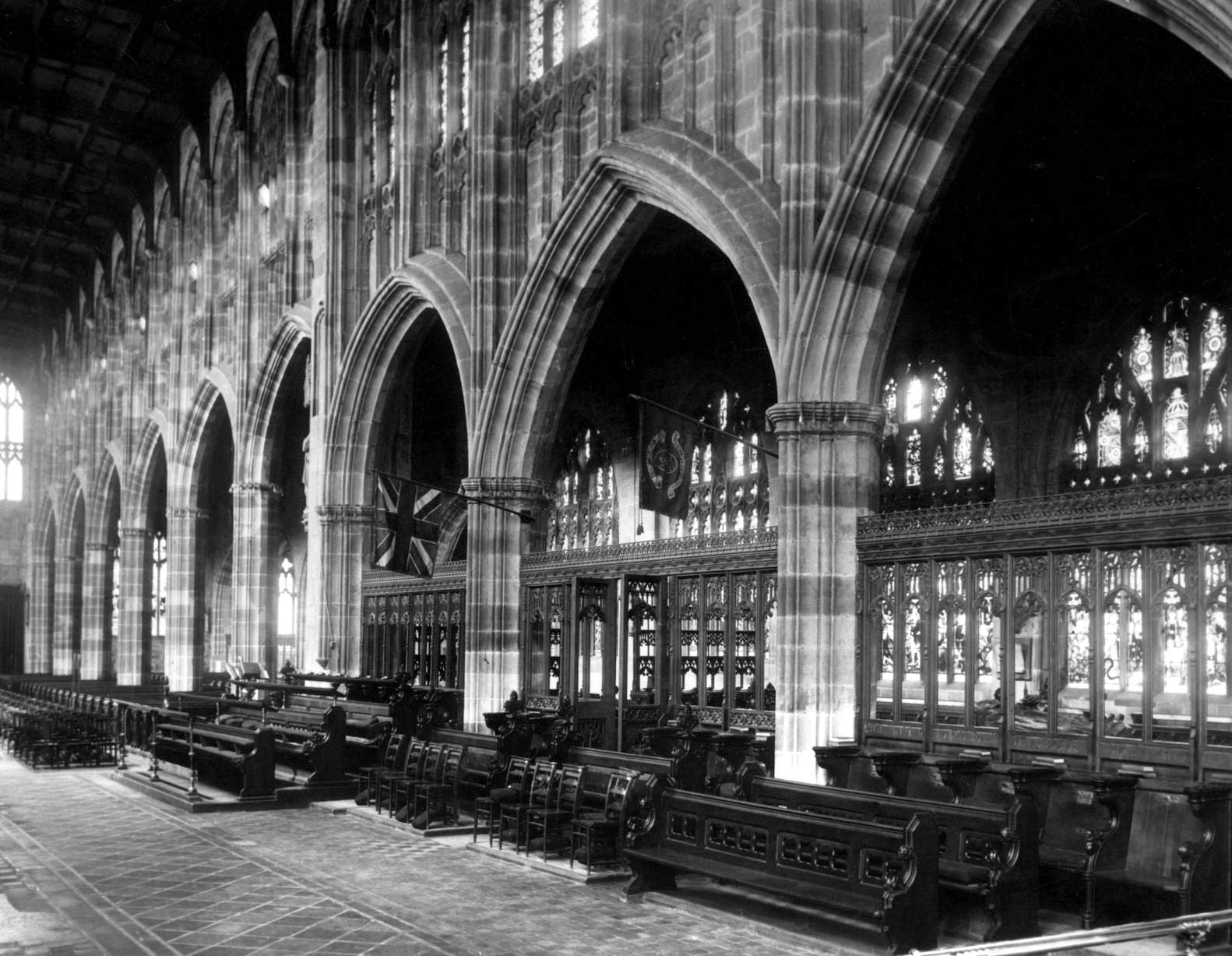
| St Lawrence’s Chapel | The East End of the Church |
 |
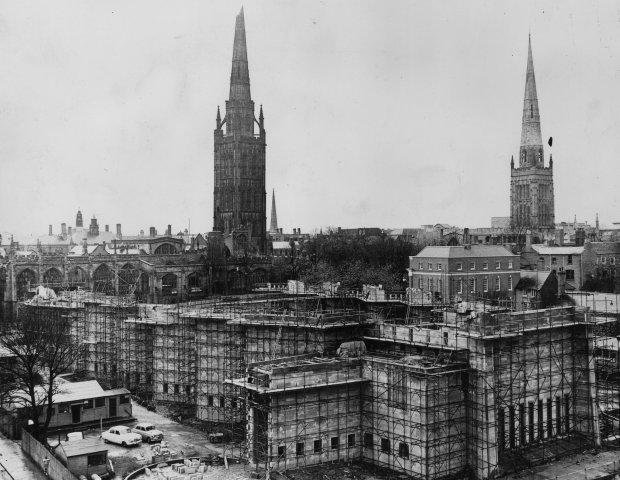 |
| The Cathedral in Ruins | The New Cathedral Under Construction |
 |
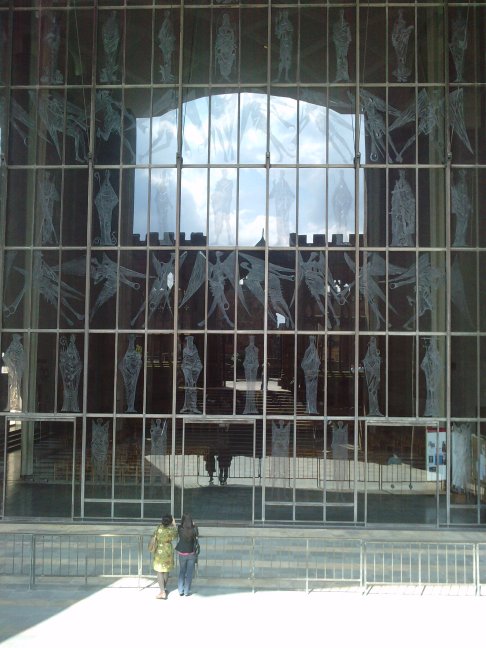 |
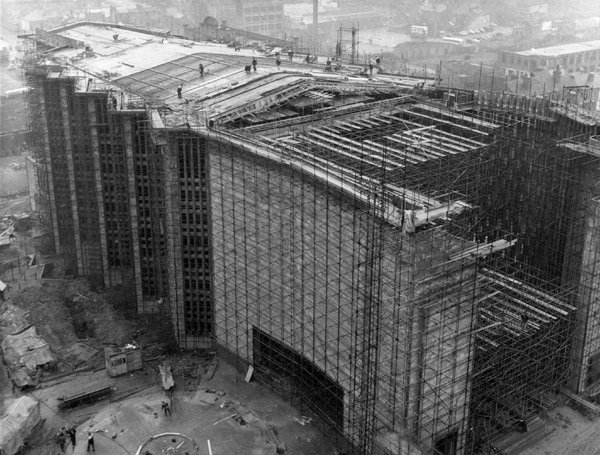
| The New Cathedral Under Construction | The Glass Screen in the New Cathedral |
 |
|
| A colourised photograph of the Cathryn pre-WWII | |
 |
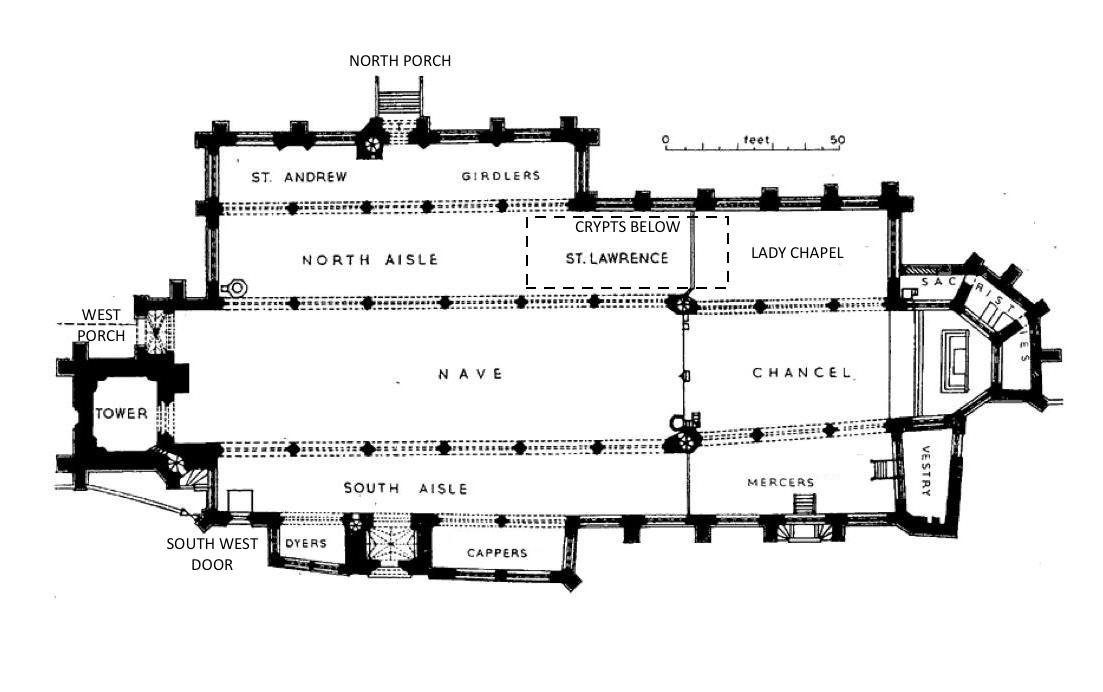 |
| The new Cathedral behind the north wall of the ruined Cathedral | A Plan of the Old Cathedral |
 |
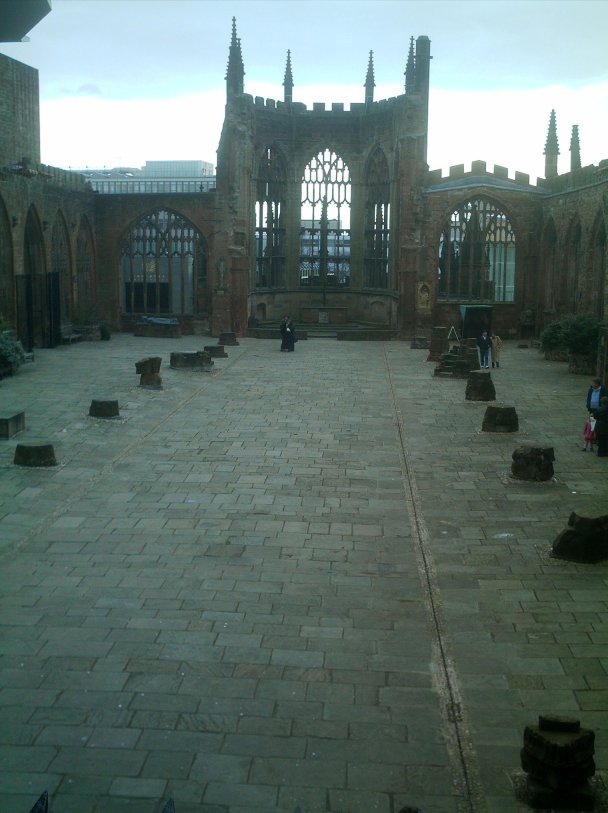 |
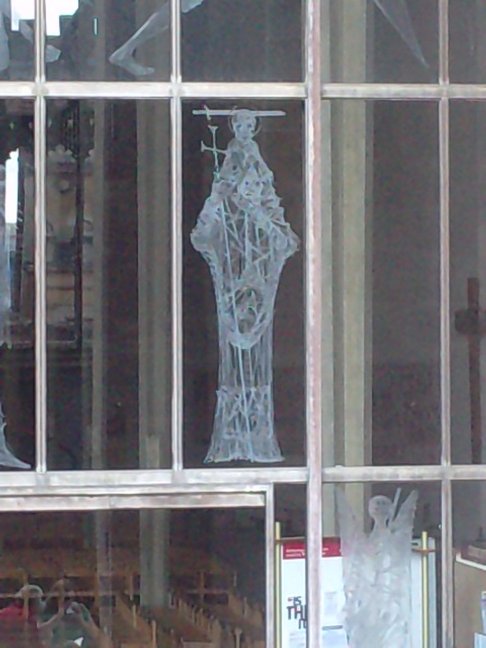
| One of the Etched Panels in the Screen | The Ruins, as Seen From the Ringing Chamber |
 |
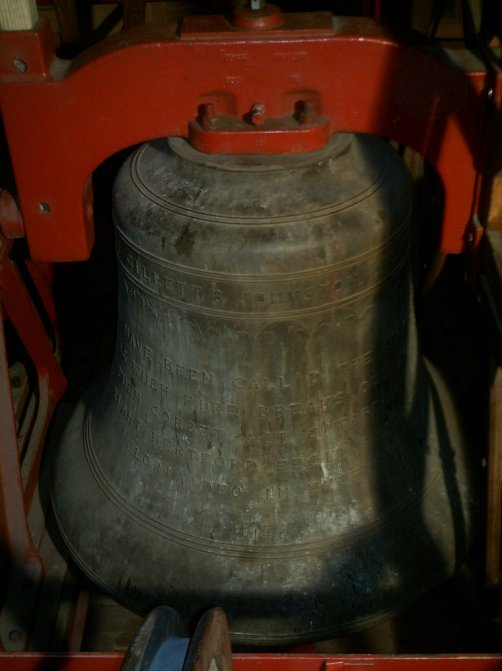 |
| The Treble | The Tenor |
 |
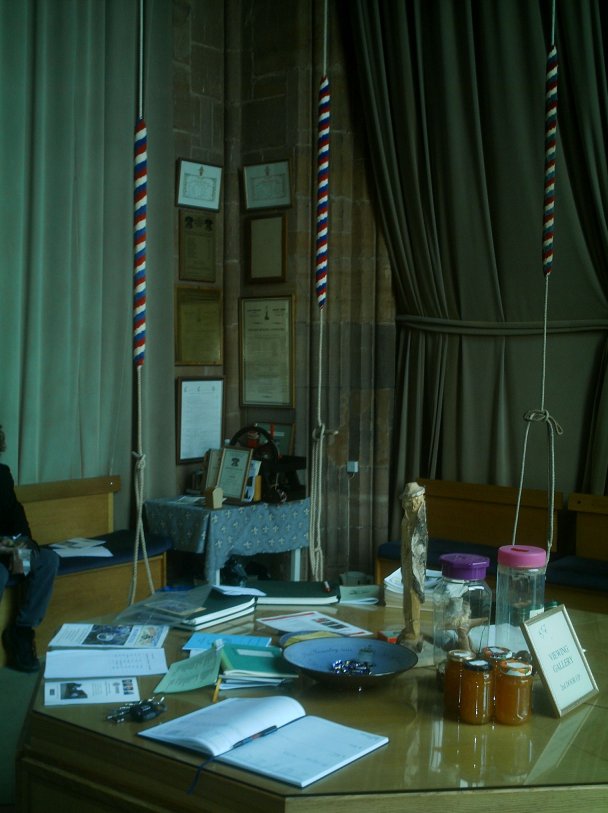 |
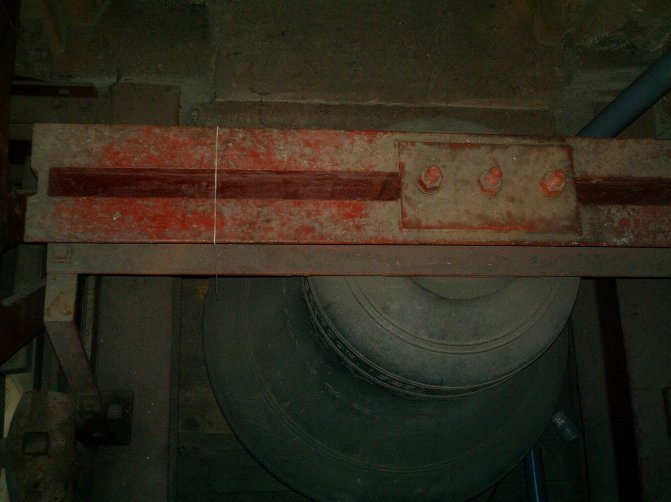
| The Sharp 9th | The Ringing Chamber Ropes 7-9 |
 |
 |
| The Ringing Room Rope 7 in foreground |
The Bells |
 |
|
| The Bells From the Viewing Gallery | |
 |
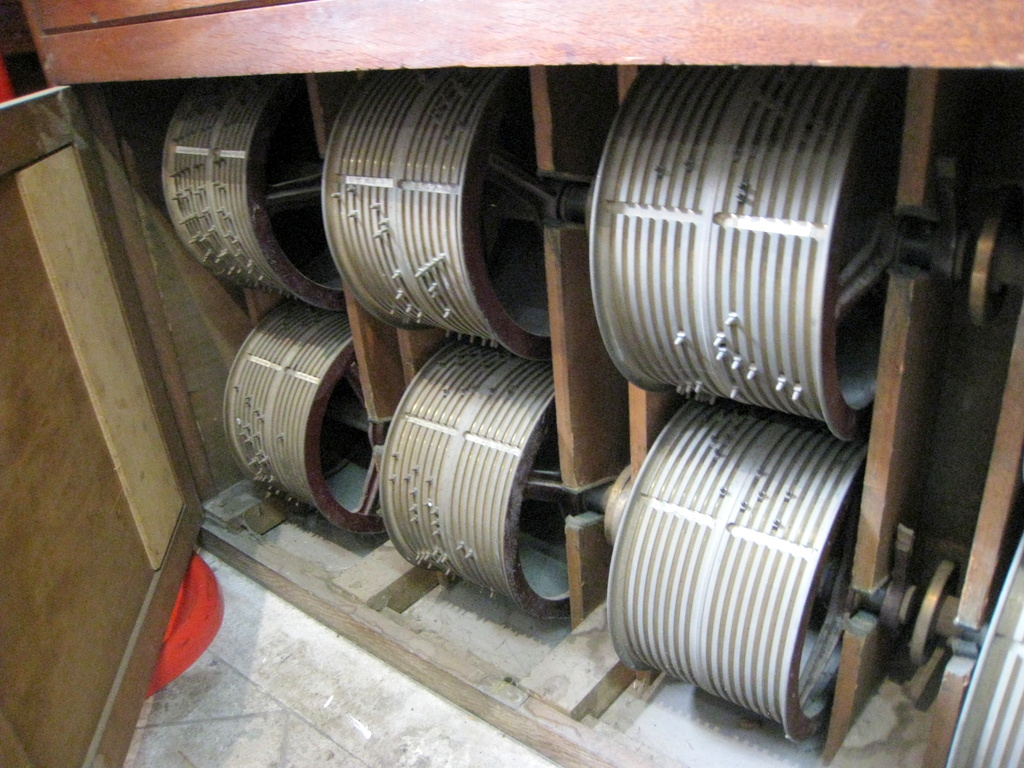  |
| The Clock Mechanism that was Brought to the Base of the Tower When the Bells Were Hung For Ringing | The old chiming barrels |
 |
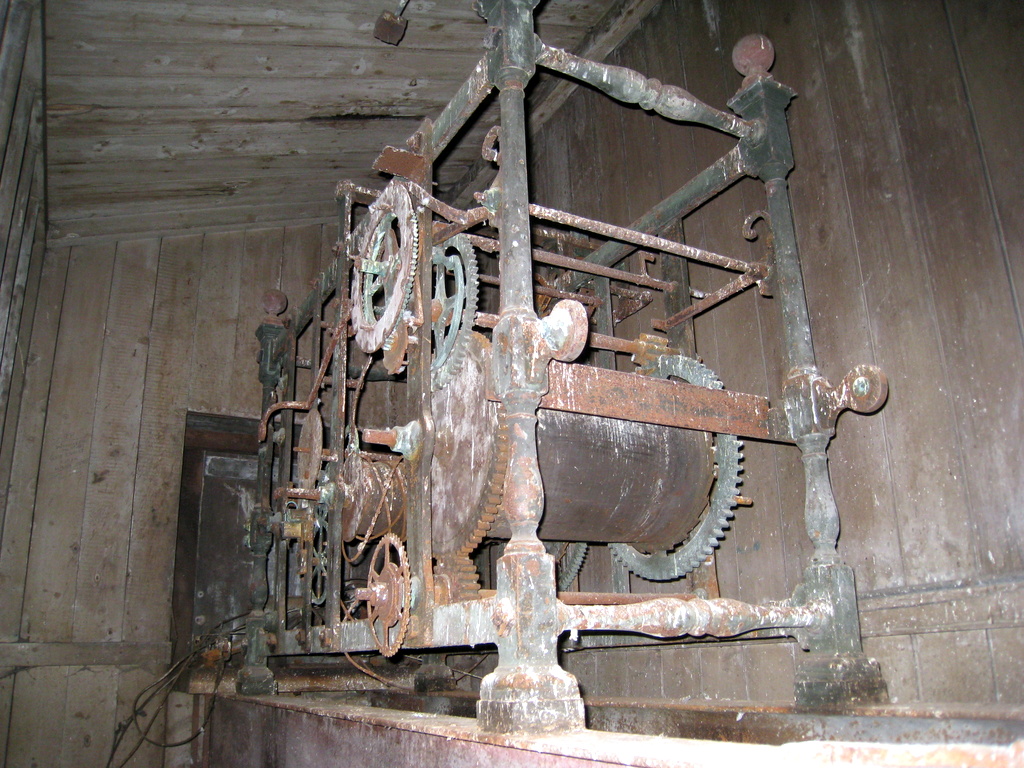 |
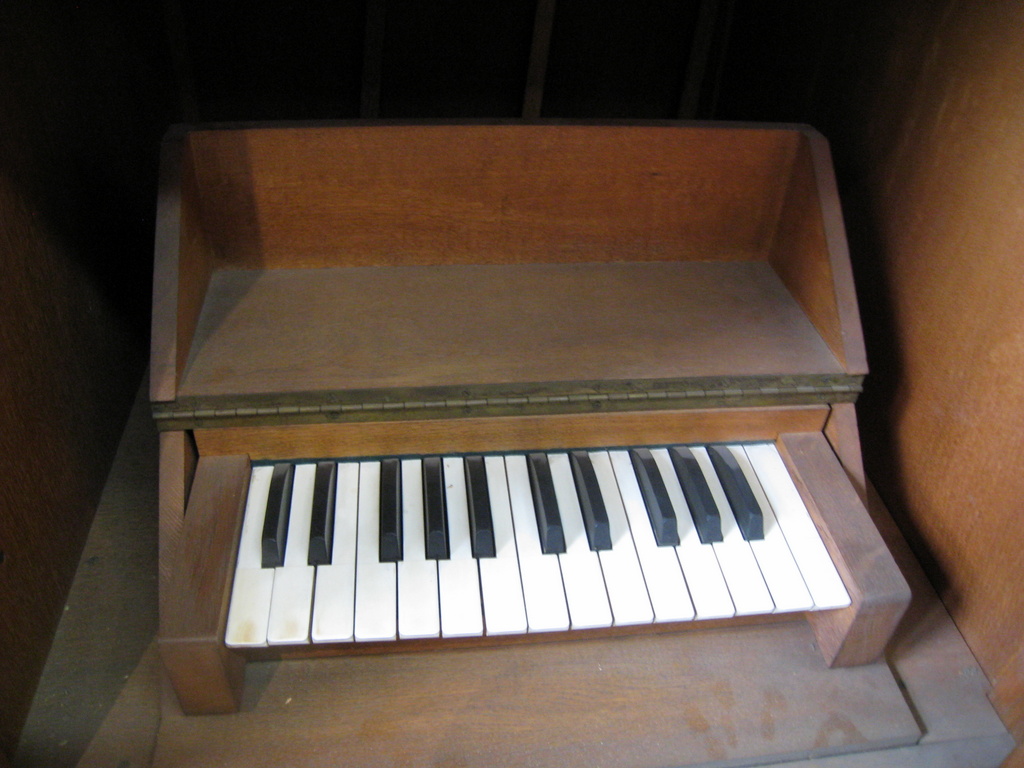
| The keyboard from which tunes could be chimed on the bells | The old clock mechanism |
 |
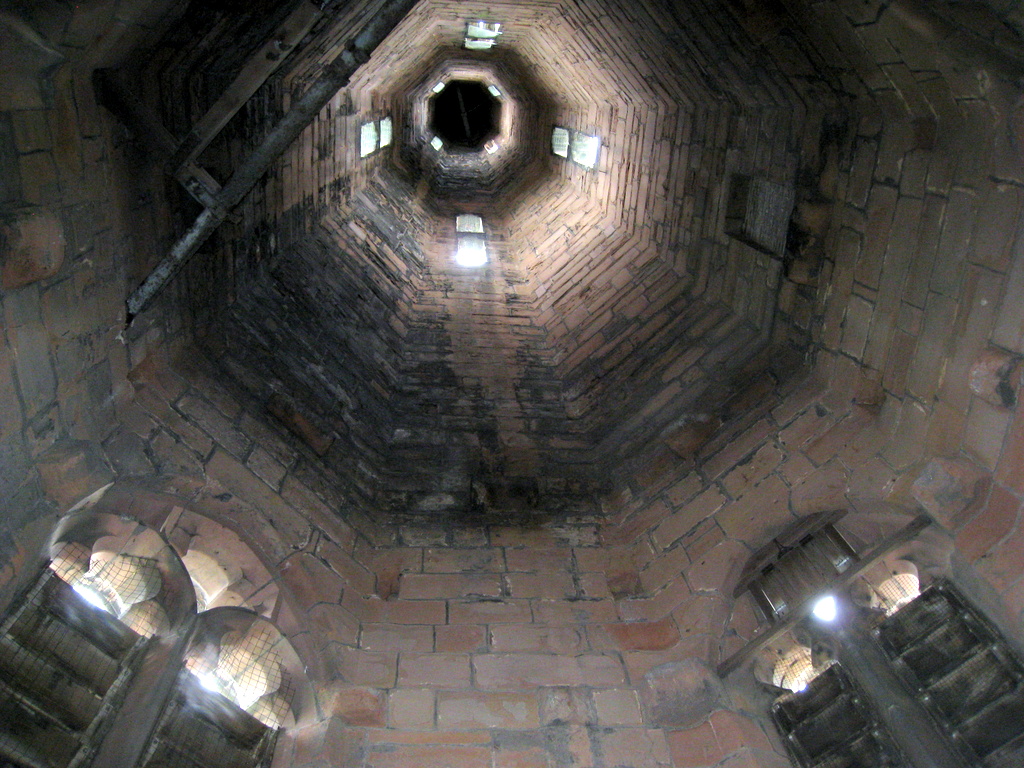 |
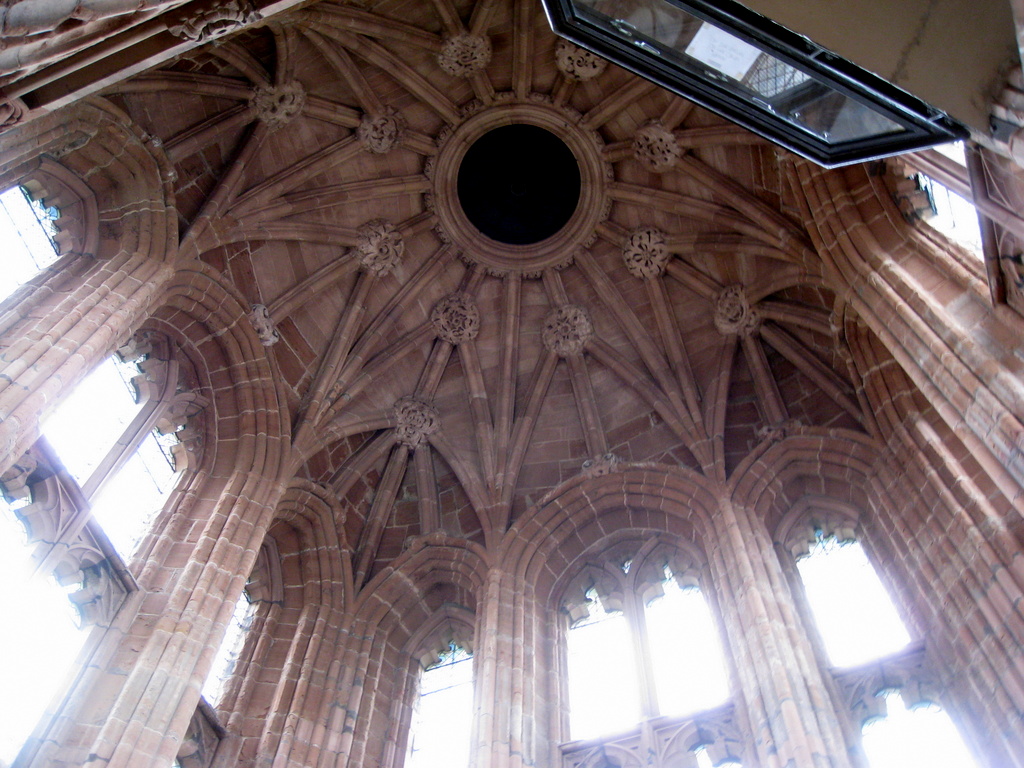
| The groined ceiling above the bells The viewing platform is top right | A view up the spire |
 |
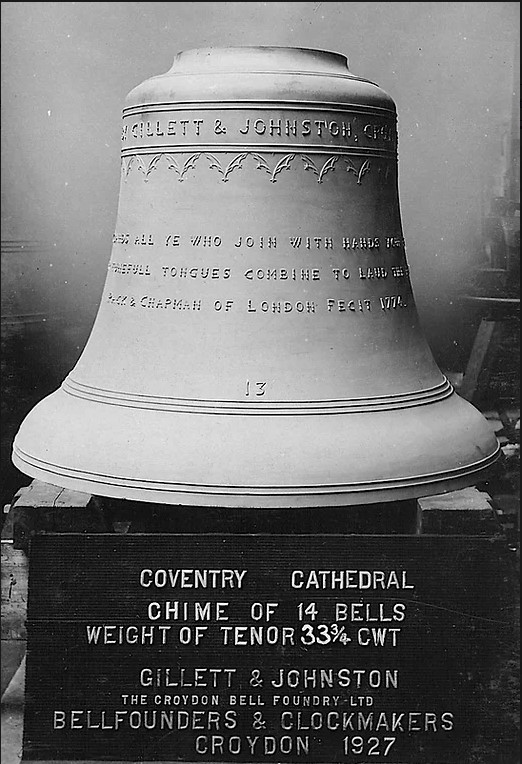 |
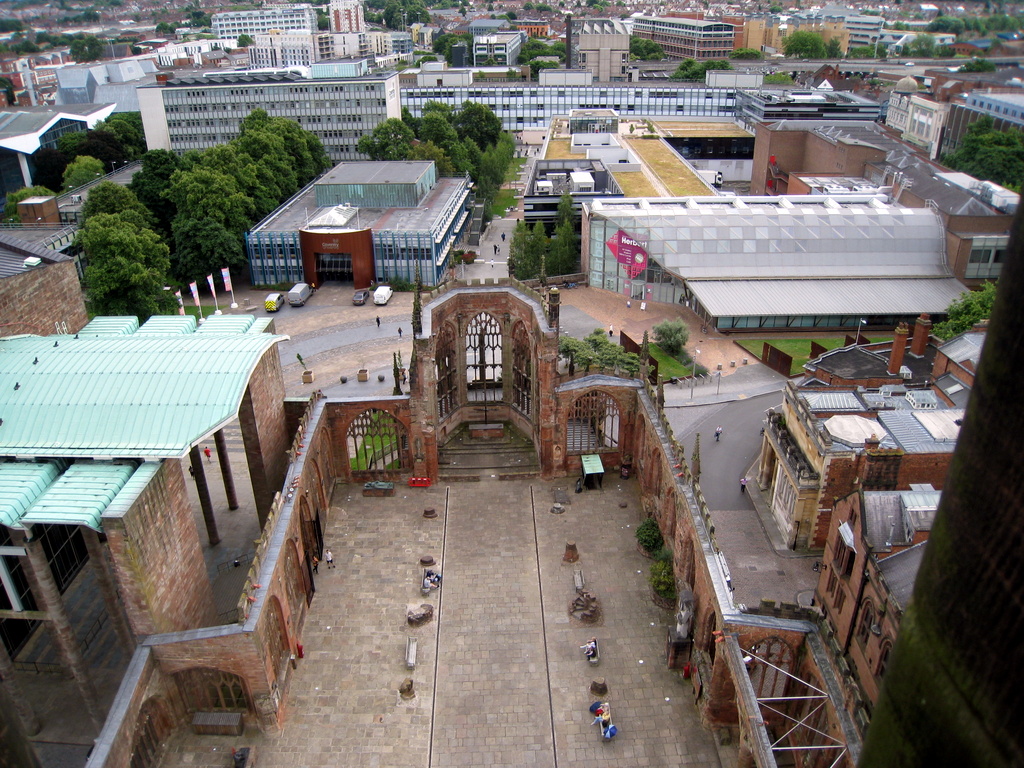
| The ruins from the top of the tower | The 11th bell at the foundry |