
Holy Trinity 8: 23-1-18 in Eb
| Grid Reference | 139/110938 | 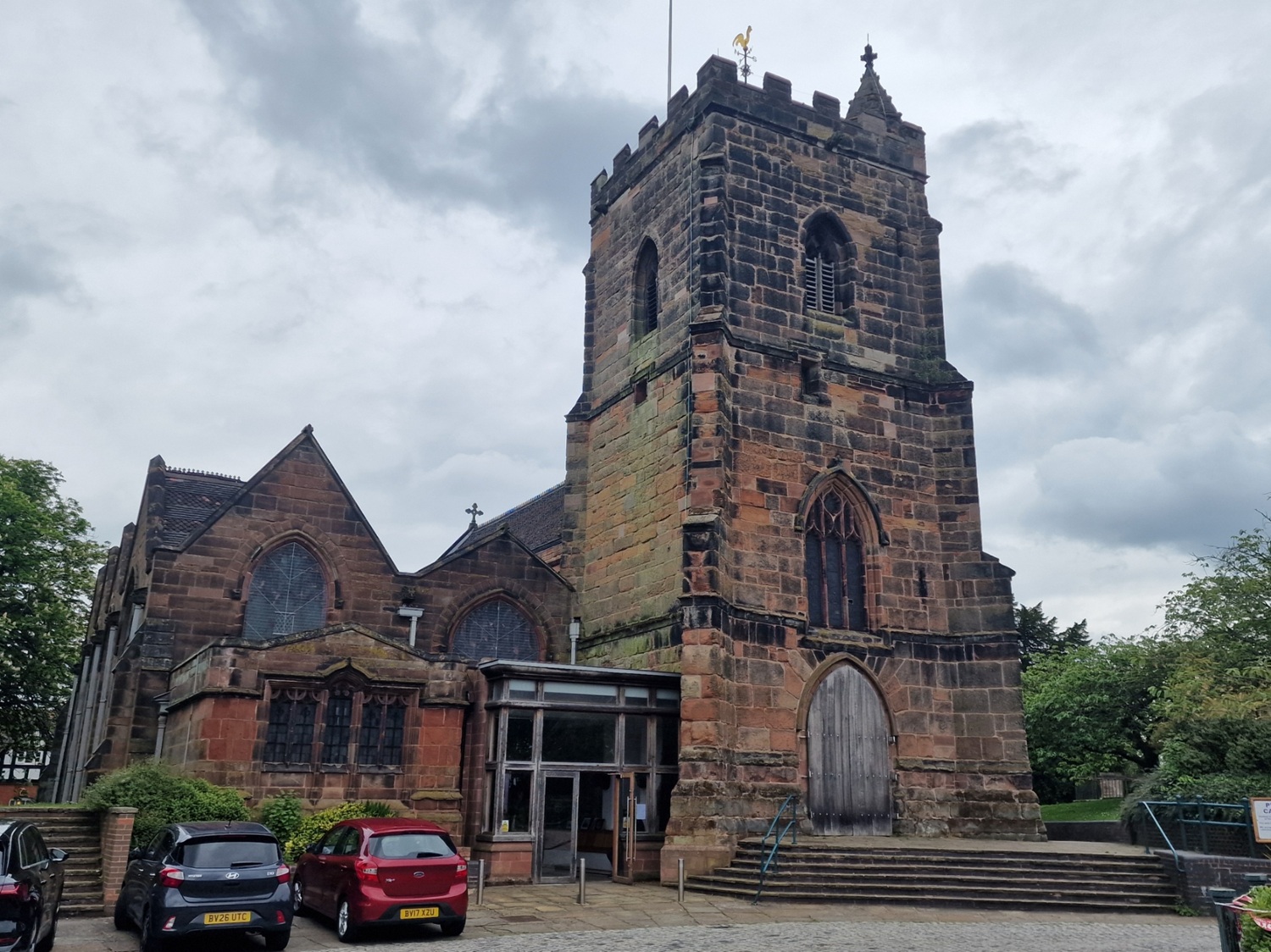 |
| Postcode | B72 1TF | |
| Affiliation | St Martin’s Guild | |
| Peals | Felstead Database | |
| Sunday | 0930-1000 & 1700-1730 | |
| Practice | Wednesday 2000-2100 | |
| Guild Website Entry | ||
History
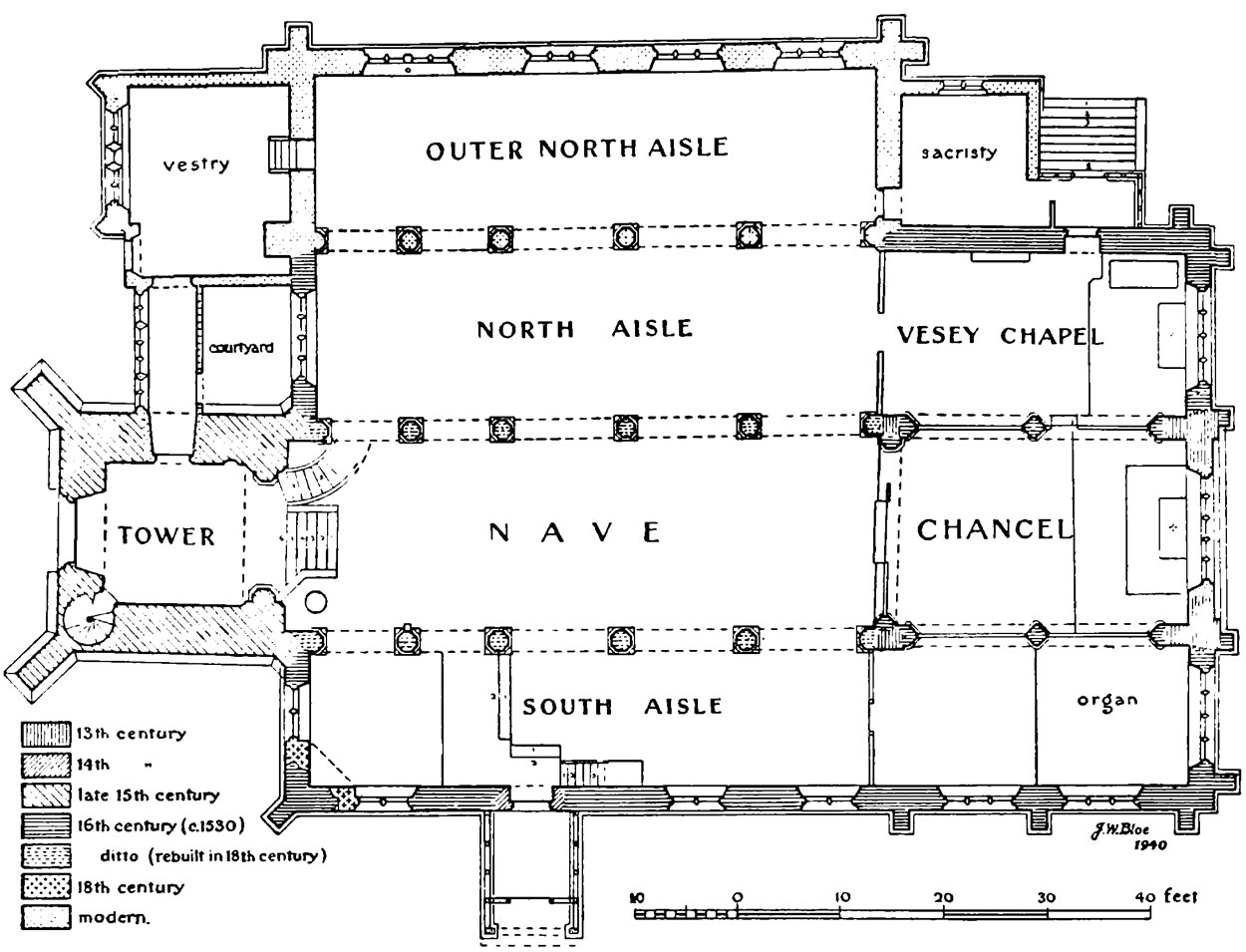
The church , stands on a rise to the east of the junction of the High Street with the Erdington-Birmingham Road and consists of a chancel, north and south chapels, nave, two north aisles, south aisle, south porch, and west tower. There are modern vestries east and west of the outer north aisle.
The church is of early-13th-century origin, but the only identifiable detail in the masonry is in the lower part of the east wall of the chancel; this has an early plinth and remains of shallow clasping buttresses. The nave was probably shorter than the present nave. There is no material evidence of enlargements before the end of the 15th century, to which date the west tower may be allocated: probably the nave was then also lengthened. The north and south chapels and nave-aisles were added by Bishop Veysey. The date 1533 is recorded for the aisles; the chapels may have preceded them by a few years, showing some difference of detail. Whether the clearstory to the nave was raised at the same time or subsequently is not evident from the masonry.
Part of the nave is said to have collapsed in 1759 and to have been rebuilt by the corporation in 1760. How much was involved in the fall is not certain, but apparently the two arcades were rebuilt with the old material. Perhaps the clearstory was then added, but packing or filling-in around the extradoses of the round arches suggests that the superincumbent walling had not given way and the arches were rebuilt below it. The roofs were probably reconstructed at the same time, but they were renewed in 1863.
The outer north aisle and vestries were added 1874–9 and much restoration has been carried out since then, especially in 1929, when the south wall was renovated, the Veysey chapel refurnished and redecorated, and other work done. Galleries of 1760 were built in the aisles and at the west end of the nave and later galleries were set in both chapels. That of the south aisle still remains, the others have been removed, but there are modern galleries at the west end of the inner north aisle and along the outer north aisle. The south porch was added probably in 1533 or soon afterwards.
The aisles and their chapels date from the sixteenth century, these later embellishments being made through the generosity of Bishop Veysey of Exeter (d.1554) who was born at Sutton. There is a monument to Veysey in the chapel on the north side of the chancel. The body of the church was extensively repaired in 1760 after part of the nave collapsed, and the building underwent substantial restoration in the Victorian period. The chancel was restored in 1863-4, the interior was reordered in a general restoration under Yeoville Thomason in 1875-9 and the outer north aisle was added in 1878-9. The western gallery of 1708 was removed and the tower arch opened up during the work of 1878-9
By 1795 there was a ring of 6 cast by Thomas Mears, tenor 22cwt. These were the successors to the four bells and a saunce bell that was in the tower at the time of the 1552 inventory. These became 6 by 1778, at the latest. Charles and John Rudhall of Gloucester supplied a ring of 6 in 1786, at a cost of £243/2/6.
Tilley and Walters note that the Corporation voted 100 guineas for a new ring in 1784 and that a certain William Hughes was killed by a piece of timber which fell while the workmen were preparing to put up the bells. They therefore speculate that this ring was short lived. This speculation is accurate, as Mears provided a new ring less than 10 years after the Rudhall ring was installed. Two of these bells remain in the present ring.
In 1884 the bells, which the visiting Erdington ringers had found to be in a poor state of repair, were restored and augmented to eight by John Taylor & Co. They recast the back four, added two trebles, and rehung the bells in the old frame with a new top frame for the trebles. The two tenors were cast with flat tops and the others had canons. The two bells of 1795 were not take to the foundry and therefore their exact weight are not recorded.
The net cost of the work was £405/12/4½, after an allowance of £250/6/3 for the metal of the four tenors was given.
The work was reported in Bell News in the edition of August 16th 1884:

After the reopening in July it was reported that the bells still went
badly and an attempt for a peal was lost. In September Taylors returned to fit 22 cast iron brackets, 40 bolts and 6 long bolts to stiffen the structure. This was invoiced on 15 September 1884 at a cost of £11/14/6.
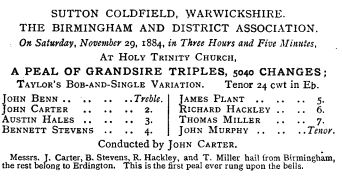
The first peal on the bells was rung shortly afterwards:

The following appear in Bell News in the edition of October 29th 1904:
“Sutton Coldfield (Warwickshire). Holy Trinity. Eight bells; 3rd and 4th by Mears 1795; the rest by Taylor 1884. Tenor, 24 cwt., diameter 4 ft. 2 in. Timber frame. Bells go well. Chiming apparatus fitted. Rehung by Taylor 1884. Ropes new 1895, good. Method ; Stedman. Sunday ringing usual half-an-hour before morning and evening service. Practice : Thursday, 7.”
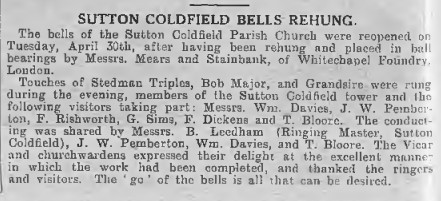
The wheels on 3 and 4 were replaced in 1927 and the frame strengthened two years later when Whitechapel rehung the bells on ball bearings, the work being invoiced on May 3rd 1929. The rehanging was reported in The Ringing World of May 10th 1929:
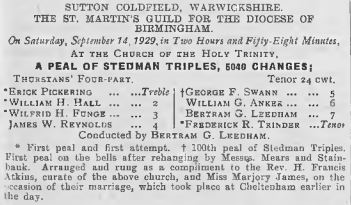
The first peal after the 1929 restoration was rung shortly after it was completed:

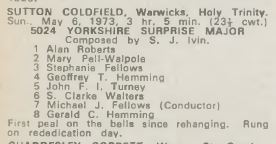
A new frame and fittings were supplied by Taylors, 1972. Prior to this restoration 23-1-17 was the accepted weight. The back two bells were cast with flat heads and the canons have been removed from the remainder. A peal was rung for the Worcestershire and Districts Association on the day of their rededication:

The ringing room walls were colourfully painted, but now have been “softened” in colour, with the odd parrot still visible!
(Most of the above information is quoted directly (with permission) from the research notes of Chris Pickford)
Details of the Bells
1884 1972
Weight Weight
1 John Taylor & Co, Loughborough 1884 5-2-18 5-1-09 29.75″ 1224.0Hz (Eb-29c)
2 John Taylor & Co, Loughborough 1884 6-0-14 5-3-05 30.00″ 1159.0Hz (D-23c)
3 Thomas Mears, Whitechapel 1795 7¾cwt 7-0-22 33.875″ 1033.0Hz (C-22c)
4 Thomas Mears, Whitechapel 1795 9cwt 8-1-07 36.50″ 921.0Hz (Bb-21c)
5 John Taylor & Co, Loughborough 1884 10-3-12 10-1-10 38.50″ 821.0Hz (Ab-20c)
6 John Taylor & Co, Loughborough 1884 13-1-25 12-3-10 41.75″ 775.0Hz (G-20c)
7 John Taylor & Co, Loughborough 1884 16-2-17 16-1-19 44.625″ 690.0Hz (F-21c)
8 John Taylor & Co, Loughborough 1884 23-1-17 23-1-18 50.50″ 619.0Hz (Eb-9c)
Inscriptions
| 1 | J : TAYLOR AND CO. FOUNDERS LOUGHBOROUGH 1884. |
| 2 | J : TAYLOR AND CO. FOUNDERS LOUGHBOROUGH 1884. |
| 3 | THOS. MEARS OF LONDON FECIT 1795 |
| 4 | THOS. MEARS OF LONDON FECIT 1795 |
| 5 | J : TAYLOR AND CO. BELLFOUNDERS LOUGHBOROUGH 1884.
Waist: |
| 6 | J : TAYLOR AND CO. BELLFOUNDERS LOUGHBOROUGH 1884. |
| 7 | J : TAYLOR AND CO. BELLFOUNDERS LOUGHBOROUGH LEICESTERSHIRE 1884.
Waist: |
| 8 | J : TAYLOR AND CO. BELLFOUNDERS LOUGHBOROUGH LEICESTERSHIRE 1884.
Waist: |
Details of the Bells in 1884
1. John Taylor & Co, Loughborough 1884 5-2-18 29.50″
2. John Taylor & Co, Loughborough 1884 6-0-14 30.00″
3. Thomas Mears, Whitechapel 1795 7½cwt 34.125″
4. Thomas Mears, Whitechapel 1795 9cwt 36.25″
5. John Taylor & Co, Loughborough 1884 10-3-12 38.875″
6. John Taylor & Co, Loughborough 1884 13-1-25 41.75″
7. John Taylor & Co, Loughborough 1884 16-2-17 45.00″
8. John Taylor & Co, Loughborough 1884 23-1-17 51.00″
Details of the Mears Bells
1 Thomas Mears, Whitechapel 1795 7-2-15 34.00″
2 Thomas Mears, Whitechapel 1795 8-3-06 36.375″
3 Thomas Mears, Whitechapel 1795 11-0-11 38.50″
4 Thomas Mears, Whitechapel 1795 11-0-14 41.375″
5 Thomas Mears, Whitechapel 1795 15-1-21 44.625″
6 Thomas Mears, Whitechapel 1795 21-3-21 50.375″
(Back four bells’ weights are scrapping values)
Photo Gallery |
|
 |
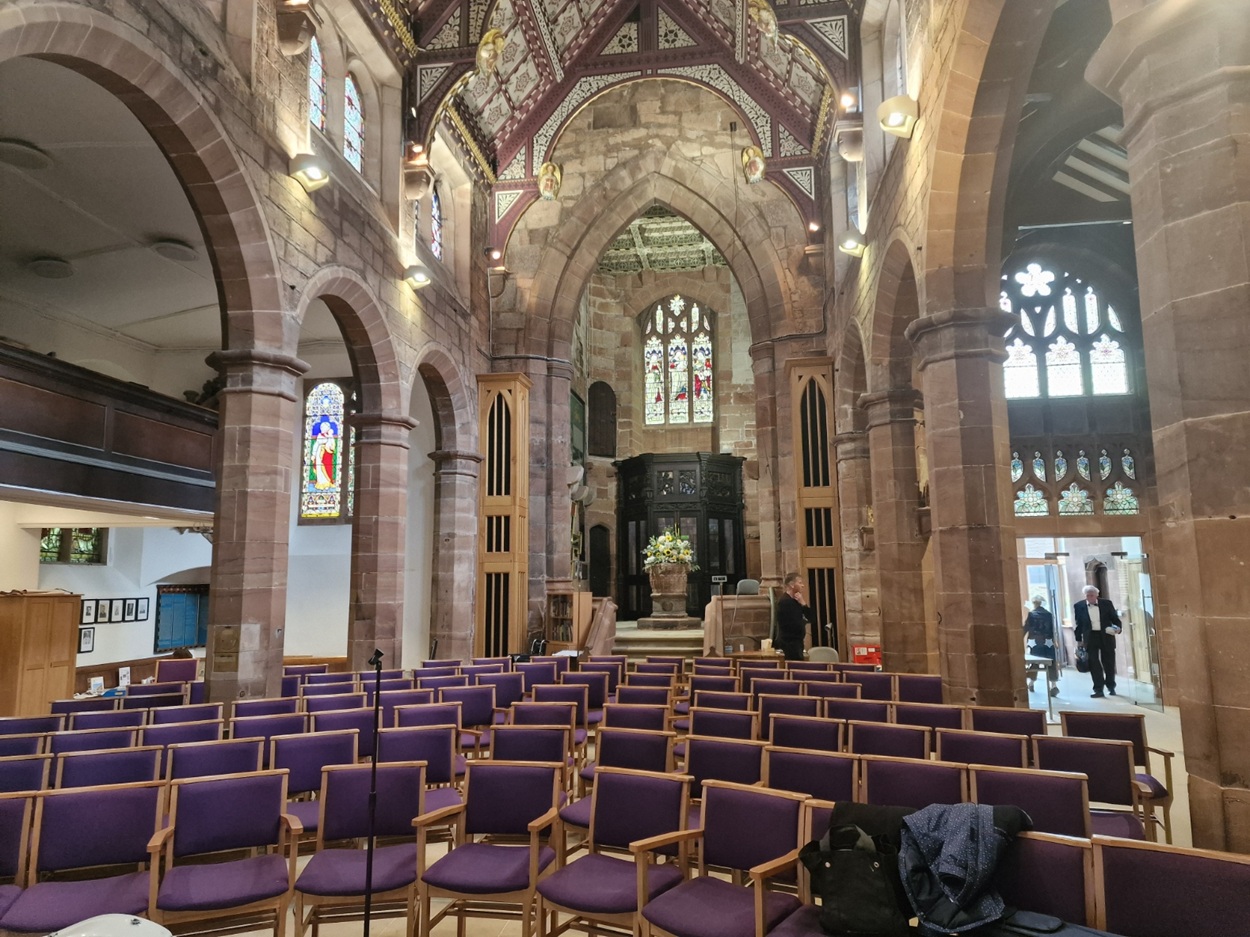 |
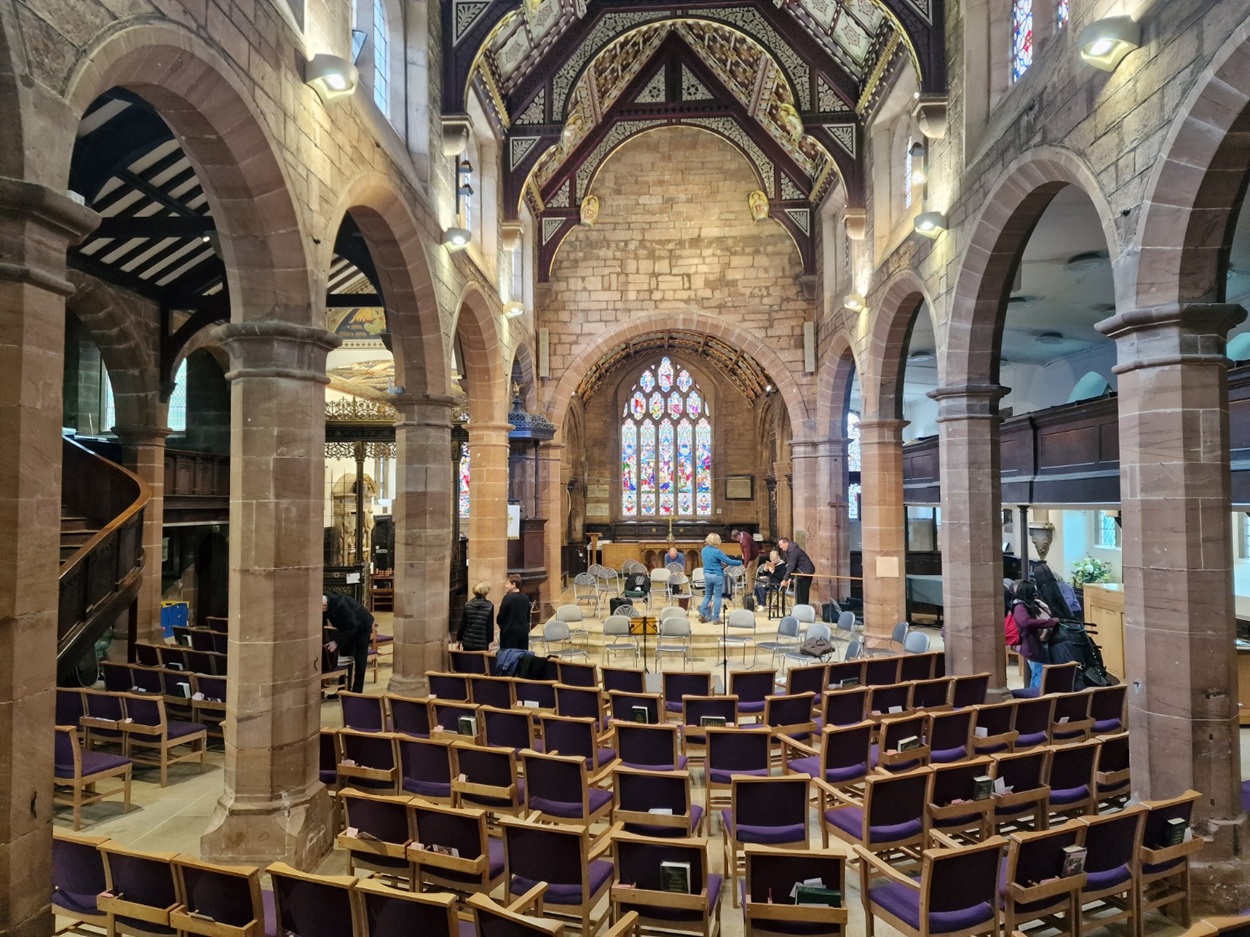
| The Church – Looking East | The Church – Looking West |
 |
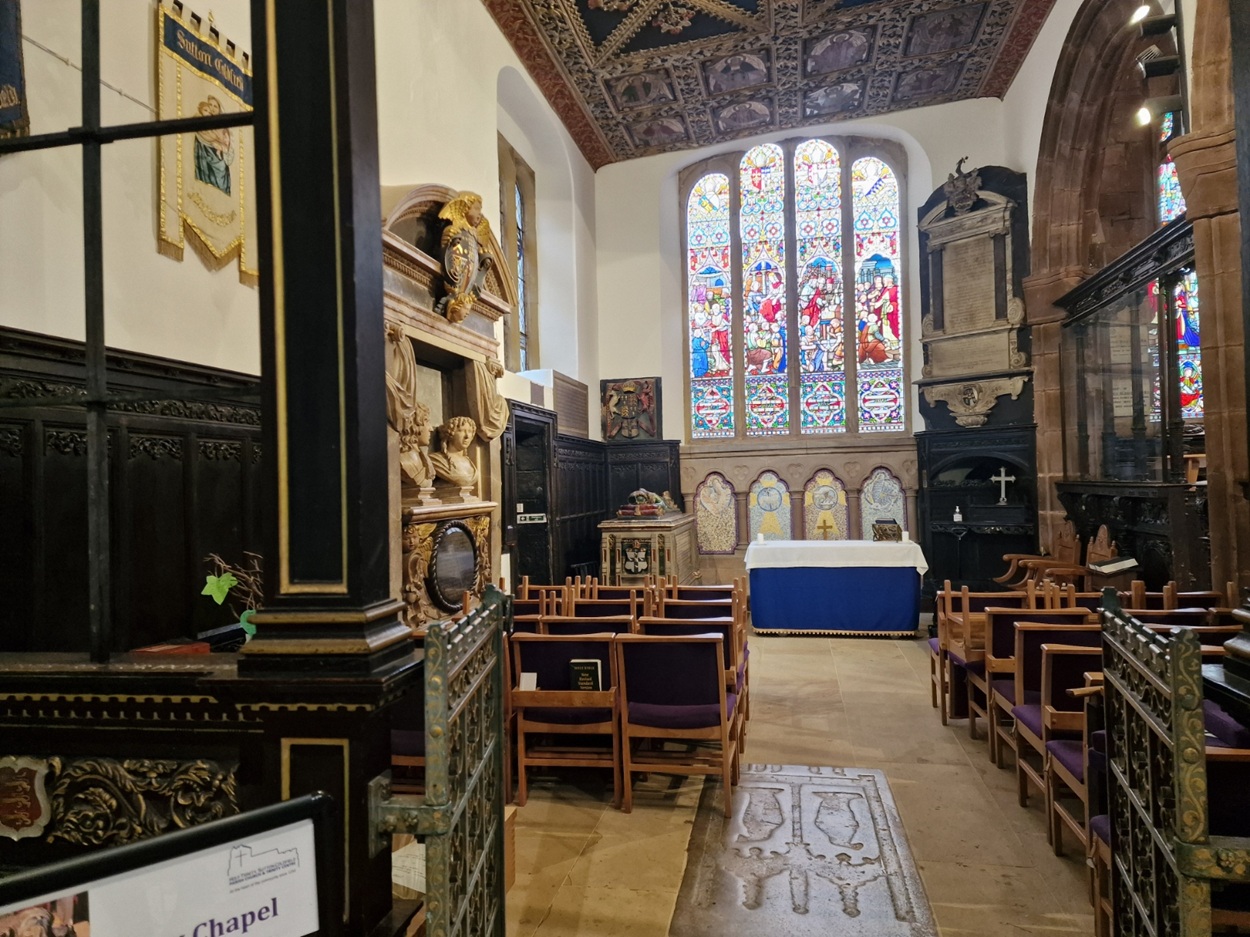 |
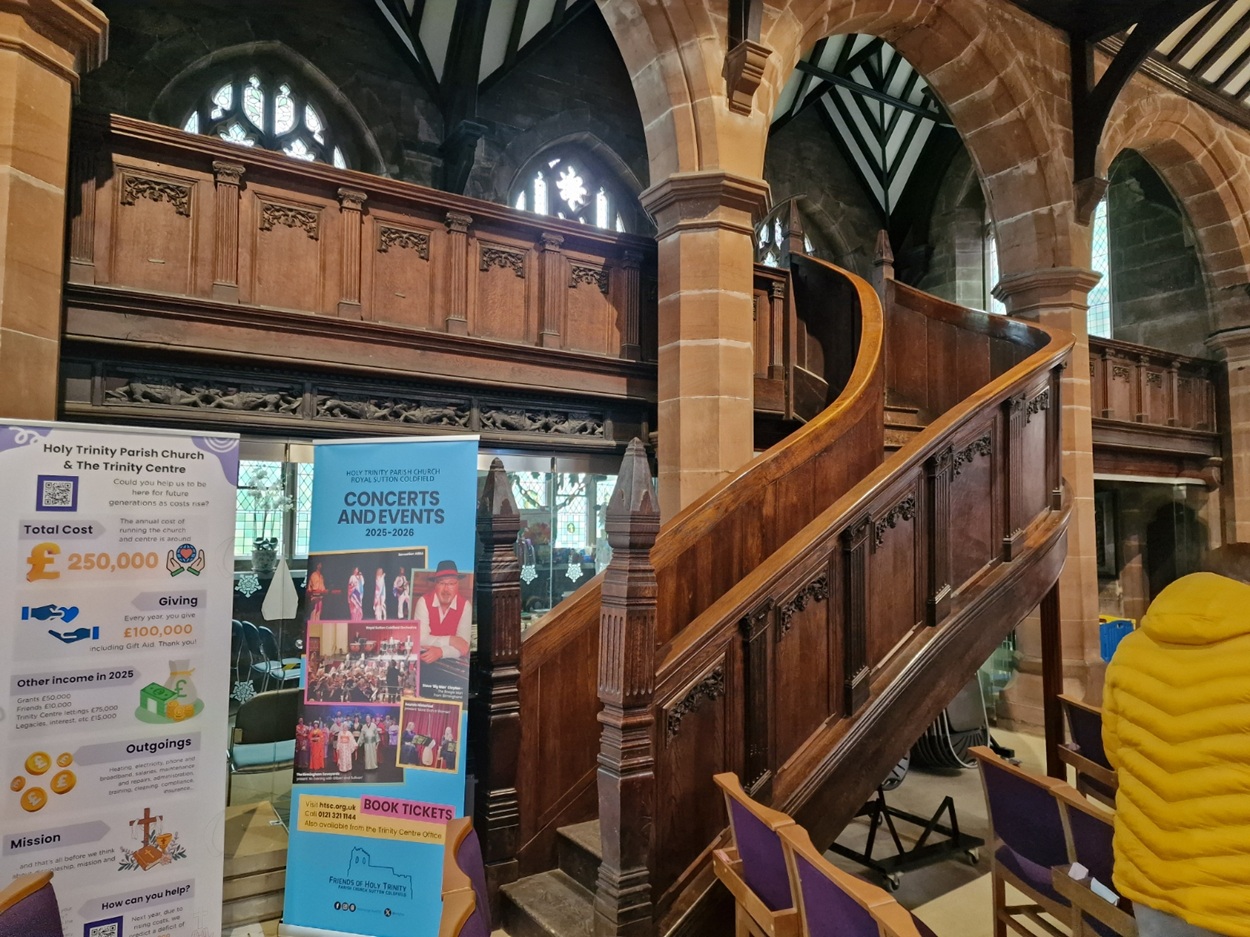
| The Fine Stairs Leading up to the South Gallery | The Vesey Chapel |
 |
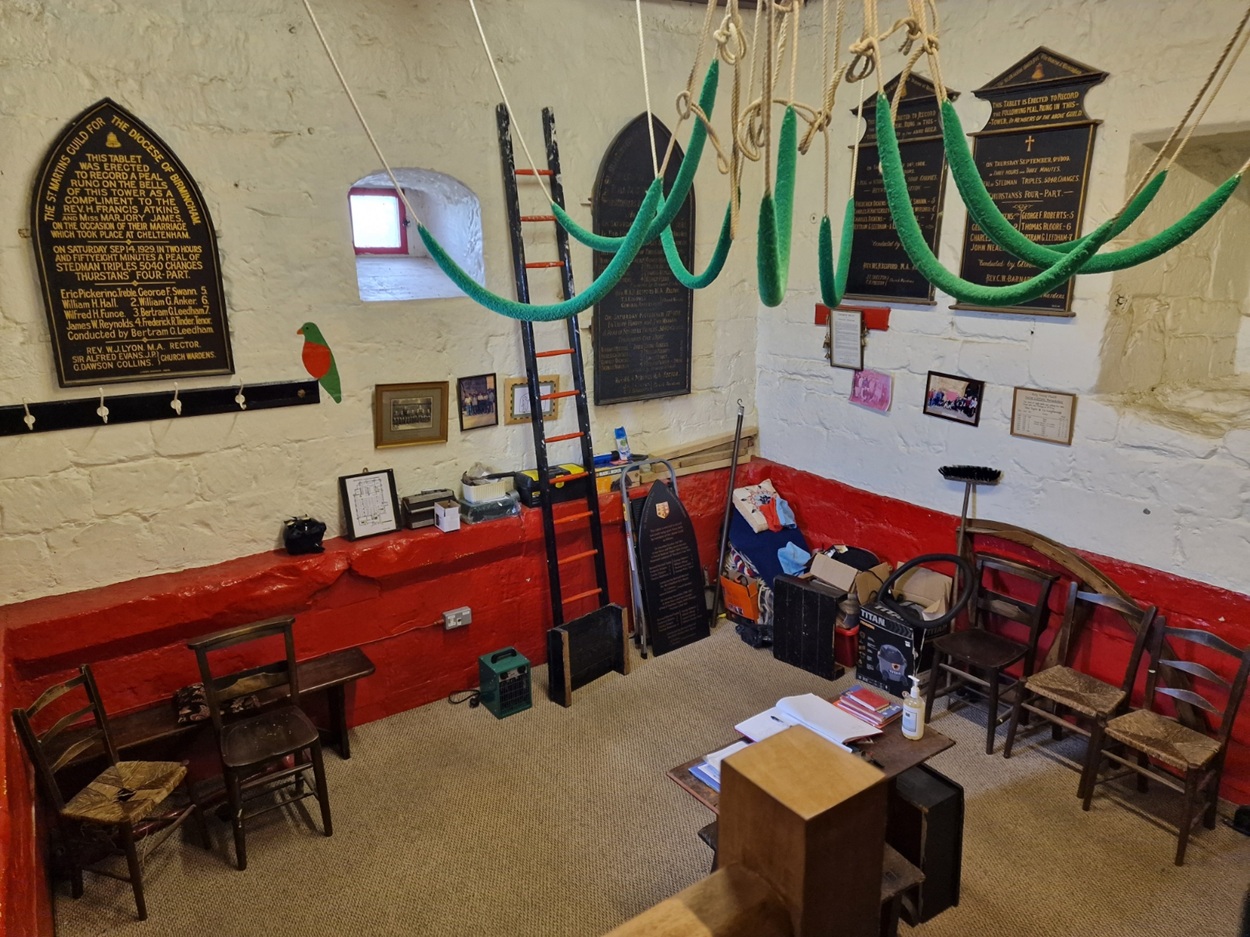 |
| Plan of the Church | The Ringing Chamber |