
St James the Great 6: 16-0-16 in F
| Grid Reference | 151/219600 |  |
| Postcode | CV37 0LJ | |
| Affiliation | Coventry DG | |
| Peals | Felstead Database | |
| Sunday | 1000-1030 & 1800-1830 (1st) | |
| Practice | Thursday 1800-1930 | |
| Guild Website Entry | ||
History
The village is (frequently!) signposted off the A46 Stratford upon Avon bypass. Another nice church in rural South Warwickshire. The bells used to be ground floor but were moved “upstairs” in the 1980s. Notice that the handrails on the stairs are from an old double-decker bus!
The church consists of a chancel, nave, north and south aisles, and a west tower. There are also modern vestries north of the chancel and south of the tower. The sequence of the earlier development of the building is a little uncertain owing to the proximity of the various periods, added to the marked differences in detail, and some confusion caused by later alterations. Probably the south arcade dates from the latter half of the 13th century and the north from the early 14th century, but the similarity of the windows in both aisles suggests that after the north aisle was built the south aisle was widened to 9 ft. to match the other.
The chancel, built of rubble, may have followed soon after the 14th-century north aisle; it is of great length compared with the nave and has large windows. The west tower was evidently erected in several successive stages: the lowest 10 ft. in the early 14th century, continued up another 8 or 9 ft. about 1340 with ashlar walling, the west window having moulded jambs rather like those of the south doorway, and completed c. 1400 in ashlar of larger stones. The clearstory was added early in the 16th century: there seems to have been some trouble from weakness in the arcades, especially the northern, which shows inequalities in the arches resulting probably from partial reconstructions, and most of its capitals have been rather crudely remoulded.
No important changes occurred before the 19th century, but there was some deterioration, as a description of 1858 mentions that the chancel was heavily buttressed on the north side and its windows had lost their tracery. The closing of the side doorways and insertion of the west doorway were done before that time. Scars and repairs in the arcades are evidence of the damage caused to the masonry by the erection of galleries in 1841. Probably the vestry south of the tower was then added. Since then the church has been well restored, the chancel windows provided with tracery, and the north vestry and organ chamber added.
The frame is by Taylors, 1887, but the bells were rehung on ball bearings by Gillett & Johnston in 1947. Prior to 1887 there were 3 bells, the present 3rd formed the treble and the 5th the tenor. They were made into 6 by adding 2 trebles and a tenor. At the time of the augmentation they recast the existing middle bell, a 1703 William Bagley bell of exactly 8cwt. They had previously recast the then existing tenor, a Henry Bagley I bell of 1665 which weighed 9-1-22, in 1874. The frame is “composite” with oak cills and frame heads and cast iron main braces. The Bell News of September 3rd 1887 reports:
Snitterfield (Warwickshire).— On Thursday, August 25th, the Hatton band paid a visit to this fine old church, the bells of which have this year been augmented from three to six, by Mess.’s. Taylor, of Loughborough, and rang six 6-scores of Grandsire Doubles, each called differently, in 29 mins. J. Bayliss (conductor), 1 ; J. Cogbill, 2 ; Rev. H. C. Courtney, 3; W . Male, 4 ; W . Clarke, 5 ; J. Barnett, 6. Tenor 15 cwt. in F. This is the first time that half-pull change-ringing has been heard in this place, and the Hatton band desire to thank the Vicar for the use of the bells, and the local ringers for having the belfry and all connected with it in such capital order. The “ go ” of the bells is excellent.
Until the 2020 restoration, all the bells retained their canons, except for the tenor which was cast with a “flat top”, and none had been turned.
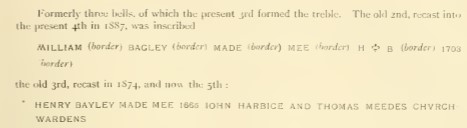
The inscriptions are given in Tilley and Walters’ book, “The Church Bells of Warwickshire”:


They also give us the inscriptions of the bells that were recast in the 1870/80s:

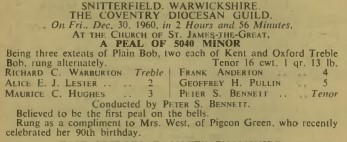
The first peal on the bells was rung in 1960:

The ringing chamber was moved up from the ground floor in 1986.
Chris Pickford wrote an excellent article about the bells at Snitterfield, and Lord Coventry’s connection with them, that was published in The Ringing World of October 19th 2007:


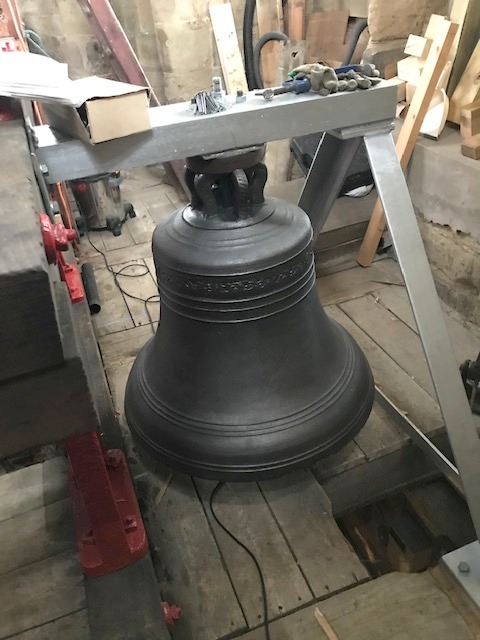
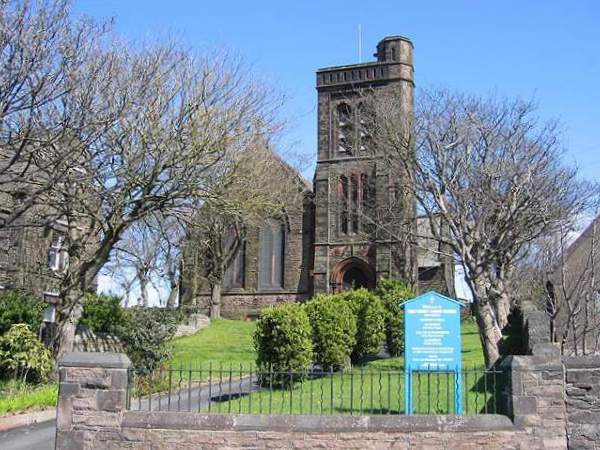
In 2020 there was restoration scheme under which the bells were rehung in the existing frame with new fittings and and the third bell was retired to become a service bell, it being replaced by a second hand bell from West Seaton, Cumbria. The canons were removed from the Snitterfield bells which had them, except for the old third bell. The West Seaton bell was cast with a flat top. The work was completed in July/August of 2020.
Entry is via the main west tower door. Please be aware of the clock release wire – it is easy to miss it! It must be attached to a hook on the left inside edge of the Ellacombe Apparatus.
Details of the Bells – Pre 2020 Restoration
1 John Taylor & Co, Loughborough 1887 5-0-23 28.375″ 1197.5Hz (D+33c)
2 John Taylor & Co, Loughborough 1887 6-0-24 30.75″ 1064.0Hz (C+29c)
3 Abel Rudhall, Gloucester 1758 5-0-21 31.125″ 944.0Hz (Bb+22c)
4 John Taylor & Co, Loughborough 1887 8-3-11 35.50″ 901.0Hz (A+41c)
5 John Taylor & Co, Loughborough 1874 10-2-25 39.375″ 793.0Hz (G+20c)
6 John Taylor & Co, Loughborough 1887 16-1-13 44.50″ 707.5Hz (F+22c)
Details of the Bells – Post 2020 Restoration
1 John Taylor & Co, Loughborough 1887 4-3-04 28.35″ 1174.0Hz (D-1c)
2 John Taylor & Co, Loughborough 1887 5-3-04 30.90″ 1047.9Hz (C+2c)
3 John Taylor & Co, Loughborough 1893 6-2-13 33.10″ 934.2Hz (Bb+3c)
4 John Taylor & Co, Loughborough 1887 8-1-14 35.50″ 877.9Hz (A-4c)
5 John Taylor & Co, Loughborough 1874 10-1-09 39.375″ 785.3Hz (G+3c)
6 John Taylor & Co, Loughborough 1887 16-0-16 44.50″ 697.5Hz (F-2c)
S Abel Rudhall, Gloucester 1758 5-0-21 31.125″ 944.0Hz (Bb+22c)
Photo Gallery |
|
 |
 |
| The Church – Looking East | The Chancel |
 |
 |
| The Church – Looking West | The Stairs to the Ringing Chamber Come Down Backwards – Like This! |
 |
 |
| The Ringing Chamber | The 2000 Pealboard – containing a picture of the webmaster! |
 |
|
| A Plan of the Church | |
| Restoration 2020 | |
  |
  |
| Bell being lowered through the Ringing Chamber floor | Bell at the base of the tower |
  |
  |
| Two bells on the truck-bed at Taylors | The bells being delivered to Taylors |
| Pictures from the reinstallation of the bells in July/August 2020 | |
  |
  |
 |
 |
 |
  |
  |
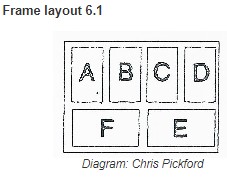 |
| West Seaton Church – source of replacement 3rd bell | The frame layout |