
St Mary 8: 12-1-17 in G
| Grid Reference | 139/038822 | 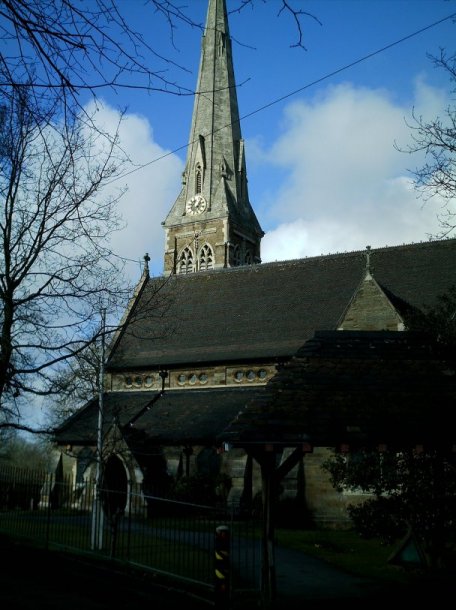 |
| Postcode | B29 6NG | |
| Affiliations | St Martin’s Guild & Worcestershire & Districts Assoc |
|
| Peals | Felstead Database | |
| Sunday | 0915-1000 | |
| Practice | Wednesday 1945-2100 | |
| Guild Website Entry | ||
History
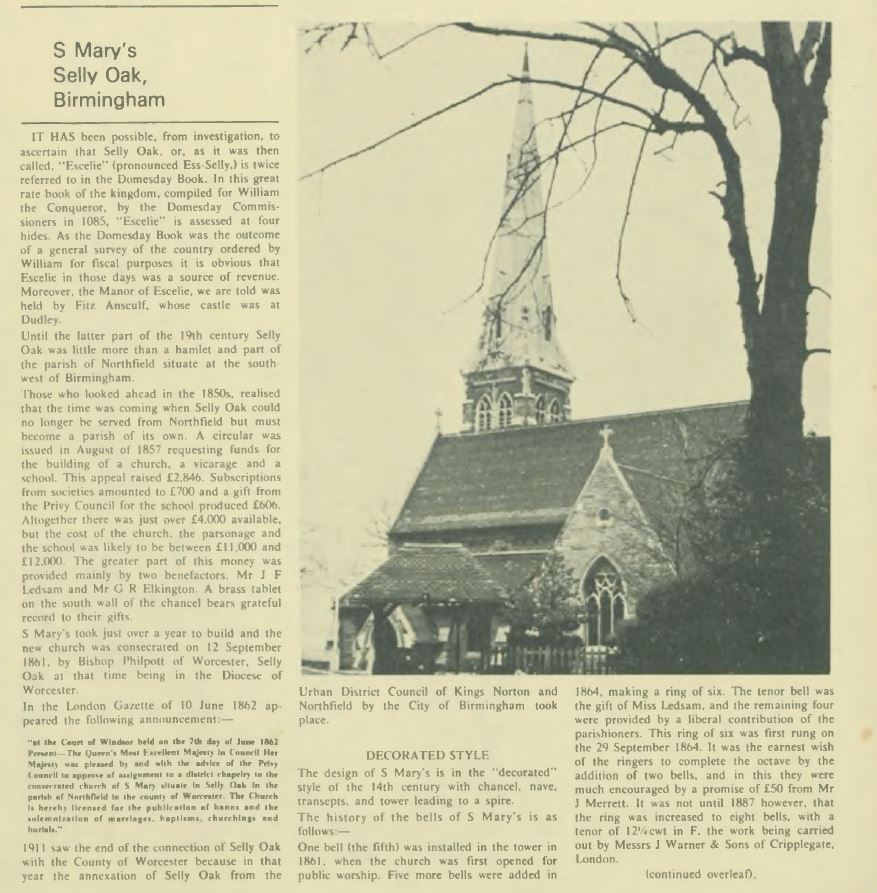
Historically in Worcestershire, Selly Oak moved into Birmingham in 1911 and hence, sort of, became part of Warwickshire, but has never been administered from County Hall. Selly Oak used to be in the Parish of Northfield, but with the large increase in population of Victorian times it was decided that the new parish of St Mary, Selly Oak should be established and a church built. The land was given by Mr Joseph Frederick Ledsham, then the Lord of the Manor, who laid the foundation stone on 12 July 1860. The construction of St Mary’s took just over a year, and the church was consecrated on 12 September 1861. The architect was Edward Holmes. The building is in a Victorian version of the Decorated Gothic style.
One bell bell was placed in the tower in 1860 to which a tenor and four trebles were added in 1864.
The six bells were rung for the first time on Michaelmas Day, 29 September 1864, as reported in a contemporary paper:
A peal of six bells has just been cast for the new church of St.Mary, Selly Oak, by Messrs. John Warner and Sons, of London, which will be rung for the first time on Thursday next. There will be a service on the evening of that day. We believe this is the first instance for many years of a peal of bells being placed in any of the new churches of Birmingham or its immediate neighbourhood, and we commend the example of parishioners of Selly Oak for general imitation.
A more detailed report appeared in Aris’s Birmingham Gazette, 1 October 1864:
On Thursday last (St. Michael’s Day) a new peal of six bells, cast by Messrs. John Warner and Sons, Cripplegate, London, were rung for the first time in St. Mary’s Church, Selly Oak. The tenor bell of the note G sharp, and weighing more than 10 cwt., is the gift of Miss Ledsam, of Griffin’s Brook; the others were procured by a liberal subscription of parishioners and friends. On every side of the church the peal was heard at a good distance, and its sweet and musical notes much admired. The ringers, members of St. Martin’s Company, were highly pleased with the tone of the bells, and the skill with which they had been rung. In celebration of this joyful event a special service was held, in which a large congregation (chiefly parishioners) joined. The prayers were said by the incumbent; the lessons by the Rev. W. B. Benison, of Balsall Heath, and the Rev. H. Clarke, rector of Northfield. The sermon was by the Rev. P. Morse, of St. John’s, Ladywood, from Psalm lxxxix. 15: “Blessed is the people which know the joyful sound.”
The collection amounted to £11.18s. 21/2d. After service a supper was laid in the schoolroom, most tastefully decorated for the occasion, provided by the liberality of the churchwardens for the ringers and choir, at which most of the principal inhabitants of the parish were present. The festival was closed by a parting peal sweetly sounding over the village in the darkness of the night until ten o’clock.
The tenor was apparently recast in 1884. To produce a heavier ring of 8 a tenor and treble were added and the fourth recast in 1887, to celebrate Queen Victoria’s Jubilee. This work was also undertaken by Warners. They were hung in a two-tier frame, with bells 2 and 6 on top.
The first peal was rung shortly afterwards:

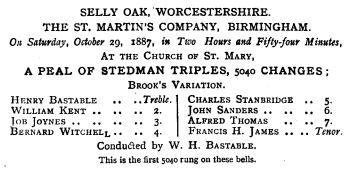
The following appears in Bell News on July 16th 1904:
“Selly Oak (Worcestershire). St. Mary. Eight bells. All by Warner. The two trebles 1887 ; date of rest not given. Tenor 12 cwt., diameter 3 ft. .5 in. Timber frame. Bells go well. Ropes new 1887, bad. Methods: Grandsire and Treble Bob. No Sunday ringing. Practice: Thursday, 7.30.”
The six bells in the lower frame all swung north-south and those in the upper tier swung east-west.
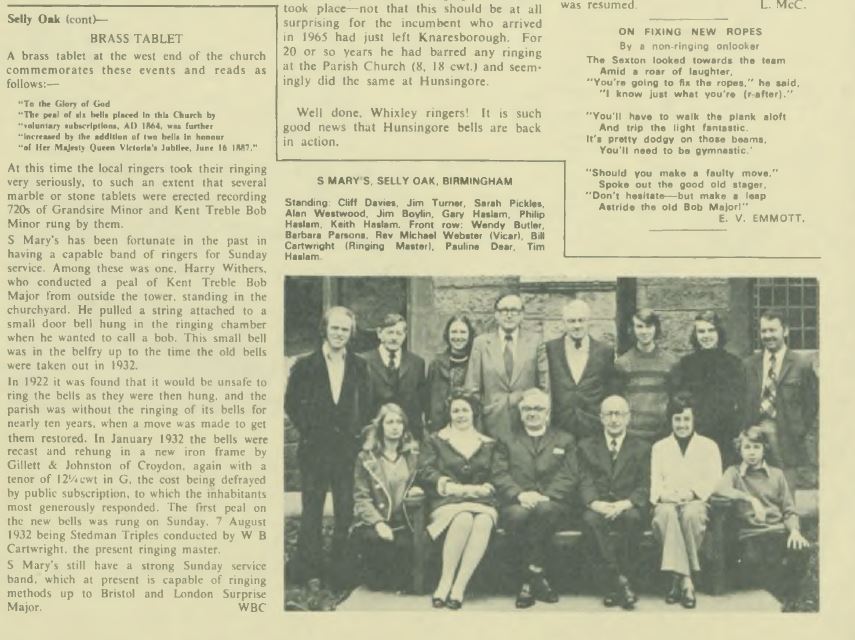
The bells were declared unsafe in 1922 and remained silent until repairs to the tower and spire and other essential work on the church had been completed.
Funds were raised for the restoration of the bells in 1931 and a faculty issued to rehang the bells in a new frame with new fittings. This appeared in The Ringing World of November 20th 1931. Note that there is no mention of an intention to recast the bells.

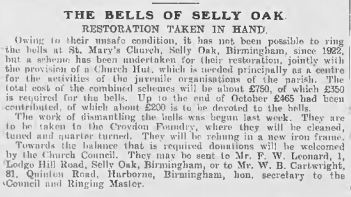
This was changed to a full recasting of the ring shortly afterwards when it was clear that funds were available for this, a supplementary faculty being issued.
The bells were recast in 1931-2, when the tower was refurbished. The re-dedication of the bells was reported in The Ringing World of April 1st 1932:
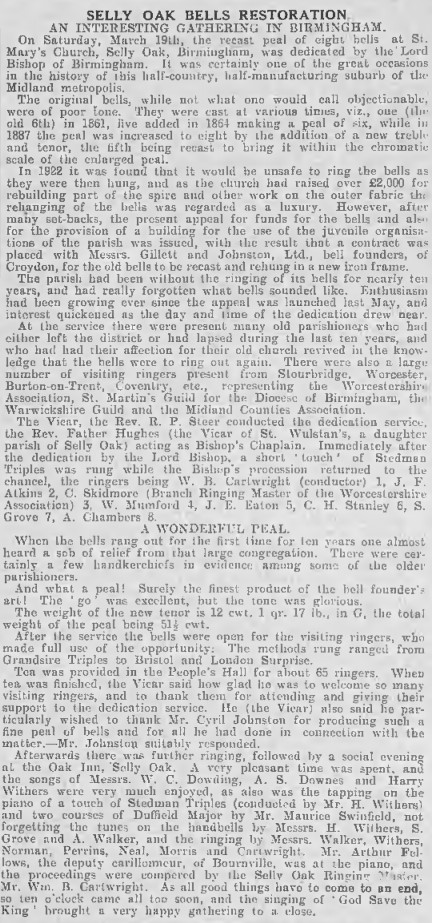
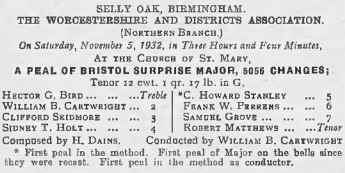
The first peal was not long in being rung:

The church was the “Front Page Tower” in The Ringing World of February 27th 1976:
  |
  |
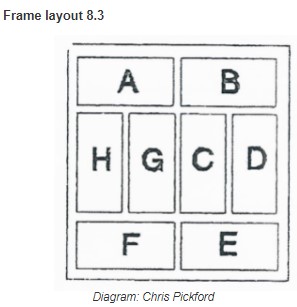
The bells are hung in a cast iron H frame on one level with ringing fittings of 1932, including cast iron stocks and ball bearings. The second was quarter turned and rehung with new gudgeons and bearings by Taylors in 1980 at a cost of £158.
The tower is in the Diocese of Birmingham and therefore part of the St Martins Guild “territory”, but has retained its links with the “Worcesters”, as part of the “and Districts” bit of the title.
Details of the Bells
1 Gillett & Johnston, Croydon 1932 4-0-07 25.50″ 1548.0Hz (G-22c)
2 Gillett & Johnston, Croydon 1932 4-0-18 26.00″ 1451.0Hz (F#-34c)
3 Gillett & Johnston, Croydon 1932 4-0-24 27.125″ 1290.0Hz (E-37c)
4 Gillett & Johnston, Croydon 1932 4-3-20 28.75″ 1161.0Hz (D-20c)
5 Gillett & Johnston, Croydon 1932 5-3-15 31.125″ 1032.0Hz (C-24c)
6 Gillett & Johnston, Croydon 1932 6-2-18 33.00″ 968.0Hz (B-35c)
7 Gillett & Johnston, Croydon 1932 9-0-21 36.50″ 871.0Hz (A-18c)
8 Gillett & Johnston, Croydon 1932 12-1-17 40.50″ 774.0Hz (G-22c)
Inscriptions
| 1 | RECAST BY GILLETT & JOHNSTON, CROYDON, 1932.
Waist: |
| 2 | RECAST BY GILLETT & JOHNSTON, CROYDON, 1932. |
| 3 | RECAST BY GILLETT & JOHNSTON, CROYDON, 1932. |
| 4 | RECAST BY GILLETT & JOHNSTON, CROYDON, 1932. |
| 5 | RECAST BY GILLETT & JOHNSTON, CROYDON, 1932. |
| 6 | RECAST BY GILLETT & JOHNSTON, CROYDON, 1932. |
| 7 | RECAST BY GILLETT & JOHNSTON, CROYDON, 1932. |
| 8 | Waist: THESE BELLS WERE RECAST BY GILLETT & JOHNSTON, CROYDON. JANUARY 1932. REGINALD P. STEER, VICAR. T.C. HUMPHREYS } J.R. JOHNSON } CHURCHWARDENS. Opposite: + BEATUS POPULUS QUI SCIT JUBILATIONEM |
The number of each bell is inscribed on its low waist.
Details of the Warner Ring
1 John Warner & Sons, London 1887 4-1-09 26.25″
2 John Warner & Sons, London 1864 4-1-23 27.00″
3 John Warner & Sons, London 1864 4-1-20 27.50″
4 John Warner & Sons, London 1864 4-2-26 29.00″
5 John Warner & Sons, London 1887 6-0-08 32.00″
6 John Warner & Sons, London 1860 7-0-04 34.00″
7 John Warner & Sons, London 1884 9-3-11 38.00″
8 John Warner & Sons, London 1887 11-2-15 41.00″ in F# sharp
(scrapping weights – tenor said to be 12-1-13 originally)
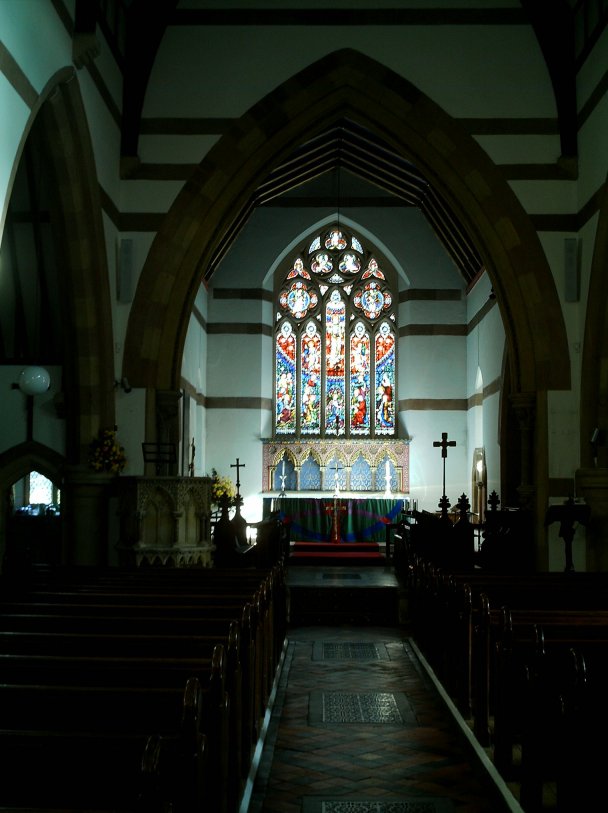
Photo Gallery |
|
 |
 |
| The Nave | The Organ |
 |
|
| The Frame Layout | |