
St Giles 8: 10-1-0 in G#
| Grid Reference | 139/970874 |  |
| Postcode | B65 9EP | |
| Recording | None Available | |
| Affiliations | St Martin’s Guild & Worcs & Districts Assoc |
|
| Peals | Felstead Database | |
| Sunday | 0945-1015 (2nd and last) 1800-1830 (Others) | |
| Practice | Monday 1945-2100 | |
| Guild Website Entry | ||
History
This church is historically in Staffordshire, but was transferred to Worcestershire in 1844. It has also moved Dioceses, as it was originally in the Worcester Diocese but is now in the Birmingham Diocese.
There has been a church here since late in the 12th century, but no trace of this is found in the present building. The church, apart from the tower was demolished and a new one built in 1840/1. The tower was rebuilt in 1858.
The church was unsafe by 1894, due to mining subsidence and closed. It was replaced by a new building in 1904/5, but this was destroyed in an arson attack in June 1913.
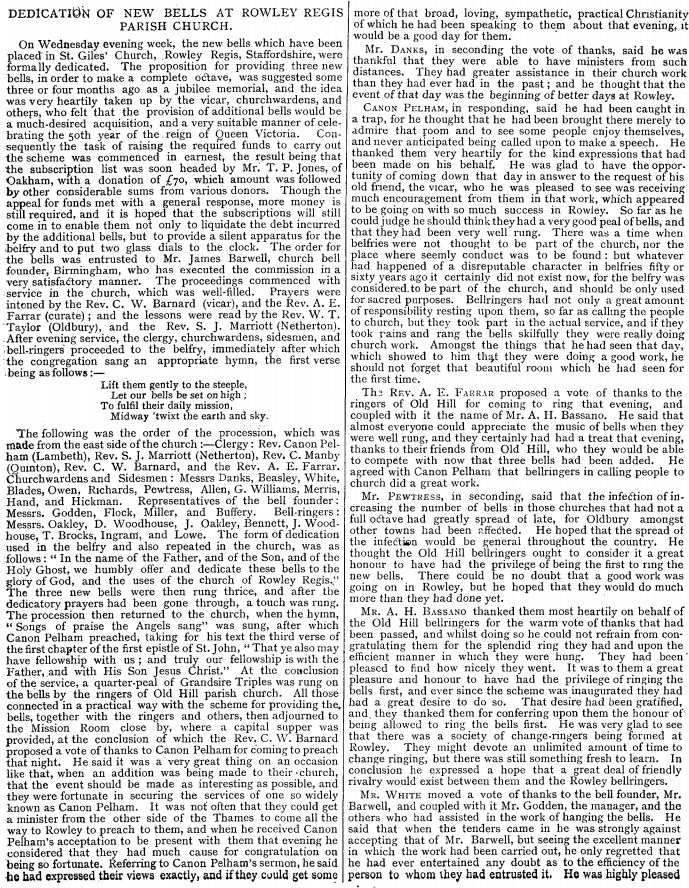
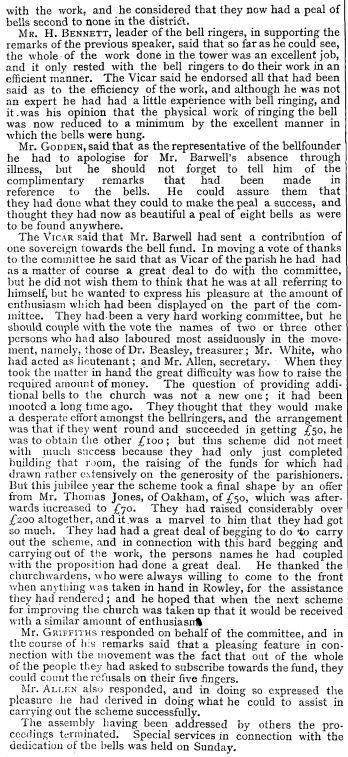
In 1552 there were “iiij belles” here. Matthew and Henry Bagley seem to have provided a 12cwt ring of 5 in 1684. The Whitechapel foundry recast the treble in 1804 and the tenor in 1848. The new tenor weighed 12-2-0. The tenor was again recast in 1881 by Blews and three trebles were added and the ring rehung in 1888 by Barwell. The dedication was reported in Bell News:
  |
  |
The first peal on the bells was rung in 1887:
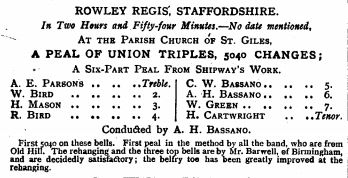

(The date for the peal is November 4th 1887 – though the Old Hill pealbook stated November 7th.)
The then record peal of Grandsire Major was rung here shortly afterwards. This is still the record length in the method – details are:
Birmingham and District Amalgamated Society
Rowley Regis, Staffordshire, St Giles
On Monday 25 February 1889, in 6 hours and 5 minutes (13)
10,272 Grandsire Major
Composed by John Carter
1 John Carter (C)
2 James Jones
3 Thomas Horton
4 William Brooks
5 Charles Carmell
6 Frank H James
7 Albert Hackley
8 John T Perry
This was published in Bell News on June 11th 1904:
“Rowley Regis (Staffordshire). St. Giles. Eight bells. The back five by Mears (date not given); the rest by Harwell, 1887. Tenor 12 cwt. Timber frame. Bells go well. Clocking permitted. Rehung by Barwell, 1857. Ropes good. Ringers all learners. Sunday ringing: 10.30 to I I , and 6 to 6.30. Practice: Wednesday, 8, Saturday, 7.”
The church was burned down in 1913, some believing the fire to have been started by Suffragettes or local striking steelworkers; this however is supposition and it was more than probable it was a simple accident, the church at this time using paraffin as a means of lighting and the latter perhaps causing the fire.
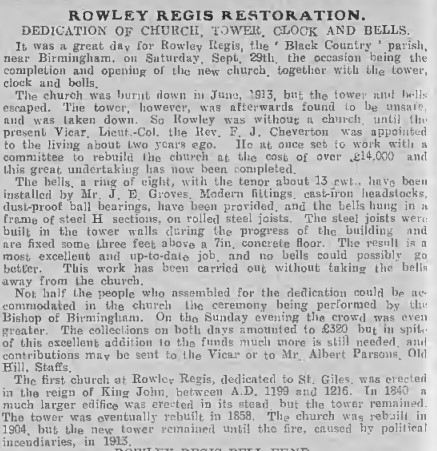
Due to the outbreak of war the church remained in a ruinous state for 10 years and was not replaced until 1923. This new church was a completely new building. J E Groves of Birmingham hung the bells in a new frame when the church was rebuilt after the fire.
The reopening is reported in The Ringing World of October 26th 1923:
The 5th was recast by Gillett and Johnson in 1952 after cracking in the previous year. The bells received major attention in 1984, involving the re-modelling of the ring, with the old fourth and sixth being incorporated as the sixth and seventh. A second-hand bell (by Taylor, 1948) was acquired from the redundant church of St. Mary Magdalene, Worcester, as a new tenor. The remaining bells were recast.
This appeared in The Ringing World of March 4th to show that work to remodel the ring had started:

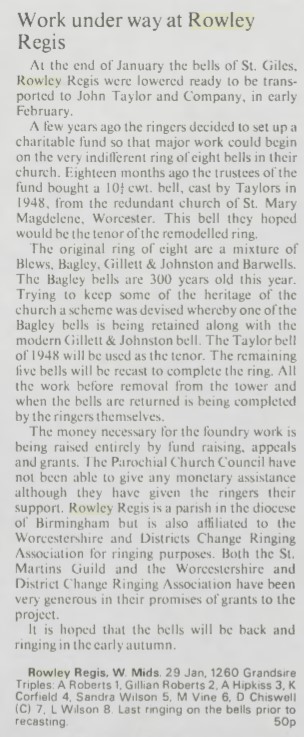
The following then appeared in March 30 1984 edition showing that the project had had a hitch.
“Weight loss at Rowley Regis
The bells from St. Giles, Rowley Regis have now been delivered to John Taylor & Co. at Loughborough and have been found much lighter than previously recorded. The tenor reputed to be 13 cwt was in fact only 11 -0-8 and in total the ring was approximately 9 cwt lighter than previously recorded.
The weight loss is of more than academic interest since the Restoration Fund now has to find an extra £1,000 to make up the anticipated credit for metal…..”
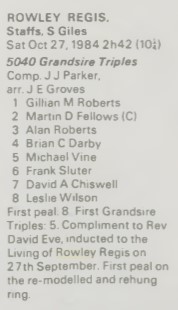
The project did succeed and the bells were re-dedicated on September 1st 1984. The first peal on the new ring followed quickly afterwards:

(Most of the above bell information is quoted directly (with permission) from the research notes of Chris Pickford)
Details of the Bells
1 John Taylor & Co, Loughborough 1984 3-0-20 23.50″ 1622.0Hz (G#-41c)
2 John Taylor & Co, Loughborough 1984 3-1-10 24.125″ 1524.0Hz (Fx-49c)
3 John Taylor & Co, Loughborough 1984 3-1-06 24.875″ 1352.5Hz (E#-56c)
4 John Taylor & Co, Loughborough 1984 3-2-06 26.00″ 1222.0Hz (D#-32c)
5 John Taylor & Co, Loughborough 1984 4-0-26 28.125″ 1084.0Hz (C#-39c)
6 Gillett & Johnston, Croydon 1952 5-1-16 30.50″ 1016.0Hz (B#-51c)
7 Henry Bagley II, Chacombe 1684 7-1-08 34.625″ 915.0Hz (A#-3c)
8 John Taylor & Co, Loughborough 1948 10-1-00 38.00″ 814.0Hz (G#-35c)
Inscriptions
| 1 | BARWELL FOUNDER BIRMINGHAM
Waist: Opposite: |
| 2 | BARWELL FOUNDER BIRMINGHAM
Waist: Opposite: |
| 3 | BARWELL FOUNDER BIRMINGHAM
Waist: Opposite: |
| 4 | HENRY BAGLEY MADE MEE 1684
Waist: Opposite: |
| 5 | MATHEW BAGLEY OF CHALCOMB MADE ME 1684
Waist: Opposite: |
| 6 | THOMAS MEARS OF LONDON FECIT 1804. / 7102
Waist: |
| 7 | WILLIAM EVERTVN AND WILLIAM BENNET CHVRCHWARDENS 1684 |
| 8 | OHN TAYLOR & CO. * FOUNDERS * LOUGHBOROUGH * 1948 * |
Details of the Bells in 1984
1 James Barwell, Birmingham 1887 4-0-00 26.00″
2 James Barwell, Birmingham 1887 4-0-18 27.00″
3 James Barwell, Birmingham 1887 4-3-14 29.00″
4 Gillett & Johnston, Croydon 1952 5-2-18 32.00″
5 Henry Bagley II, Chacombe 1684 6-1-09 33.00″
6 Henry Bagley II, Chacombe 1684 7-1-08 35.00″
7 Matthew Bagley, Chacombe 1684 8-1-23 38.00″
8 William Blews & Sons, Birmingham 1881 11-0-03 41.00″
(Weights are “as received” at Taylors for the 1984 restoration)
Inscriptions
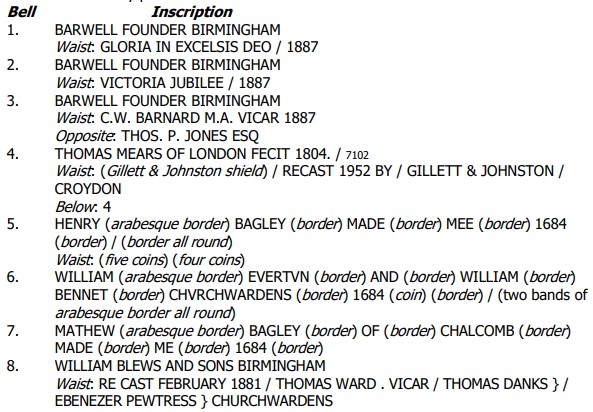
Photo Gallery |
|
 |
 |
| The Church Following the Fire in 1913 |
The Interior |