
St Mary the Virgin 6: 10-1-2 in G
| Grid Reference | 139/163711 | 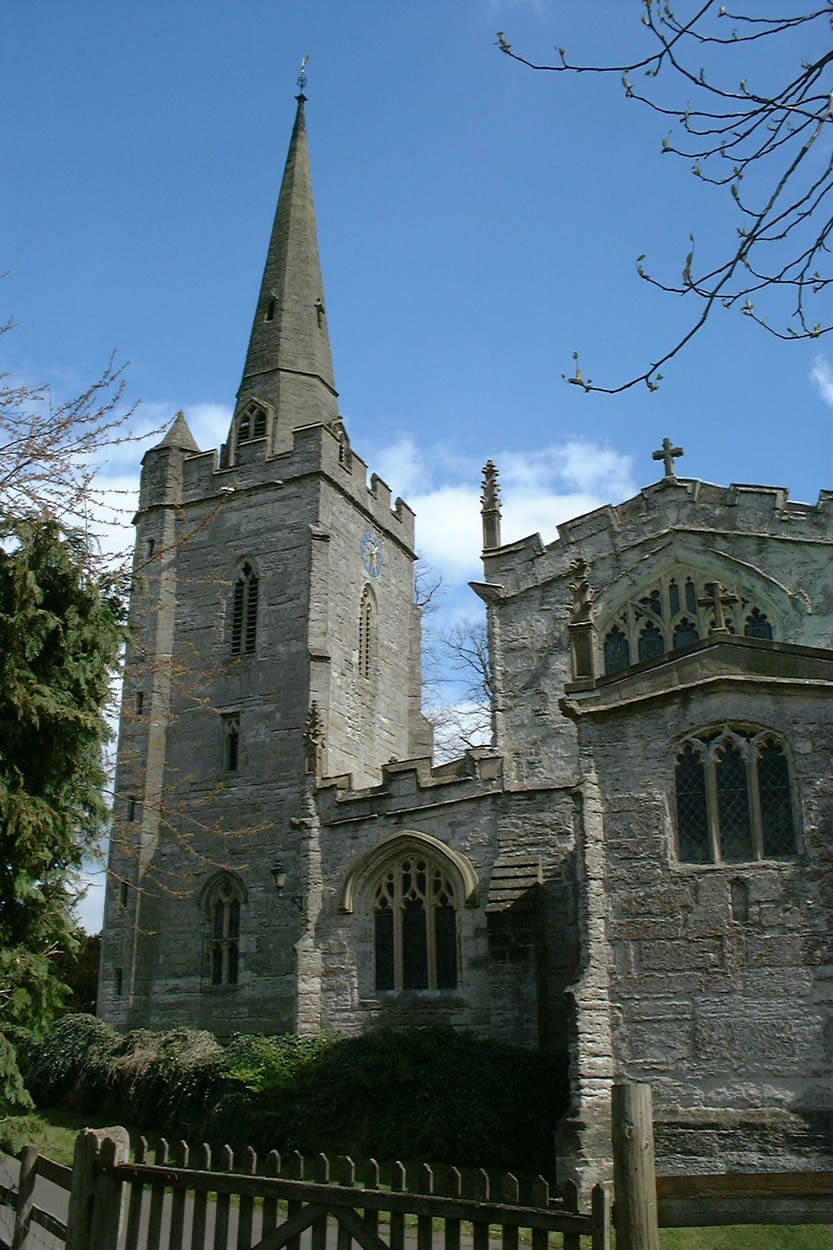 |
| Postcode | B94 5NX | |
| Affiliation | St Martin’s Guild | |
| Peals | Felstead Database | |
| Sunday | 1025-100 | |
| Practice | Thursday 2000-2100 | |
| Guild Website Entry | ||
History
Be careful with your map reading when looking for the church; it in not in the main part of the village. It is situated a good mile to the north, towards Hockley Heath, past the Cricket Club. There is a signpost off the B4439 to the church. Coming from Hockley Heath it is off to the right just after the last turn to Packwood, Knowle being signposted to the left.
The church is a short and broad building consisting of a chancel, north chapel, north and south aisles, south porch, a small western parvise, and a north tower, once detached but now connected up with a vestibule, and with a spire. The nave dates from the early 12th century, when it had no aisles; one window survives over the north arcade. Early in the 13th century a north aisle was added, with an arcade of four bays, inserted in the earlier wall a bay at a time. The south aisle was added about the middle of the century. The chancel was rebuilt and the north chapel added probably at much the same time but their windows were enlarged subsequently.
The tower, detached from the church, was built at the end of the 14th century to the north of the east end of the north aisle. Probably the boundary and roadway west of the churchyard were more or less as now and therefore there was no room for the usual west tower. The spire was probably later.
The whole building was remodelled in the 15th century; the clearstory was raised above the nave, and the aisle walls, except for parts of the south, were rebuilt. The 13th-century chancel arch was reconstructed to make it as wide as possible, as well as higher, the 13th-century material being re-used. The north arcade also shows signs of a later rebuilding.
The west parvise or muniment room, also added in the 15th century, is a rare feature and may indicate that the church then possessed some highly esteemed sacred relic which could be visited by pilgrims. There was just room for it in this position, but its lower story had to be arched for processional purposes. The chancel was repaired in 1860, when the east window, which had been blocked, was renewed. Other restorations were carried out in 1872–3 and the top of the spire was rebuilt in 1884. The vestibule leading to the tower is modern but it is probable that there was some sort of corridor preceding it.
There is a room on the side of the church under which you can walk to find the tower door and short almost vertical ladder to get to the ringing room.
In 1552 there were four bells and a saunce bell at Lapworth. Of the bells mentioned in the Edwardian Inventory of that year one survived – the present fourth, which was probably cast at Worcester in about 1440 by a founder named Richard le Belyetere. The current third bell was cast by an itinerant founder, Bryan Eldridge who hailed from Chertsey. He cast a number of bells for churches in the county between 1656 and 1658. The fifth bell was cast by Hugh Watts I of Leicester.
The bells were examined by the Rev. H.T. Tilley for his book on Warwickshire bells in February 1876 and again by William Saunders (the Sherbourne manuscript) on 20 July 1891. Tilley noted that the frame has pits for six bells with the “treble hung above the rest”. Saunders provides a slightly more detailed description of the frame and fittings with a plan of the old bellframe and brief notes on the clock. He noted “Ring of 5. Cage good. Treble above.
The frame was arranged on the hollow-square plan with four pits round the walls. These pits housed bells 2-5 with a clockwise rope circle. The treble was hung in the middle of the frame and swung diagonally from north-west to south-east, its rope falling between those of bells 4 and 5. It looks as though the treble pit was slightly raised above the heads of the other pits rather than at a higher level in the tower.
The tower and spire was restored in 1884 and the bells were rehung a few years later by Carr of Smethwick – who stated in “Campanology” on 9th December 1896 that they were about to carry out this work.
The current cast iron frame and fittings were provided by Taylors in 1963, at which time the treble (previously 4-3-8) and tenor (previously 10-0-3) were recast and a new treble added to make the ring up to six. Both recast bells had been originally cast by William Mears of Whitechapel in 1786. They recast the old tenor and added a new treble at this time.
The following appeared in The Ringing World of April 19th 1963, “The five bells at Lapworth, Warwickshire, have been rehung and a treble added. The bells are to be dedicated on Sunday, April 28th, at 6 p.m. Evensong. There will be ringing after the service.” The first peal on the bells was rung shortly afterwards:

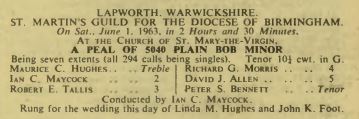
Prior to the 1963 restoration the then five bells were hung in an old wooden frame of “hollow square” design with four pits around the walls, with the treble hung in the middle of the frame, swinging diagonally north-west to south east, with fittings dating from an c.1897 restoration by Charles Carr of Smethwick. The new bells were cast without canons, but the old ones retain their canons. The three old bells are “listed” and have been quarter turned.
The inscriptions of the then 5 bells were given in Tilley and Walters’ book “Church Bells of Warwickshire” in 1910:

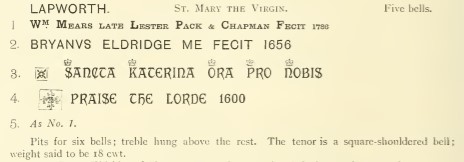
The new treble is inscribed on the waist
| Side A | IN MEMORY OF ALFRED MELSON 1853-1929 |
| Side B | EDWARD FENWICK, RECTOR ROGER WATKINS CHURCHWARDENS NOEL BAMFORD 1963 |
Both recast bells have their old inscriptions and the date and Taylors mark and also:
| THIS BELL RECAST AND THE PEAL REHUNG BY PARISHIONERS AND THEIR FRIENDS 1963 * * * (rest same as treble) |
There is some parking on the road by the church.
Details of the Bells
1 John Taylor & Co, Loughborough 1963 3-3-20 26.00″ 1305.0Hz (E-18c)
2 John Taylor & Co, Loughborough 1963 4-0-10 27.50″ 1163.0Hz (D-17c)
3 Bryan Eldridge II, Coventry 1656 5-0-02 30.00″ 1036.0Hz (C-17c)
4 Worcester foundry, c1440 6-1-15 32.25″ 978.0Hz (B-17c)
5 Hugh Watts I, Leicester 1600 7-2-06 35.00″ 871.0Hz (A-18c)
6 John Taylor & Co, Loughborough 1963 10-1-02 38.625″ 777.0Hz (G-17c)
Photo Gallery |
||
 |
 |
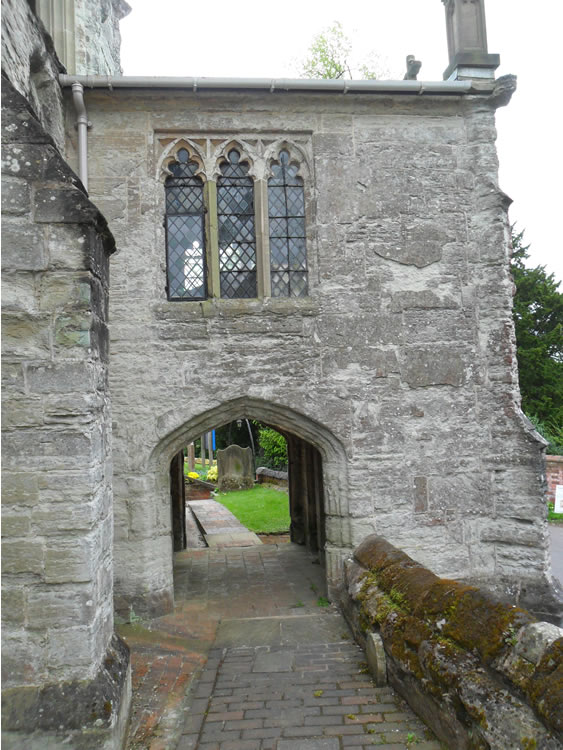 |
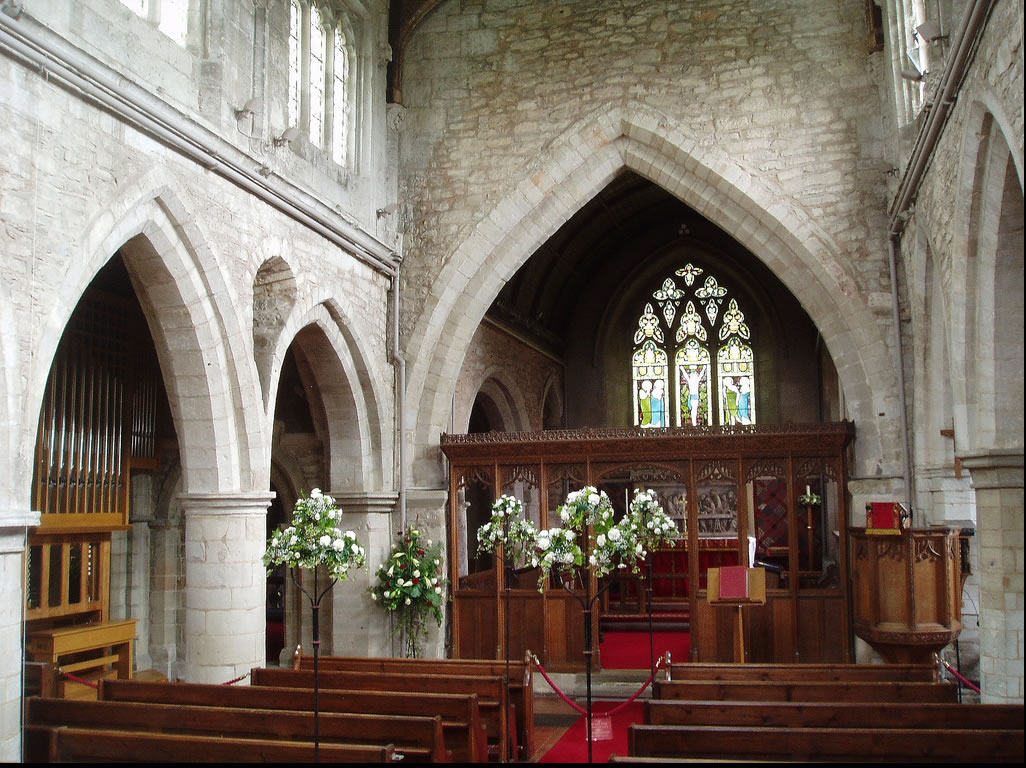
| The Church – Looking East | The Church – Looking West | The Priest’s Room. One staircase to go up and another to come down! |