
All Saints 6: 11-2-14 in F#
| Grid Reference | 140/287008 |  |
| Postcode | CV9 3DP | |
| Affiliation | St Martin’s Guild | |
| Peals | Felstead Database | |
| Sunday | By Arrangement | |
| Practice | By Arrangement | |
| Guild Website Entry | ||
History
The remains of thick walls east of the arcades indicate a 12th-century origin of the nave, but no details of this period survive. The chancel, which leans to the south of the nave-axis, was rebuilt and enlarged early in the 13th century. A clearstory was added to the chancel in the 16th century. The north aisle and arcade date from about 1260. Probably the original windows were narrow lancets and were replaced by the present late-14th-century windows, or else the walls were entirely rebuilt, the 13th-century doorway being reset.
The south aisle and arcade and probably also the chancel arch were built about 1320 and the aisle was carried eastward beyond the chancel arch to form a chantry chapel (the Chetwynd chapel). The clearstory to the nave may be a little earlier than that of the chancel. The west tower and south porch are modern; the date 1820 is on the latter. The old tower being thought to be in a dangerous condition, a new tower was built in 1845-7. The cost to take down the bells from the old tower and then reinstall them in the new one was £33/2/5½.
In 1552 there were three bells and a small call bell – iij belles and a saunce bell – here. Of these, two were recast in the second half of the sixteenth century by members of the Newcombe family of Leicester, perhaps in the 1570’s or 1580’s. The fourth bell survives, but the third (diameter 31” and weighing 5-2 23) was recast a semitone lower when the ring was remodelled in 1906. When the ring was increased to 5 bells is not certain, but, based on the evidence of the frame, which was built for 5 bells, it seems possible that there were 5 bells here by 1640.
The the ring of 5 bells at this tower were augmented to six by the addition of a tenor in 1906, the third, a Newcombe bell like the fourth, being recast a semitone lower at the same time. The canons were removed from the old four bells and they have been turned and re-tuned. The “new” bells remain unturned. The fittings are by Taylor 1906, but tenor was rehung on ball bearings in about 1970. The second has a modern metal plate inside the crown, indicating that a fault was found with this bell during the 1906 restoration. The fittings consist of cast iron headstocks, fixed steel gudgeons, plain bearings (apart from the tenor) and traditional type wheels, stays and sliders.
The 17th century frame is “listed” as being historically important. it is “massive” and, being older than the tower, it was re-erected in its present place in 1845. All the bells, except the fourth, swing north to south.
In order to fit the new tenor into the existing frame in 1906, Taylors created wo pits – now containing bells 5 and 6 swinging mouth-to-mouth and north south – in the old tenor pit and in the western part of the transverse pit. All the bells except the fourth now swing North to South. Taylors strengthened the frame by inserting iron tie-rods and cast-iron angle plates
W.W. Worthington, the Burton brewer, rang in the first peal on the bells in 1910 and gave the “Caspar” peal board. the details of the first peal are:


The tenor has long been quoted as being in G, but is actually F#-28c. The inscriptions are given by Tilley and Walters in their book, “The Church Bells of Warwickshire” (giving a wrong date for the casting of the treble):
 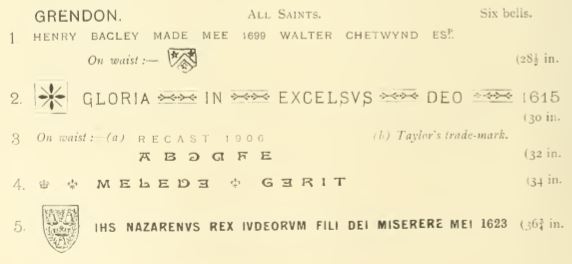 |
  |
Details of the Bells
1 Henry Bagley, Ecton 1692 4-3-07 28.50″ 1221.0Hz (D#-33c)
2 William Clibury, Wellington 1615 4-3-10 30.125″ 1091.0Hz (C#-28c)
3 John Taylor & Co, Loughborough 1906 6-0-04 32.00″ 971.0Hz (B-30c)
4 Thomas Newcombe II, Leicester c1570 6-3-08 34.00″ 916.0Hz (A#-31c)
5 Hugh Watts II, Leicester 1623 8-1-23 36.875″ 820.0Hz (G#-22c)
6 John Taylor & Co, Loughborough 1906 11-2-14 41.18″ 728.0Hz (F#-28c)
Photo Gallery |
|
 |
 |
| The Church – Looking East | The Church – Looking West |