
St Mary the Virgin 8: 3-0-25 in Eb Anticlockwise
| Grid Reference | 150/121672 | 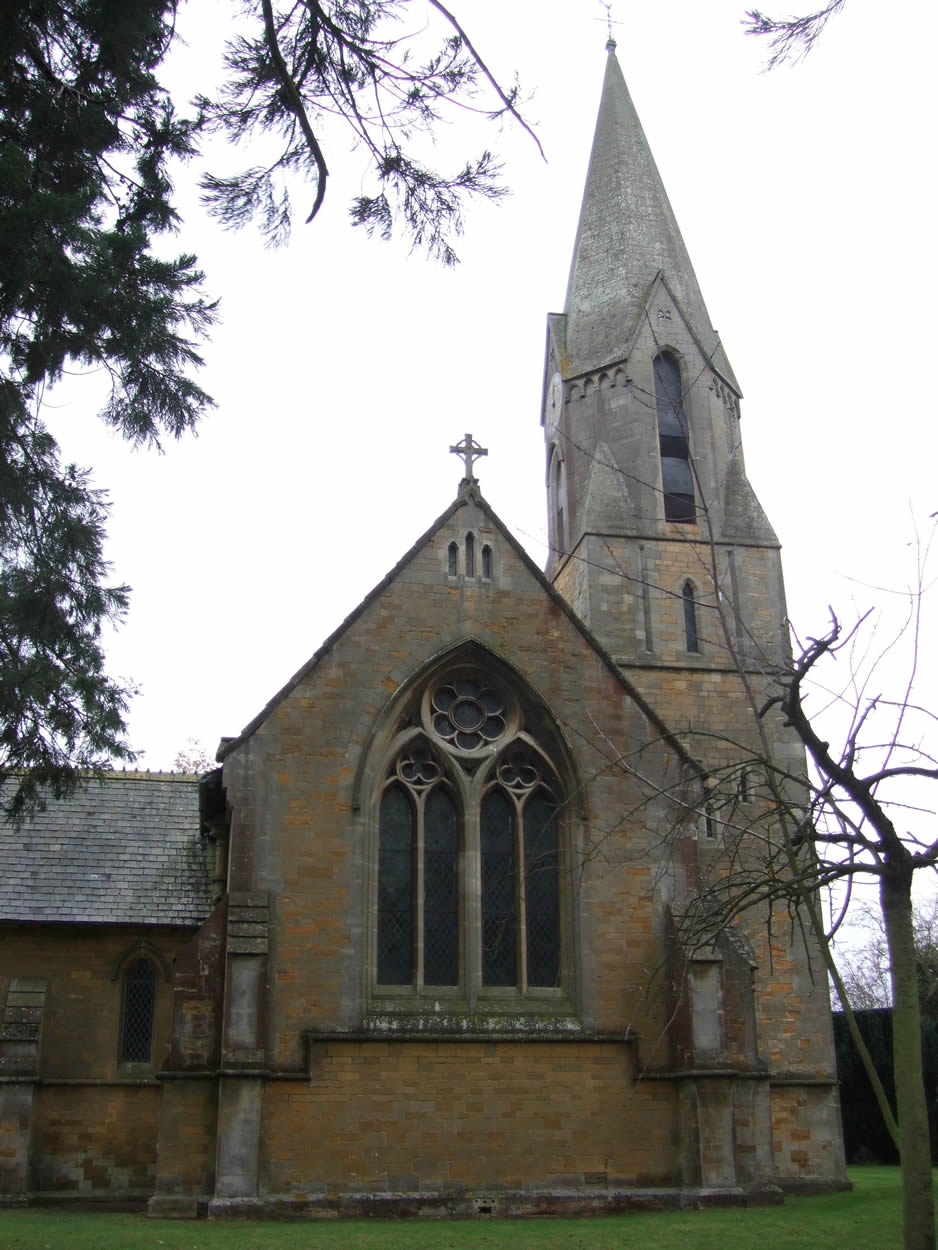 |
| Postcode | B95 5PG | |
| Affiliation | Coventry DG | |
| Peals | Felstead Database | |
| Sunday | 5-15-6.00pm (2nd Check) | |
| Practice | 7.00-8.30pm (4th Check) | |
| Other Information | Benefice Website | |
| Guild Website Entry | ||
History Of The Bells
A small ring of bells in a very small tower! They are by Warners, and are a little bit of an acquired taste, some bells’ tuning not being the most accurate and some bells double clapper. They are certainly characterful and not to be forgotten, once rung. The ring could also be chimed from a keyboard in the ringing room at the outset.
The bells were cast for the new church in the village which was built in 1874-5, the architect being John Pollard Seddon of London. It was built in memory of William and Mary Newton of Barrells Part, at the expense of their sons and daughters. This donation included the ring of bells. Note that the tower is so small that the louvres have to be “bowed” in order that there is enough room for these bells to swing. They were installed under the supervision of William Martin who was responsible for the erection of the church. James E Hawkes was killed whilst helping to install the bells, falling some 38 feet down the scaffolding.
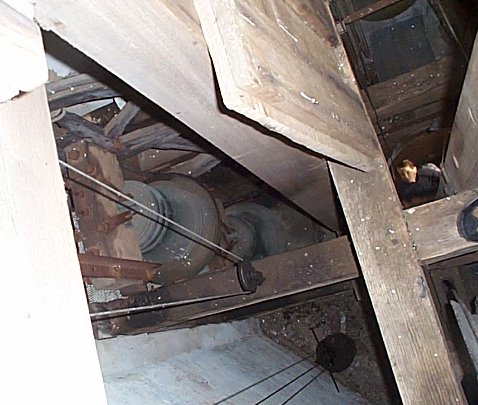
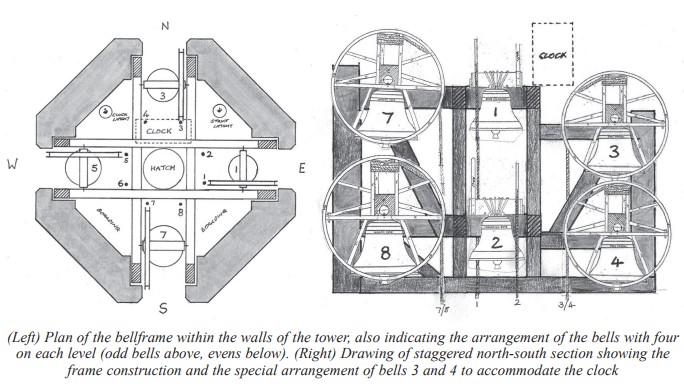
The frame is ingenious. It is a “double decker” Maltese Cross in shape, with the bells in pairs at the end of the arms, odd bells over even bells. There is a “hole” in the middle of the frame directly above the trapdoor to allow for access.
The one word inscriptions on bells 7-1 make up the phrase: “Come let us make a joyful noise”. the tenor is inscribed “CAST BY JOHN WARNER AND SONS LONDON 1874” and on its waist
EN (shield) MRN
In the shield are three battle-axes, the arms of the Newton family, of Barrells. It is lozenge shaped to indicate female ownership of the property. The initials are of Elizabeth and Mary Rosa Newton, the donors.
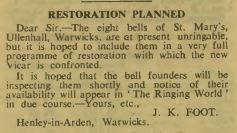
There was some hope that the then unringable bells would be thoroughly rehung in 1962, this appearing in The Ringing World on May 18th that year:

The bells had obviously not been rung for some time up until 1977 – when this article appeared in The Ringing World of August 5th that year.
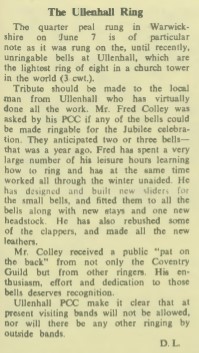
Fred Colley did most of the work himself. Fred’s account of the work that he did can be found here. From this report we can see that the treble was unhung at that time and Fred needed to do a considerable amount of work to get the bells into a ringable state.
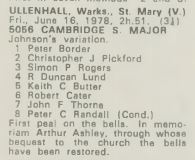
Details of the quarter peal are:


The first peal on the bells was rung in 1978, one of only four, so far rung, the last being in 2001.

The fittings consist of elm heastocks (all new) stock hoops, strap gudgeons, plain bearings, wheels, clappers and pullies. Warners had originally fitted metal spur stays and sliders, but these had caused damage to the headstocks. New stays and sliders of a modified design were fitted when the bells were overhauled.
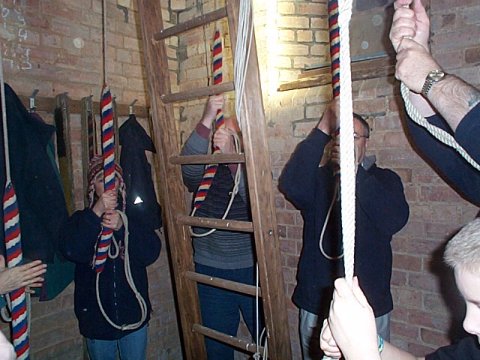
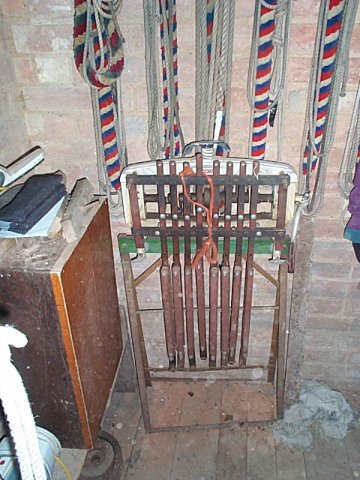
They are loud inside, (ensure that the traps are in place as the clock winder sometimes leaves them out). They handle reasonably well for their weight but the front two or three are very tricky and the inexperienced may find them a little too light and anticlockwise! The ladder in the middle of the rope circle sometimes needs moving more to a more vertical position in order to ring the two trebles. Don’t try to ring them too fast, try about 3 hours peal speed. Note the “Acme” brand mangle via which all 8 bells can be chimed.
The church is signposted to the west off the road through the village. Yes it is the church with a spire that you see quite quickly! Don’t think, “That never has a ring of bells in it”. It does! Park in front of the church and enter via the door round the back of the tower, i.e. at the base of the tower on the right of the photograph.
Details of the Bells
1 John Warner, London 1874 1¼cwt 17.50″ 2467.6Hz (Eb-15c)
2 John Warner, London 1874 1½cwt 17.625″ 2193.8Hz (D-81c)
3 John Warner, London 1874 1¾cwt 19.00″ 1822.8Hz (C-89c)
4 John Warner, London 1874 2cwt 20.00″ 1804.0Hz (Bb+57c)
5 John Warner, London 1874 2¼cwt 21.00″ 1624.4Hz (Ab-39c)
6 John Warner, London 1874 2½cwt 21.625″ 1492.2Hz (G+86c)
7 John Warner, London 1874 2¾cwt 23.75″ 1351.8Hz (F-57c)
8 John Warner, London 1874 3-0-25 25.00″ 1219.6Hz (Eb-35c)
Bell Tuning
These pairs should be exactly one tone apart:-
2 & 3 together
3 & 4 together
These should sound as “true” rings:
The Front Four
The Back 5
All Eight Together
The bell tuning expert Bill Hibbert notes,
The third’s nominal is two semitones flat, making it almost the same note as the fourth.
The second is a semitone flat.
The third is so flat that it’s prime is lower than that of the fourth
Primes are horribly flat everywhere, especially round the front
Hums, bizarrely, are pretty near the double octave, especially in the first, second, fourth and fifth.
His full analysis is here as an Excel file.
Photo Gallery |
|
 |
 |
| Ringing around the ladder. The rope in the foreground obscures the treble ringer. |
The Third Above the Fourth |
 |
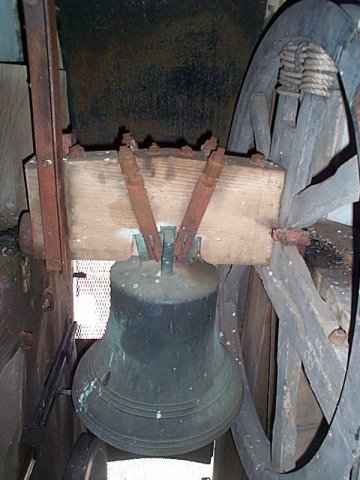 |
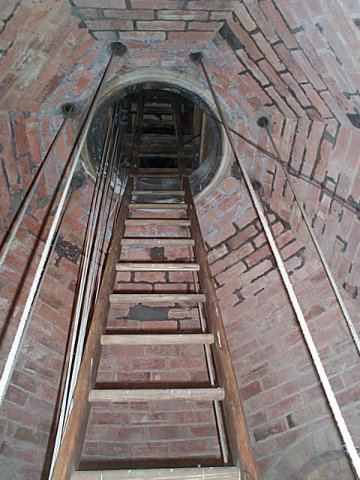
| The Way Up to the Bells | The Fifth. Note the Metal Stay! |
 |
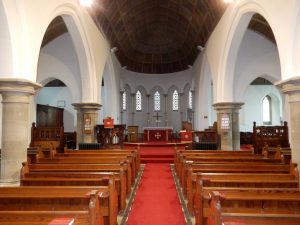 |
| The Acme Mangle | The Church – Looking East |
 |
|
| Chris Pickford’s Frame Drawing | |