
St Giles 8: 8-1-8 in Ab
| Grid Reference | 139/148843 |  |
| Postcode | B26 3TU | |
|
Recording (as a 6) |
||
| Affiliation | St Martin’s Guild | |
| Peals | Felstead Database | |
| Sunday | 0930-1000 | |
| Practice | Friday 2000-2100 | |
| Other Information | Church Website | |
| Guild Website Entry | ||
History
Sheldon was once a small village in the Warwickshire countryside to the east of Birmingham. The church is first mentioned in 1291 but believed to be of twelfth-century origin or older. The nave, with its fine fourteenth-century timber roof, dates from around 1330. The embattled west tower was erected in 1461, as recorded in an inscription in the base of the tower which reads
“In [the] year of our Lord MoCCCLXI ye stepel was begon ye masson had thr[ee] and forti pond vjs and viijd for makyng of the st’pel”.
The top of the tower was repaired by John Cheshire in 1821. The main Victorian restoration of the church took place in 1866-7. Slater and Carpenter were the architects, and the church was reopened after restoration on 31 October 1867.
The inventory of 1552 shows that there were four bells here. The then second, now fifth, bell of c1380-1400 predates the tower, which was built in 1461. The third bell, now the tenor, was recast by Thomas Newcombe of Leicester in c.1580. The tenor bell (no longer at the church) was recast by john Martin in 1650, weighing 9-3-13.
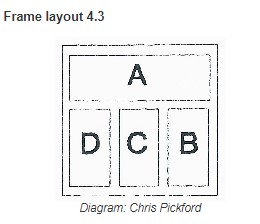
The frame dates from about 1600, though it uses some earlier timbers. There were three parallel pits for bells 1, 2 & 3, with the tenor hung in the transverse pit, which seems to have been added later.
In 1723 Joseph Smith of Edgbaston recast the treble and carried out repairs to the fittings of the four bells, at a cost of £10/2/0. Work was also carried out on the bells in 1754, repairs to the ironwork, gudgeons and brasses. The wheels were replaced in 1762 and one again replaced in 1790. In 1805 Mr. Hunt was paid £25.8.3½. “for Repairing the Bells”
In 1911 the bells were quarter turned and rehung with new fittings by James Barwell of Birmingham. Some of the Barwell fittings – including wooden stocks, plate gudgeons, plain bearings in iron housings with hinged lids, wheels, stays and sliders – remain in the belfry. Barwell fitted reversing blocks for the clappers of bells 1, 3 and 4 and fitted an independent staple in the second. The church accounts include the following entry relating to the work: “Barwell Ltd., for rehanging and Quarter Turning Bells, also relaying Floors in Ringing Chamber and Bell Chamber £65.13.6.”
They were rehung on ball bearings locally in 1978.
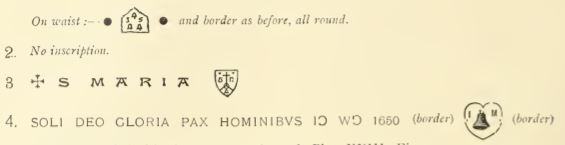
Tilley and Walters in their book, “The Church Bells of Warwickshire”, give the inscriptions of the bells that remained as they were until the 1990s restorations

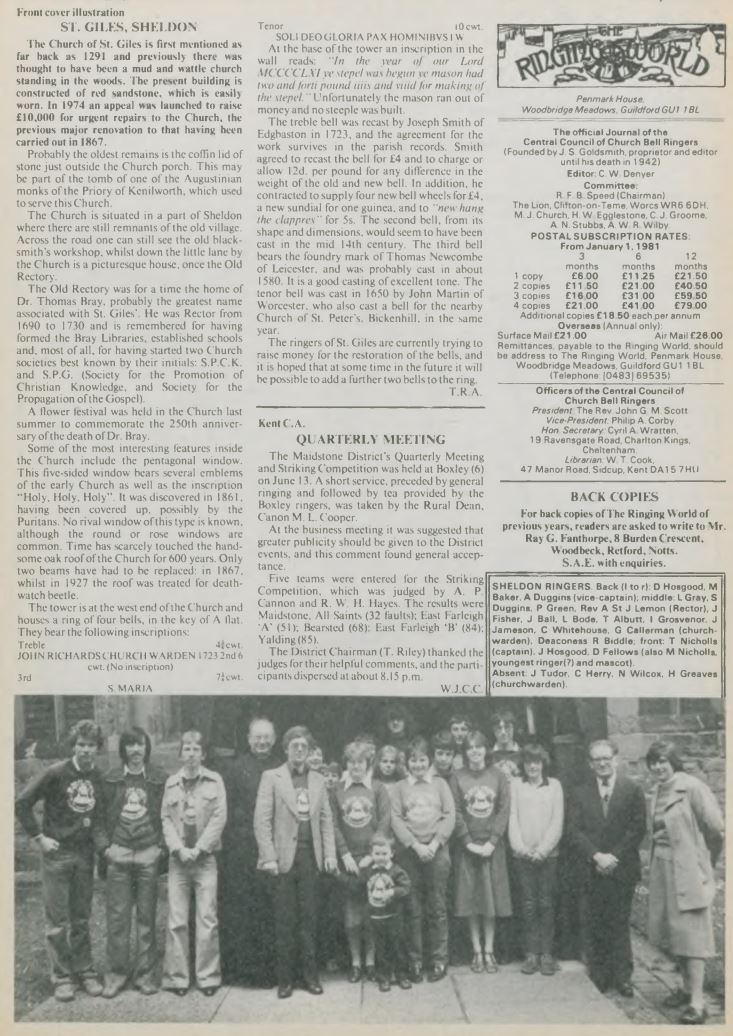
The church was the “Front Page Tower” in The Ringing World of July 10th 1981, in which the hope to add two trebles is mentioned.

After a lengthy process, when the restoration plans changed from one scheme to another, the bells were eventually re-modelled as a ring of six. The old tenor (John Martin 1650) was sold for use as a single chiming bell at Hawes (North Yorkshire).
Two new bells were cast in 1992 to make five, and later a redundant bell from St. Gregory the Great, Small Heath, was added to make six. This bell was one of the last bells cast by Charles Carr of Smethwick.
The bells were hang in a cast iron lowside frame for six bells made by John Taylor & Co in 1986-7 and installed by Arthur Berry of Malvern, though the frame was kept in storage until 1992. at this point the three remaining old bells were hung in the existing frame and the two newly cast ones in the new frame.
The three old bells were subsequently provided with new fittings and moved to their pits in the new frame. This was completed early in 1997. The treble was added to complete the ring of six in April 1998. The ring was further augmented to 8 in 2010.
The back three bells retain their canons and have been quarter turned, the others being cast with flat tops. The new trebles were cast and tuned some time before the hanging of them was completed in November 2010.
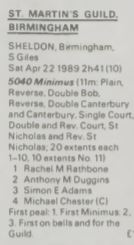
The bells were first peals as a ring of 4. The details are:

The ring of 5 was not pealed, the next peal being on the ring of 6:

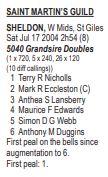
To date, the ring of 8 has not been pealed.
The interesting old wooden frame remains in situ above the ring.
Details of the Bells
1 Taylor, Eayre & Smith Ltd, Loughborough 2008 3-0-24 23.50″ 1700.0Hz (Ab+40c)
2 Taylor, Eayre & Smith Ltd, Loughborough 2007 3-1-14 24.00″ 1604.0Hz (G+39c)
3 Charles Carr, Smethwick 1926 3-1-05 25.125″ 1428.0Hz (F+38c)
4 John Taylor & Co, Loughborough 1992 3-2-12 25.875″ 1268.0Hz (Eb+32c)
5 John Taylor & Co, Loughborough 1992 4-0-08 27.50″ 1133.0hz (Db+37c)
6 Joseph Smith, Edgbaston 1732 4-2-10 29.375″ 1070.0Hz (C+38c)
7 Unknown (uninscribed), c1350 5-1-22 32.125″ 953.0Hz (Bb+38c)
8 Thomas Newcombe II, Leicester c1580 8-1-08 36.50″ 848.0Hz (Ab+36c)
Photo Gallery |
|
 |
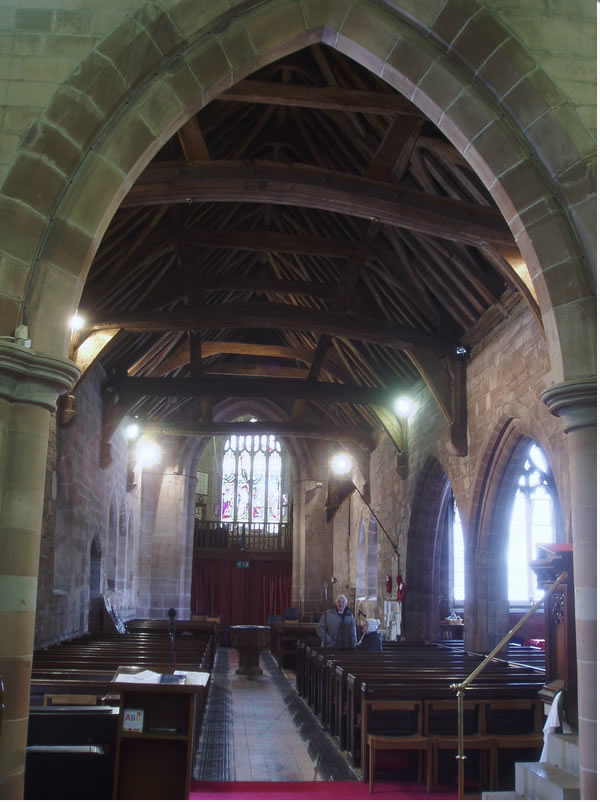 |
| The Church – Looking East | The Church – Looking West |
 |
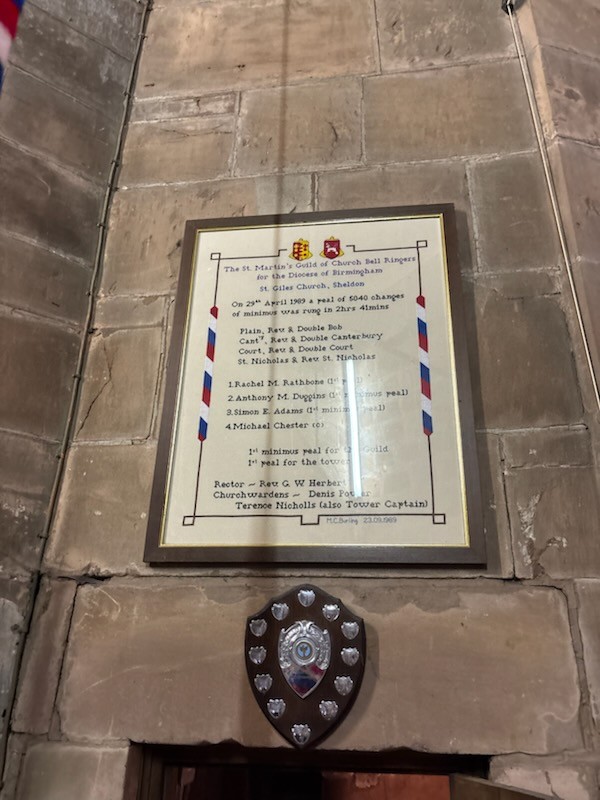 |
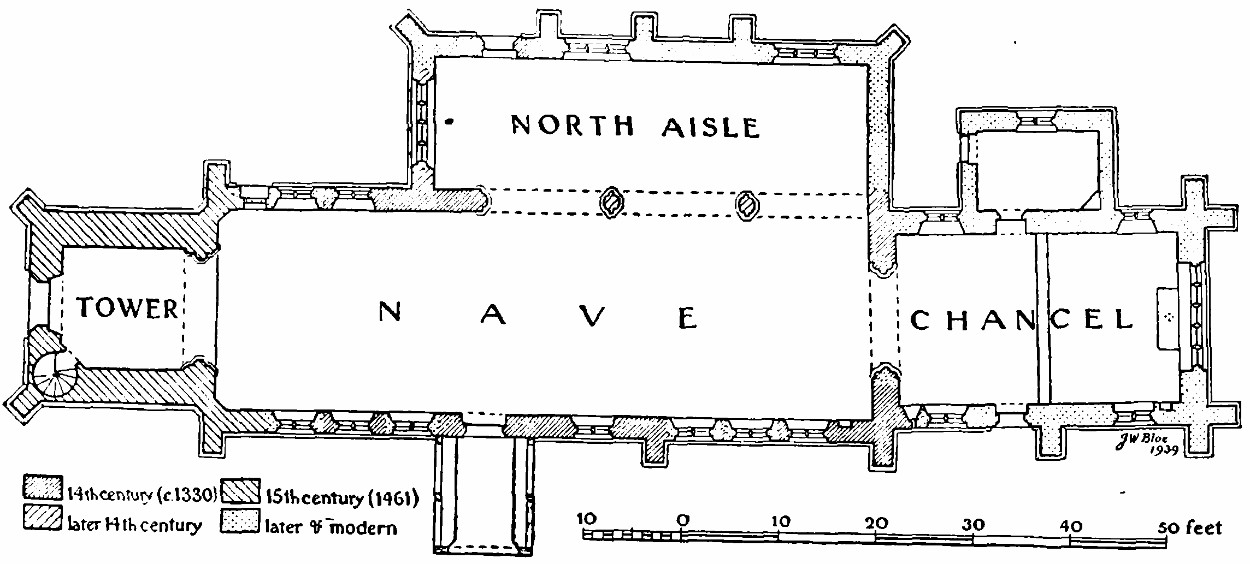
| Plan of the Church | The embroidered pealboard for the first peal on the Bells, rung when they were a ring of 4. |