
St Agnes 2: 10-2-22 in Ab
| Grid Reference | 151/198522 | 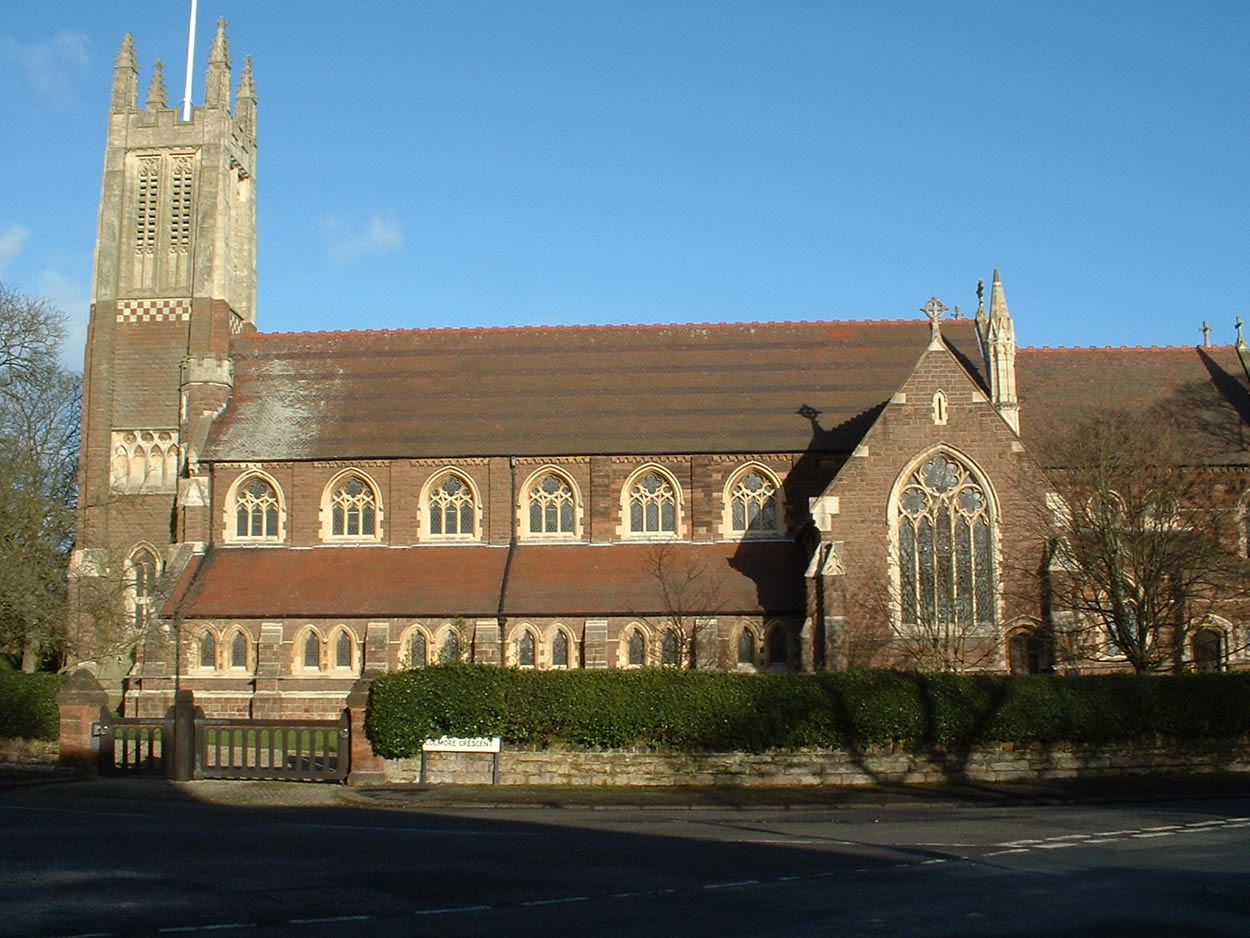 |
| Postcode | B13 9SJ | |
| Other Information | Church Website |
History
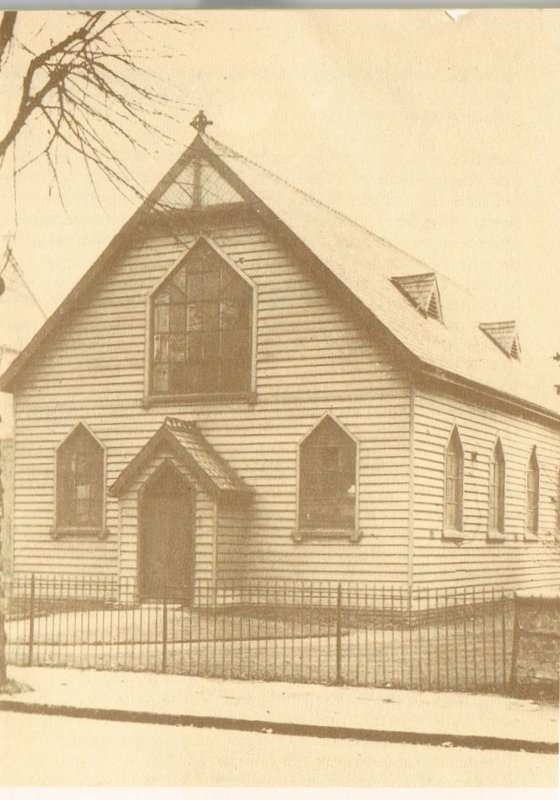
On Thursday, October 3rd 1878 a meeting was called to discuss the increasing of the seating for the Church of England in this area. Plans to extend St Mary’s (q.v.) did not find favour and instead it was decided to build a wooden church. This was built at a cost of £635 and was opened in April 1879. It was to be used for services for just over five years and cost some £635, including all the fittings. When it was sold, the wooden church went to the new parish of St. Mary and St. Ambrose on Pershore Road (q.v.), where it still stands, now acting as the church hall.
An architectural competition was organized amongst seven Birmingham architects in the summer of 1882 for designs for the new church. The anonymously submitted designs were considered at great length by the committee, and the three best were displayed for public viewing at the National Schools in November. The winning architect proved to be William Davis, of Colmore Row. Although detailed plans were now available, money was still not forthcoming on a sufficient scale and, with only £2000 in the bank, it was with considerable trepidation and heart-searching that the Committee sanctioned a start on the building in July 1883. It was decided that the foundations of the whole building should be built but that, to begin with, only the eastern half of Davis’s substantial church should be completed. William Bloore’s tender of £4045 for the building work was accepted and a Masonic foundation stone laying ceremony decided upon.
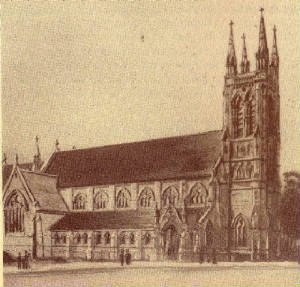
At the opening of the church on October 29th 1884 the parts of the church which were completed included the chancel, the north and south transepts and the first two bays of the nave and aisles. The organ chamber on the north side of the chancel and a small vestry on the south side had been built. the 2nd phase of the building was completed in 1893 and this included the lower part of the tower. The church was offered £1000 by “CARADOC” in October 1928 offering to donate £1,000 towards the completion of the tower. Quotes were obtained for this, including/excluding a spire. £4,500/£3,300. The church were unable to find the extra funds and decided not to go ahead. However the former parishioner CARADOC offered to pay £3,000 if the job could be finished for this amount and the tower was completed in 1931/2 (Taken from “History of Moseley” – no longer on the church website)
The two bells – the treble and tenor of five – are hung low down in the section of the tower completed in 1893. Originally, they were hung in the unfinished belfry for chiming at a total cost of £318/9/3.
The tower was eventually finished in 1931-2 thanks to a gift of £3000 from an anonymous donor who originally identified himself as “Caradoc”. After his death in 1942, the donor was identified as John George Hammond of Moseley. The architect for the completion of the tower was C.E. Bateman and the contract for the work was secured by Collins and Godfrey of Tewkesbury. When the work was completed, the bells were rehung in a new cast iron frame in their present position in the heightened tower.
They have standard Taylor ringing fittings including cast iron stocks, ball bearings and Hastings stays in a cast iron H frame, all provided and installed by Taylors in 1932. The frame is set out for eight bells on two levels and the girders are in place, but only the frame-sides needed for the two bells were actually installed.
The Taylor invoice for the work, 7 May 1932, shows that the some of the work was undertaken by the building contractors. It was for “Rehanging the two bells of St.Agnes Church, Moseley, according to estimate 12 May 1931”, including providing four frame castings and four end pieces. There is a note “The contractor supplied & fixed the steel frame girders. We drilled them” and another “The contractor took down & dismantled existing fittings”. The charge for Taylors’ work was £78. (CJP)
The louvres are blocked up half-way for sound control and there is a sound lantern on top of the tower
These bells are believed to be ringable.
Details Of The Bells
1 John Taylor, Loughborough 1921 3-2-18 1260.0Hz (Eb+21c)
2 John Taylor, Loughborough 1921 10-2-22 842.0Hz (Ab+24c)
Inscriptions
| 1 | 1921 ERECTED IN MEMORY OF HARRIET INSTON BY HER SISTER Opposite: (Taylor’s circular mark) |
| 2 | 1921 ST.AGNES’. MOSELEY * * * ERECTED BY THE PARISHIONERS AND CONGREGATION Opposite: (Taylor’s circular mark) |
Photo Gallery |
|
 |
 |
| The Wooden Church | The Part Built Church |
 |
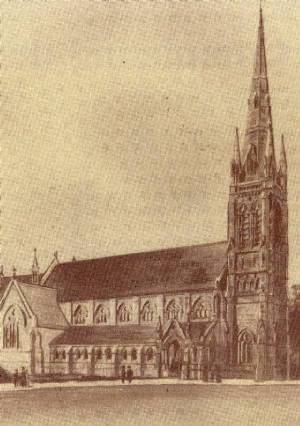 |
| Plan 1 for the Tower | Plan 2 for the Tower |