
SS Mary & Bartholomew 8: 12-0-22 in G
| Grid Reference | 139/203808 | 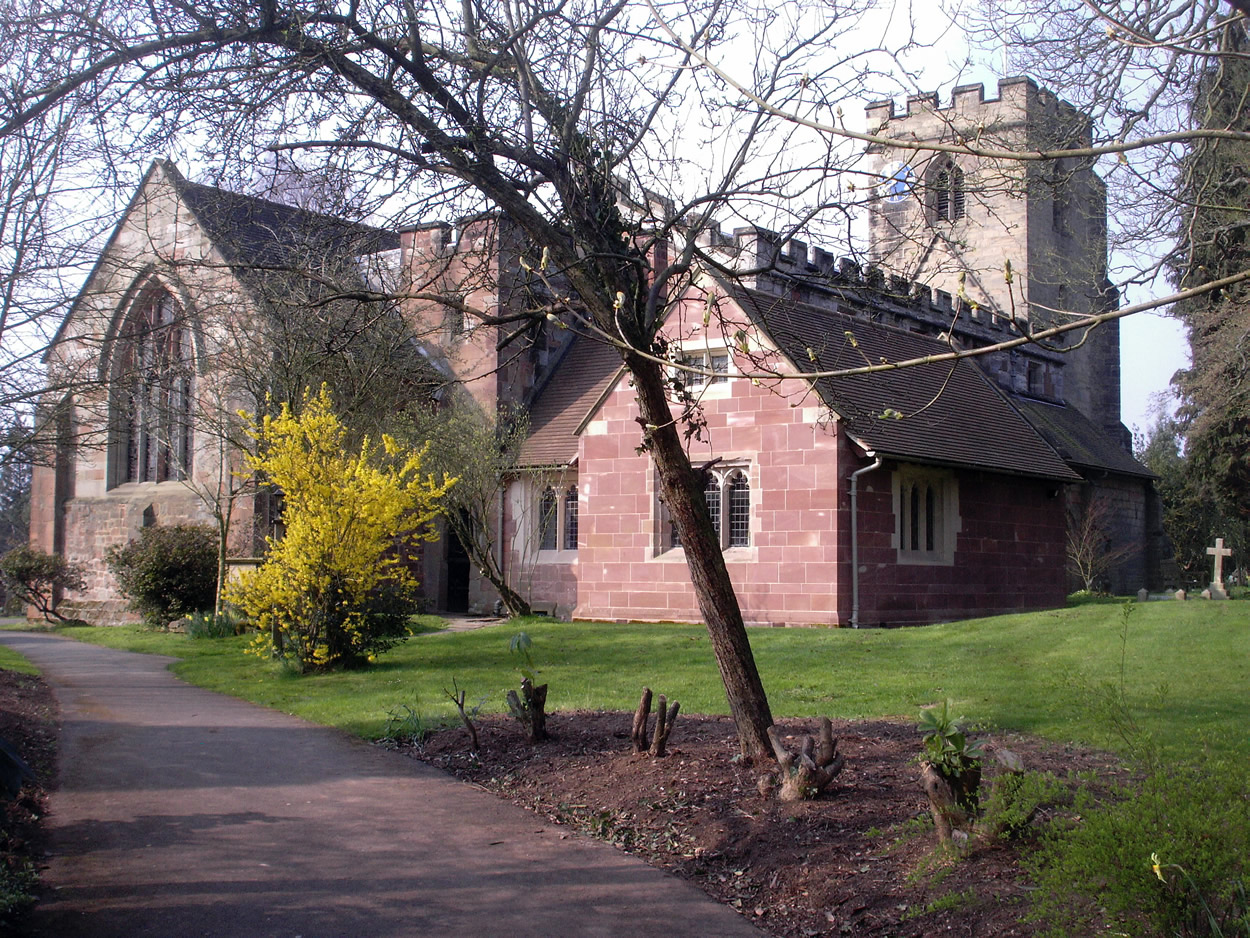 |
| Postcode | B92 0AT | |
| Recording | None Available | |
| Affiliation | St Martin’s Guild | |
| Peals | Felstead Database | |
| Sunday | 1000-1030 | |
| Practice | Monday 2000-2100 | |
| Guild Website Entry | ||
History
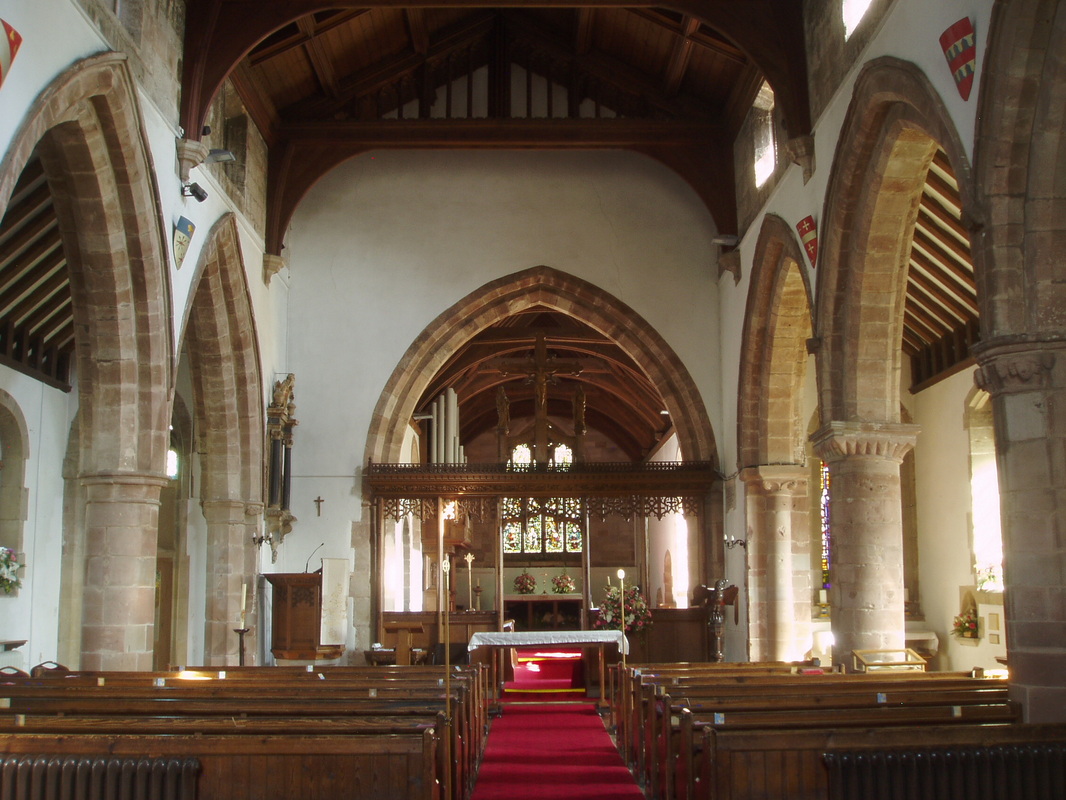
The church of has a chancel, nave with narrow aisles, west tower, south porch, and north vestry. The chancel is of about mid 12th-century date. It is comparatively long and narrow for the period, in a church of this size, and it has an unusual north doorway near the west end; it is possible that it represented the complete church, at least for a short time. The nave, if not coeval, was built soon afterwards and had a late-12th-century south aisle, of which the arcade remains. Possibly the nave was of the same width as the chancel, but was widened to the north about 5 ft (1.5 m). about the middle of the 13th century and a narrow north aisle and arcade added. The chancel arch was widened at the same time to the utmost limits permitted by the width of the chancel. For some reason, probably weakness, the north aisle was rebuilt late in the 14th century on the old foundations of the narrow aisle. This was followed by a similar rebuilding of the south aisle early in the 15th century, again without widening it.
About the same time the west tower was begun, but carried up only a short way, the completion being delayed until late in the century. The last medieval alteration was the building of the clearstory in the 16th century in place of the old steeply pitched roof indicated by the lines on the tower. The tower bore a tall spire “till by the extraordinary violence of lightning and thunder happening on St. Andrew’s Day, in the night, in the year 1643, it was cloven, and fell to the ground: at which time the whole fabrick, with the tower, were torn in divers places.” The south porch and north vestry are modern, and various repairs and restorations have been executed to other parts. The chancel was rebuilt in 1879 with the old material overseen by the architect W. E. Nesfield. All the roofs are modern.
There were 3 bells here by 1552, but when Henry Oldfield recast the two tenor bells at Walsall in 1629 there were now four, 13-1-3. The treble was recast by Hugh Watts of Leicester in 1634, weighing 7-3-18. The bells seem to have been destroyed when the spire was hit by lightening on St Andrew’s Day 1643. The tower and the body of the church was severely damage. The spire was never rebuilt, but some work was done to the bells by 1654, possibly by John Martin of Worcester.
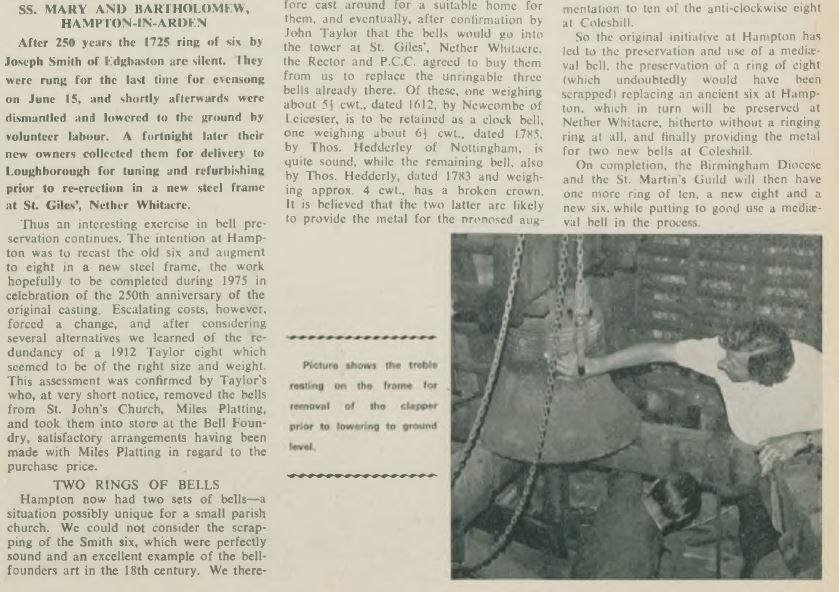
The bells were recast into ring of six by Joseph Smith of Edgbaston, 1725, being later rehung in a composite frame by Barwell of Birmingham in 1907 and then subsequently rehung on ball bearings by Taylors. These bells were transferred in 1976-7, to Nether Whitacre.
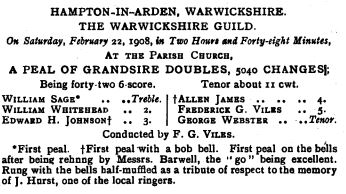
The first peal on the ring of 6 was rung in 1908:

The bells now here were originally cast for St. John’s, Miles Platting, Manchester, where they replaced an earlier ring of six, tenor 11-1-10, that had been supplied by Warners in 1872. That church was built at the expense of Sir Benjamin Haywood and was in Italian Romanesque style with a north west campanile. It was very “high” church. There were said to be problems with tower oscillation and the tower was strengthened in 1911.
The recasting in 1912 was paid for by Sir A.P. Heywood, the first President of the “Central Council” and Sir Benjamin’s grandson. . The bells were cast flat topped and tuned on the true-harmonic system and hung in a cast iron frame.
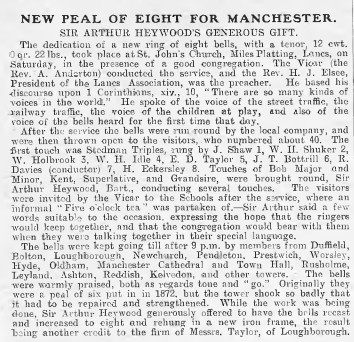
Their dedication was reported in The Ringing World of April 19th 1912:
This church was reported in 1967 to be suffering from settlement and its demolition authorised in 1971; the last service being on Easter Sunday 1973. It was replaced by a modern church without a tower.
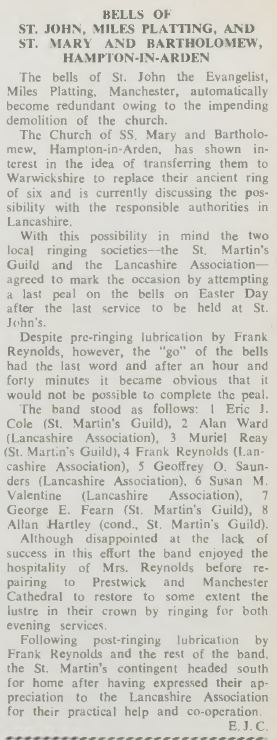
The bells became available for transfer after the demolition was authorised and the Miles Platting bells were last rung in 1973, when a peal after the final service failed.
The lost peal was reported in The Ringing World of May 11th 1973.
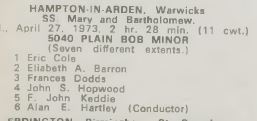
 One further peal was rung at Hampton before the removal of the ring of 6:
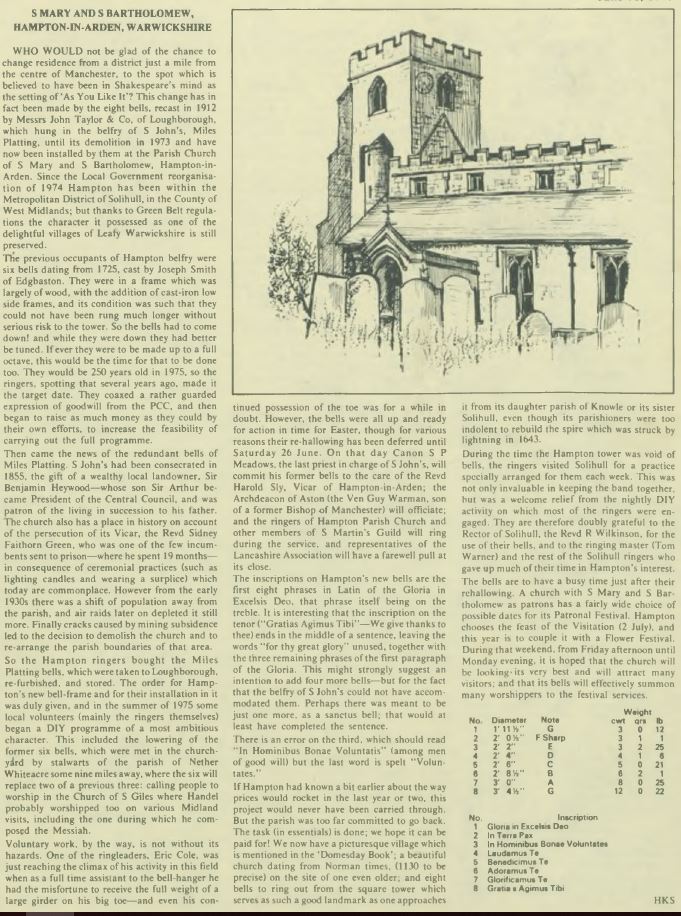
The Miles Platting bells were formally acquired for Hampton in 1975-6. They are hung in a cast iron frame incorporating H castings from the Miles Platting frame, with new steelwork. The fittings are also mainly from Miles Platting, but Taylors replaced the former (steel) headstocks of the two trebles and rehung the whole ring on ball bearings when they were transferred here in 1975-6.
Some of the Barwell framesides were used in the hanging of the two new trebles at Aldridge, West Midlands, in 1977.
The removal of the ring of 6 was shown in The Ringing World of September 12th 1975:

The installation of the ring of 8 from Miles Platting was reported in the edition of June 18th 1976:
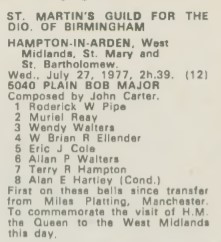
The first peal on the bells in this tower was rung the following year:

Details of the Bells
1 John Taylor & Co, Loughborough 1912 3-0-12 23.625″ 1546.0Hz (G-24c)
2 John Taylor & Co, Loughborough 1912 3-1-01 24.375″ 1449.0Hz (F#-37c)
3 John Taylor & Co, Loughborough 1912 3-2-25 26.00″ 1290.0Hz (E-38c)
4 John Taylor & Co, Loughborough 1912 4-1-06 28.00″ 1159.0Hz (D-23c)
5 John Taylor & Co, Loughborough 1912 5-0-21 30.50″ 1030.0Hz (C-28c)
6 John Taylor & Co, Loughborough 1912 6-2-01 32.50″ 967.0Hz (B-37c)
7 John Taylor & Co, Loughborough 1912 8-0-25 36.125″ 869.0Hz (A-22c)
8 John Taylor & Co, Loughborough 1912 12-0-22 40.375″ 771.5Hz (G-28c)
Inscriptions
All the bells have the Taylor circular trade mark above “* 1912 *” on their waists. They are inscribed on their shoulders:
- GLORIA IN EXCELSIS DEO
- IN TERRA PAX
- IN HOMINIBUS BONAE VOLUNTATES
- LAUDAMUS TE
- BENEDICIMUS TE
- ADORAMUS TE
- GLORIFICAMUS TE
- GRATIAS AGIMUS TIBI
Details of the Ring of 6
1 Joseph Smith, Edgbaston 1725 4-3-01 28.00″ 1334.0Hz (E-20c)
2 Joseph Smith, Edgbaston 1725 4-3-13 28.875″ 1202.0Hz (D+40c)
3 Joseph Smith, Edgbaston 1725 5-0-15 30.00″ 1079.0Hz (C+53c)
4 Joseph Smith, Edgbaston 1725 5-3-19 31.625″ 1015.0Hz (B+47c)
5 Joseph Smith, Edgbaston 1725 7-2-22 34.25″ 871.0Hz (A-18c)
6 Joseph Smith, Edgbaston 1725 11-0-12 39.625″ 794.0Hz (G+22c)
Photo Gallery |
|
 |
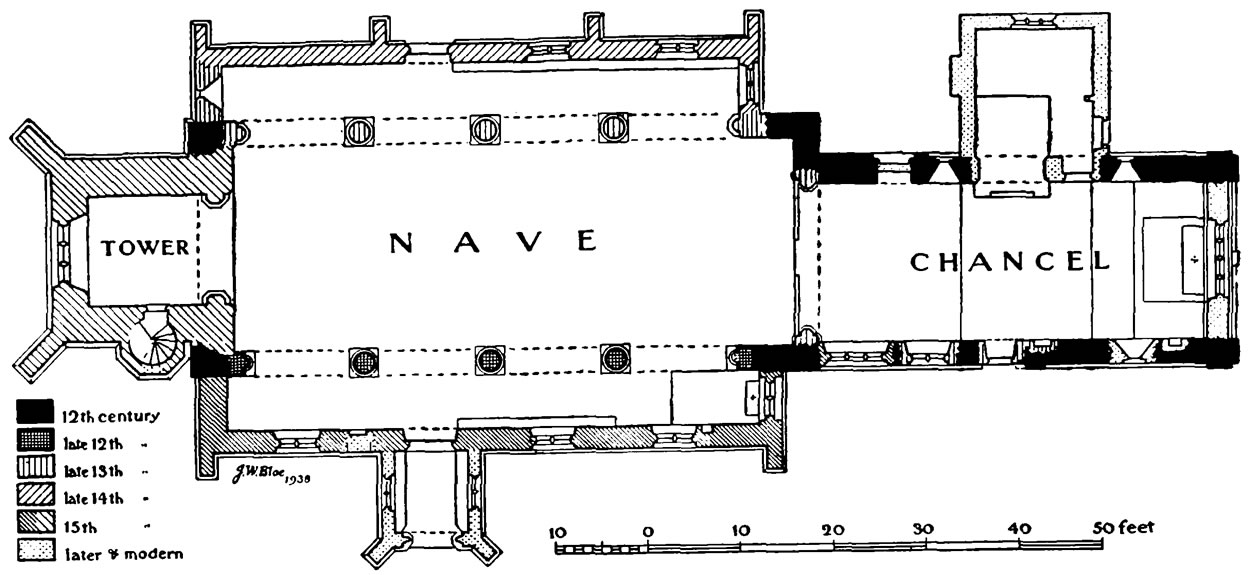 |
| The Church – Looking East | A Plan of the Church |