
SS Nicholas & Peter ad Vincula 3: 7½cwt in A
| Grid Reference | 139/177928 |  |
| Postcode | B76 9ES | |
| Affiliation | St Martin’s Guild | |
| Peals | None | |
| Sunday | None | |
| Practice | None | |
| Guild Website Entry | ||
History
The present Church of St Nicholas and St Peter ad Vincula is of Norman origin (1170–1190), established in 1165 when the Augustinian Canons of the Abbey of St Mary de Pratis, Leicester were granted the right to present a priest to the parish. The church was lengthened in the 14th century and the Perpendicular style tower was added in 1460 by the Earl of Warwick, but it was never finished with its intended spire. Late in the 15th century the nave was extended by about a third and the west tower was built. The south porch was probably added at the same time, but this was rebuilt on the old base in 1800.
By this time the building had fallen into disrepair and was restored in typical 18th-century fashion. The 12th-century windows were blocked, the 15th-century gothic windows had their mullions removed and were fitted with iron casements, the steep-pitched medieval roofs were replaced by low-pitched slate roofs. In 1895 the church was again restored in typical 19th-century fashion with the idea of bringing the church back to its medieval origins. The blocked windows were opened, the missing tracery on other windows was replaced and new roofs of higher pitch were built. A carved stone Saxon font was recovered during refurbishments to the church by Lord Norton. The font had been buried under the nave floor, possibly during the Reformation, and indicates that a church has been present on the site since Saxon times. This font has been in use ever since its rediscovery.
There were three bells at Curdworth – iij belles in the steple in 1552. One of these, the present tenor, remains. Another, the treble, was recast by John Martin in 1663. The Browne-Willis listing of 5 bells here in c.1750 must be erroneous.
Chris Pickford notes:
Regarding the medieval tenor, it should be noted that bells with similar lettering and marks exist at Hartlebury and at Old St. Martin’s Church, Worcester, and there was formerly a bell of this type at Brewood, Staffordshire. While H.B. Walters tentatively suggested that these bells might have been cast by a Lichfield founder in the early C14 (Michael de Lichfield mentioned just before 1300 or Henry Mitchell who cast a bell for Croxden in 1313). These dates are impossibly early for a bell like the Curdworth one, and Christopher Dalton (in 2003) thought it probably “later mediaeval”.
In 1460, a bellfounder names John Brasyer of Walsall (along with Thomas Baly of Walsall) instigated a suit against the Vicar of “Credeworth” Warwickshire for debt. It is most likely that this suit relates to a debt due to the founder for casting a bell, and it could possibly give an indication of the date and founder of this bell. It is also possible, though, that the debt was for one of the other pre-1552 bells since recast. So while Brasyer almost certainly cast a bell for Curdworth in about 1460, we cannot be entirely certain that the surviving tenor is his.
The surviving Churchwardens’ accounts commence in 1739 and the early years include a few minor repairs to the bells. In 1750, Edward Freeman was paid 1s.6d. “for a staple for the Bell” and 1s. “for Iron to hang the Clapper”. The interest, however, is in the payments in connection with the recasting of the second bell by Thomas Eayre of Kettering in 1756:
| 1754 | |
| 3 April Paid the Other Churchwarden for goeing to Litchfield for Advice | 2s.9d. |
| For my Journey to Kettering amd Expences | 13s.6d. |
| 1755 | |
| Feb 15 Spent Bargaineing with Mr. Eayre for Casting the Bell | 2s.6d. |
| Paid Ricd. Brown for his Trouble | 2s.0d. |
| Spent Takeing the Bell Down | 5d. |
| Carrying it to Birmingham | 2s.6d. |
| Spent Unloading and Weighing it | 6d. |
| 2 May Expenses at Birmingham Load ye New Bell | 1s.0d. |
| Paid the Caryers Bill for 6C :3qr:21lb up and 9C :0qr:14lb Down in all 16C :0qr:7lb at 4s | £1.12s.1½d. |
| Carrying the Bell from Birm: | 2d.6s. |
| Spent unloading it | 6d. |
| Paid for 3 new bellropes | 5s.3d. |
| 1756 | |
| 7 Oct Paid Mr. Thos. Eayre for the new Bell and for new hanging 3 Bells | £14.3s.6d. |
| 1757 | |
| Pd for A Letter from Kettering [possibly about the clock] | 4d. |
| March 28 Pd for plates for the Bell wheels | 10d. |
Thus, Eayre was paid £14. 3s. 6d. for “the new Bell and for new hanging 3 Bells.” The weight of the old bell was 6cwt. 3qrs. 21lbs., but the weight of the present bell was not recorded in the accounts as the 9cwt. 0qr.14lbs. of goods delivered to the parish by the carrier included three new sets of fittings for the bells.
The bells are refitted with elm headstocks, plate gudgeons, plain brass bearings and traditional type wheels, stays and sliders. These fittings are the work of James Barwell Ltd of Birmingham, who rehung the bells in 1905, at a cost of £38. Taylors had quoted £43 if rehung in the old frame or £89 if they were hung in a cast iron frame.
This work was reported in “Church Bells” magazine on January 12th 1906:
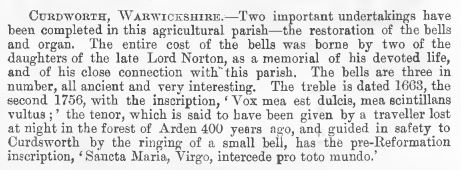
There was work carried out on the bells by the late Gordon Lane of Kingsbury in the early 21st century to ensure that they remained ringable. They are an anti-clockwise ring and the tuning is 1,2,4 of 5. The tenor’s note is exactly half way between A and Bb.
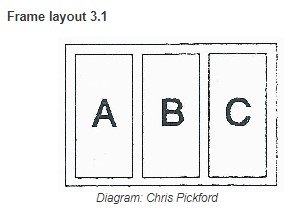
The treble was cast in 1663 by John Martin of Worcester and it is not a good bell. The second was recast by Thomas Eayre I in Kettering in 1756, at a cost of £14/3/6 for the bell and rehanging the three. The old bell weighed 6-3-21. The founder of the tenor is unknown. The frame itself was probably installed in the middle of the seventeenth century and is “listed”. the bells are hung in three parallel pits and swing eat to west. The treble is in the centre pit, the tenor to the north and the second to the south.
All the bells have been quarter turned and retain their canons. The treble has been tuned to raise its strike note, the other two being maiden castings.
The inscriptions are given in Tilley and Walters’ book, “The Church Bells of Warwickshire”:

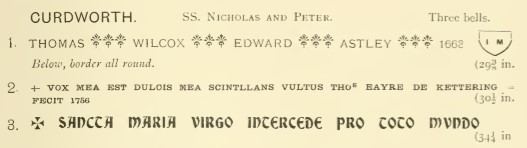
The bells were described by the renown bell historian, Christopher Dalton, in The Ringing World of April 25th 2003:
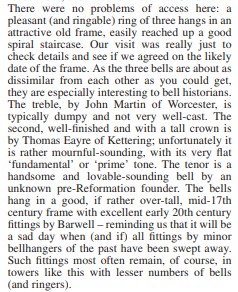
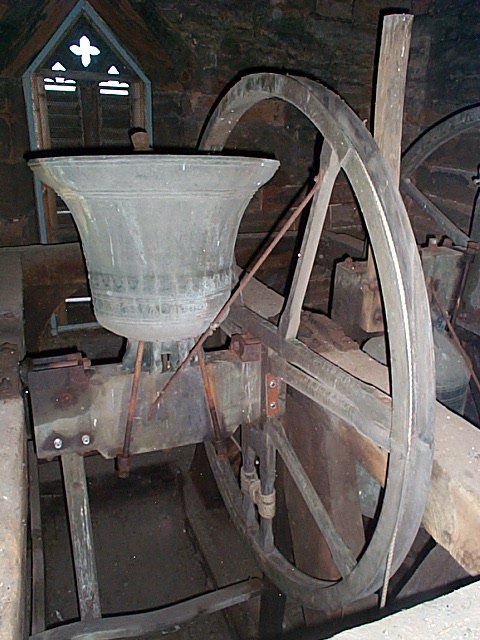
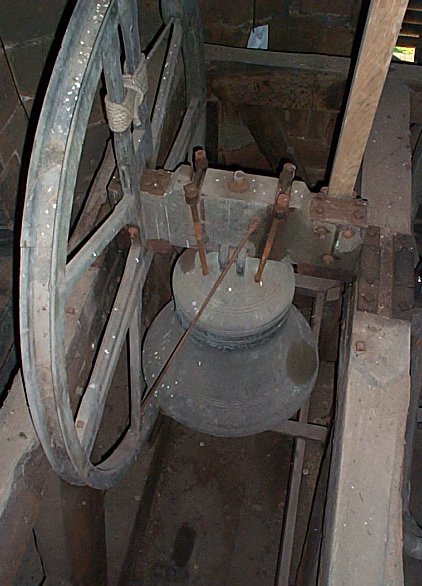
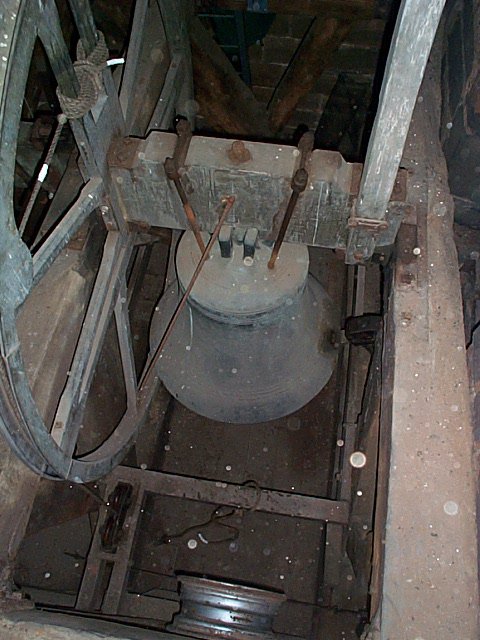
There is normally a chiming rope attached to the tenor and this needs to be switched on the wheel with the ringing rope before the bells can be rung. You can see the old car wheel in the tenor pit round which the rope is coiled.
Details of the Bells
1 John Martin, Worcester 1663 5 cwt 29.375″ 1192.5Hz (D+26c)
2 Thomas Eayre I Kettering 1756 5¾ cwt 30.50″ 1064.5Hz (C+30c)
3 Midland founder, C14th 7½ cwt 34.25″ 906.0Hz (A+50c)
Photo Gallery |
|
 |
 |
| The Treble | The Second |
 |
 |
| The Tenor | The frame layout |