
St John the Baptist 6: 5-3-22 in B (GF)
| Grid Reference | 151/292366 |  |
| Postcode | CV36 5HS | |
|
Recording – old 5 Recording – the ring of 6 |
||
| Affiliation | Coventry DG | |
| Peals | Felstead Database | |
| Sunday | 1000-1030 (2 & 4) | |
| Practice | Monday 1930-2100 | |
| Guild Website Entry | ||
History
A church very much at the south end of the Diocese. The church here is largely of C13th date, with chancel, nave, north aisle and west tower. It is notable for its fine C14 tomb of a franklin and for the decorative and heraldic glass assembled by an 18th Century Rector. The main Victorian restoration in 1876-7 was carried out under the superintendence of a local builder, James Pickering of Cherington, without the employment of an architect. They are a ground floor ring and the entrance is through the North Porch door into the church. Until recently they were not the easiest set of bells to ring, being an old fashioned ring of 5.
There were 3 bells up 1842. The tenor was recast and two trebles were added by Taylors at a cost of £105. It is thought that the previous tenor was also a Bagley bell of 1742. The treble was cast with a defect in its crown which was rectified via the use of iron plates around the canons and inside the bell. Only the third had been tuned at this point. The cost of hanging in 1842, by the local carpenters Thomas and William Attwood, was £24 15s 6d. The bells retain their canons.
In recent years those ringing the bells noted that they really were in need of major work, but were not by any means unringable. The bells were hung in their original frame and fittings of 1842 – no major work being carried out since their installation. This was installed by Thomas and William Attwood of Cherington, at a cost of £24 15s 6d. The fittings were suppled by W & J Taylor of Oxford. The four smallest bells had elm headstocks, hoop gudgeons, plain brass bearings and traditional wheels/ stays and sliders. The tenor had strap gudgeons.
The first peal on the bells was rung in 1910 – and the name of the tower was not spelled correct, at least how it is known to be today:


The inscriptions at this time are given by Tilley and Walters in their book, “The Church Bells of Warwickshire”


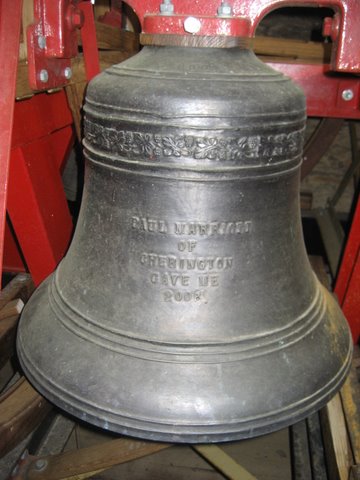
In 2006 the bells were rehung in a new frame, augmented to 6, with the existing cracked treble recast and the others retuned. When the treble was examined closely in the foundry before being broken up for recasting it was noticed that the crack had been skilfully filled in with lead. There is no evidence that the bell was removed from the tower to do this and we can therefore only speculate that the job was done in situ some time in the last 150 years. The new frame was made by one of the local ringers to the designs of the foundry. The back four bells still retain their canons, the two trebles being cast with flat tops.
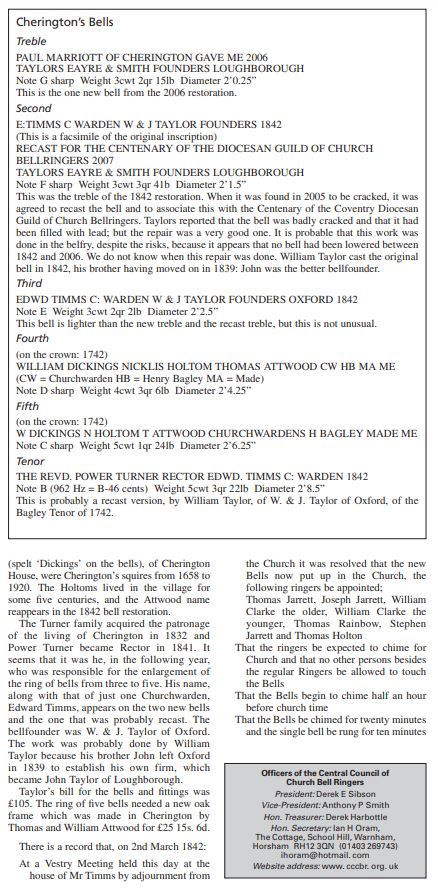
An extensive article about the restoration, including the inscriptions, was published in The Ringing World of March 23rd 2007:


The first peal on the ring of 6 was rung in 2010. The details are:

 Details of the Bells
1 Taylors, Eayre & Smith, Loughborough 2006 3-2-15 24.50″ 1624.0Hz (G#-39c)
2 Taylors, Eayre & Smith, Loughborough 2006 3-3-04 25.50″ 1447.0Hz (F#-39c)
3 W & J Taylor, Oxford 1842 3-2-02 26.50″ 1288.0Hz (E-41c)
4 Henry Bagley III, Witney 1742 4-3-06 28.00″ 1215.0Hz (D#-42c)
5 Henry Bagley III, Witney 1742 5-1-21 30.25″ 1081.5Hz (C#-43c)
6 W & J Taylor, Oxford 1842 5-3-22 32.50″ 962.0Hz (B-46c)
Photo Gallery |
|
 |
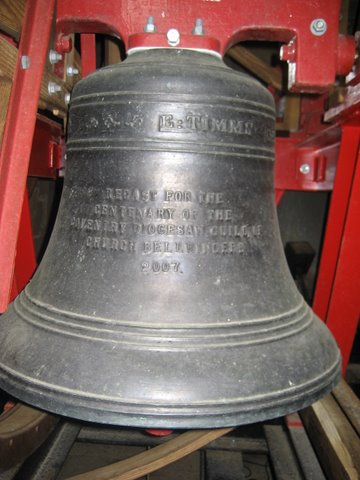 |
| The New Treble | The Recast Second |
 |
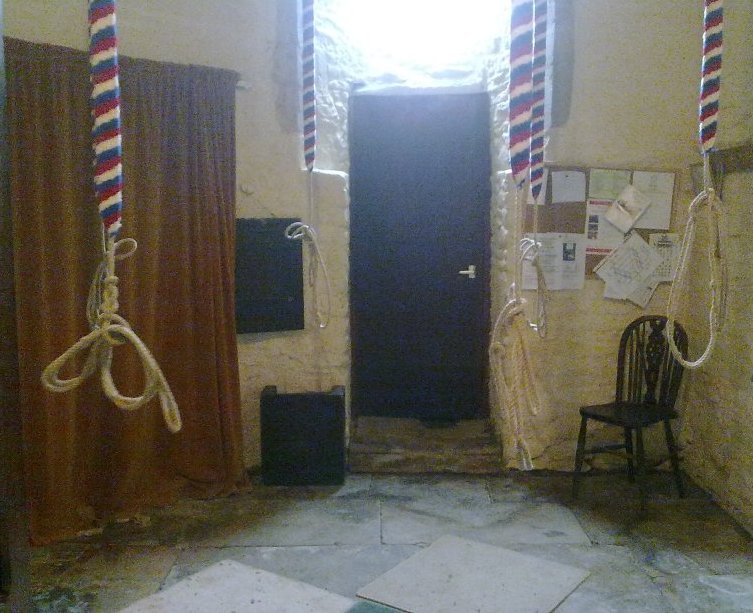 |
| Cherington Bellringers Christmas 1912 |
The Ringing Room |
 |
 |
| The Church – Looking East |
The “Franklin” Tomb A Franklin was a free landowner not of noble birth. Believed to be Robert le Fraunkelyn, a local landowner who died in 1262. |