
St John the Baptist 8: 10-2-16 in F#
| Grid Reference | 139/286283 | 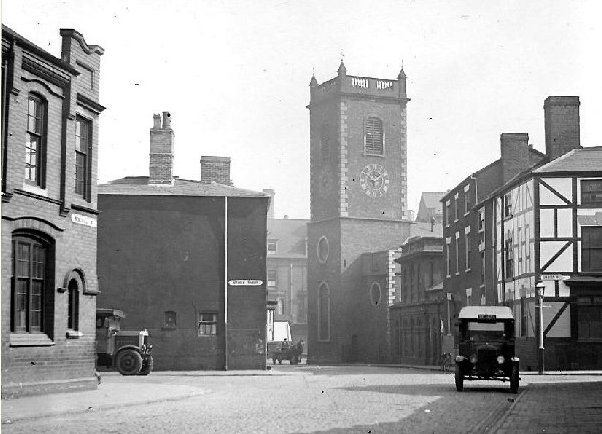 |
| Postcode | B12 0NB | |
| Peals | Felstead Database | |
| Date Lost | 1947 |
History
A church here was built as early as the 14th century. Despite being in sight of St Martin’s-in-the-Bullring, it was a chapel of ease to Aston; located some three miles distant. It was not for 600 years that it became a separate parish and also the parishioners ceased to elect its incumbent.
In 1548/9 “the Chapell lyinge at Dyrettende nexte the towne of Birmyngham” possesed “Two belles by estimacion there ml weight” (i.e. 10 cwt). These bells evidently hung in the square bell turret with pyramid roof and weather-vane shown in earlier illustrations of the building. Nothing else is known of the bells,
The church was rebuilt in the 1730s, at a cost of £1643, and the tower was added, or completed, in 1762.
The following appeared in the newspapers in 1775:

A ring of eight by Robert Wells, tenor quoted as being 11-2-4, (though the scrapping weight was less) of Aldbourne was installed in 1776. They were highly praised for the musical qualities at the time, but this opinion was not shared by ringers at their demise!
A peal of Plain Bob Major was rung on 30th July 1776, the day after the bells were dedicated. The Coventry Mercury and Birmingham Gazette of Monday 5th August 1776 both reported the new bells: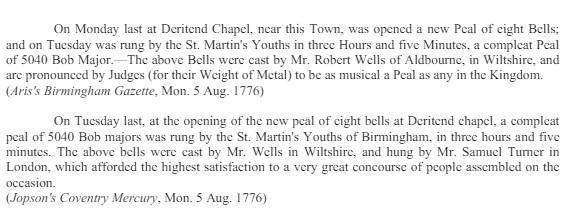
A peal of Grandsire Triples soon followed:

A peal of Plain Bob Major was reported in 1787

A long peal of Grandsire Major was rung here in 1794

The bells were hung in a double jack-braced wooden frame of 1776. There were four bells (3, 4, 8 and 7) in parallel pits in the middle, with two bells on each side at right angles swinging mouth-to mouth and north-south – 1 and 2 on the west side of the tower, and 5 and 6 on the east.
The fittings were partially renewed by Blews in 1872, and were again repaired by Barwell in 1895. There was a series of articles about rings of bells in Bell News and this is what is said of this tower in the edition of June 21st 1902:
“St. John, Deritend. Birmingham Amalgamated Society. Eight bells. All by Wells, 1776. Tenor 13 cwt., diameter 3 ft. 5 in. Timber frame. Bells go well. Slight repairs by Barwell, 1895. Soundbows worn. Ropes poor. Methods: Grandsire, Stedman, Plain and Treble Bob. Sunday ringing on festivals only. Practice: Friday, 8.”
The ring was again repaired by Barwell in 1913. The dedication of the bells is reported in The Ringing World of October 3rd 1913:
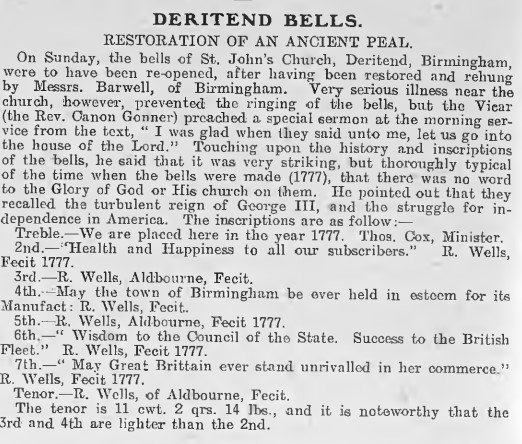
(The scrapping weights do not agree with the last line of this report)
The first peal on the rehung bells had to wait until 1918:

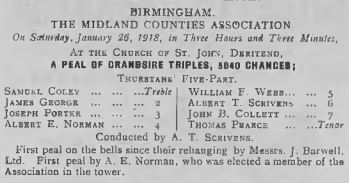
A report of the peal appeared in The Ringing World on February 1st 1918:
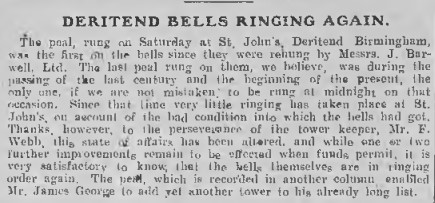
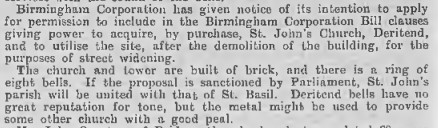
Thought the church was restored between 1881 and 1891, with sittings for 800 people, hanging demographics and land use meant that the church was closed in 1936. The following was reported in The Ringing World of April 26th 1935:
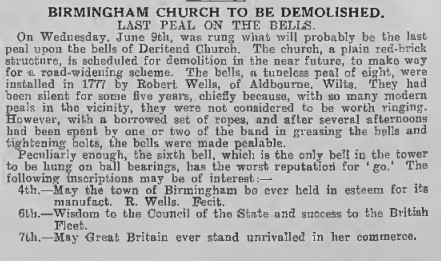
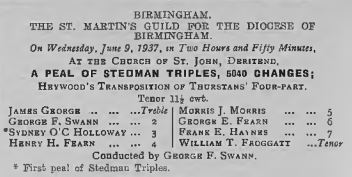
The last peal on the bells was reported in The Ringing World of June 25th 1937:

However, demolition was delayed by the outbreak of WWII and the church was badly damaged by bombing in 1940.
There was a mention of the church and bells at a Guild meeting in July 1944 – it seems that members thought that the bells had already been removed:
“Reference was made to the removal of the bells from St. John’s, Deritend, and the secretary was requested to communicate with the Bishop regarding a stone peal tablet erected in the belfry recording two peals, one the first one the bells, rung over 100 years ago It was suggested that possibly the tablet might be erected in the tower where the bells are installed. St. John’s Church was seriously damaged by enemy action and is scheduled for demolition to allow road widening.”
It was demolished in c.1947. The Bull Ring Trading Estate is now located on the site. The bells were removed when the building was demolished. Taylors did the removal at a cost of £41/15/0. They were taken to Bishop Latimer’s church, where they were stored for some years before being recast by Taylors towards a new ring of eight there in 1957-8. (q.v.).
The following appeared in The Ringing World of May 16th 1958:
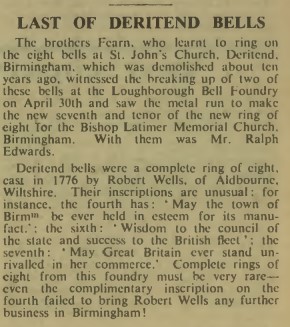
(Most of the above bell information is quoted directly (with permission) from the research notes of Chris Pickford)
Details of the Bells
1 Robert Wells, Aldbourne 1776 5-0-25 27.75″ 1505.0Hz (F#+29c)
2 Robert Wells, Aldbourne 1776 5-1-25 28.375″ 1420.0Hz (Ex+28c)
3 Robert Wells, Aldbourne 1776 5-2-24 29.75″ 1261.0Hz (D#+23c)
4 Robert Wells, Aldbourne 1776 6-0-01 31.00″ 1138.0Hz (C#+45c)
5 Robert Wells, Aldbourne 1776 6-2-21 32.875″ 1010.0Hz (B+39c)
6 Robert Wells, Aldbourne 1776 7-2-13 34.75″ 938.0Hz (A#+11c)
7 Robert Wells, Aldbourne 1776 8-3-14 37.75″ 841.0Hz (G#+22c)
8 Robert Wells, Aldbourne 1776 10-2-16 40.875″ 757.0Hz (F#+39c)
(Scrapping Weights)
Photo Gallery |
|
 |
 |
| Deritend High Street in 1887 Showing “The Golden Lion” and the Church Tower |
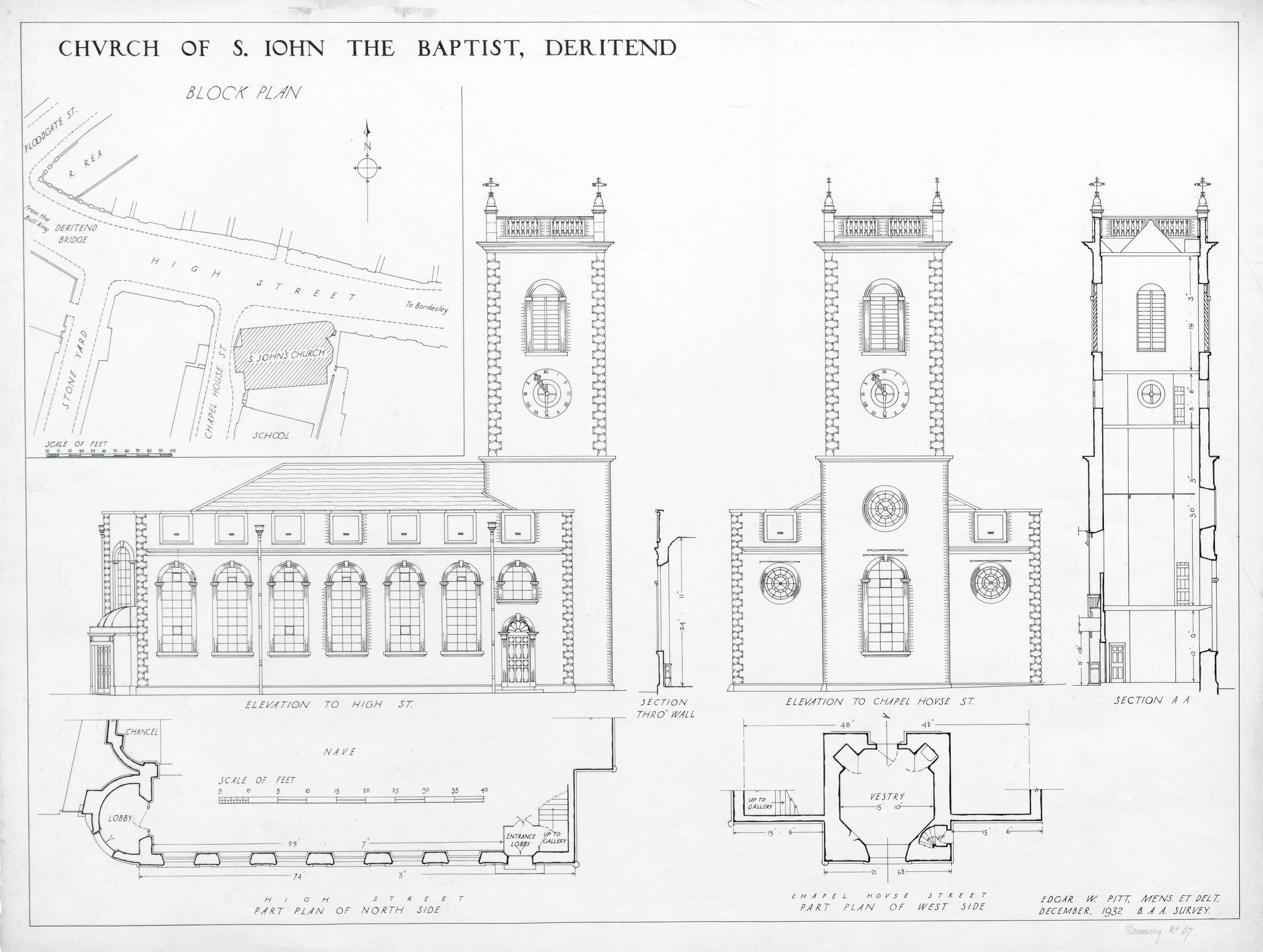
Architects Drawings of the Church |