
Bishop Ryder’s Church 8: 12-3-24 in F#
| Grid Reference | 139/287404 | 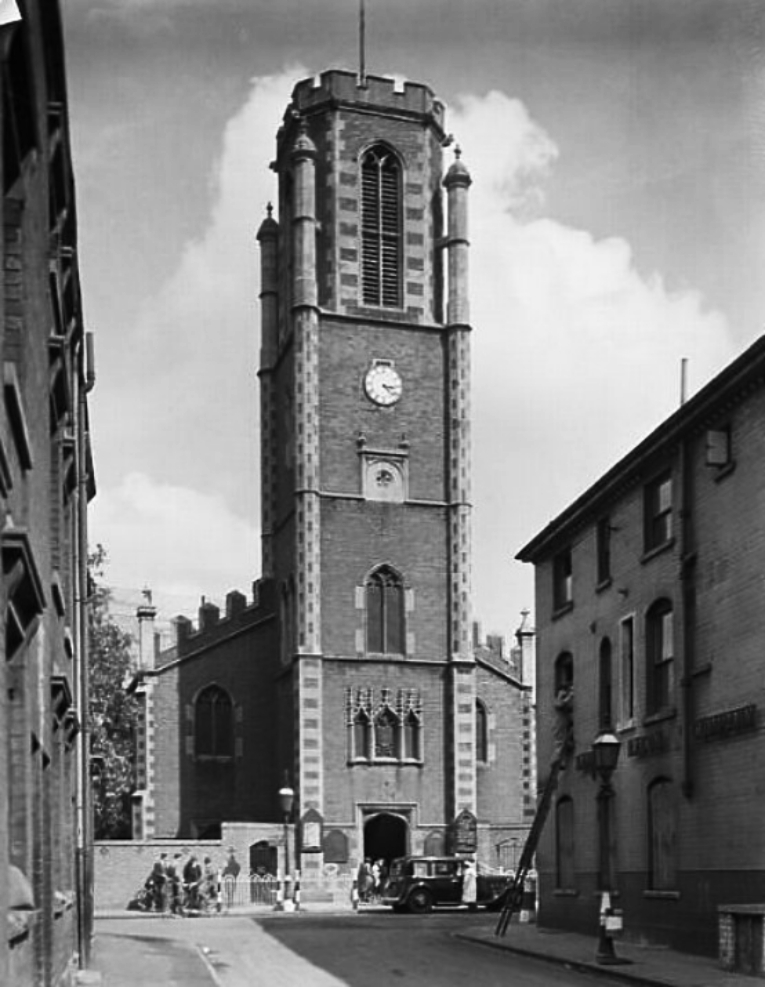 |
| Postcode | B4 7ED | |
| Peals | Felstead Database | |
| Date Lost | 1959 |
History
This church was built in 1837/8, at a cost of £4,500, in Gem Street. It was a memorial to the Bishop of Lichfield, Right Reverend Henry Ryder, who had died in 1834 and who had been supportive of the need to build a church in this area. It was a red brick and stone church, designed by Thomas Rickman and Richard Charles Hussey in the Gothic style. Its parish came from that of St Martin in the Bullring. The Chancel was rebuilt in 1894 by J. A. Chatwin, funded by J. C Holder in memory of his father, Henry Holder.
In 1925 the parish of St Mary, Whittall Street which closed that year, was united with Bishop Ryder’s, as in 1939 was part of the parish of St Bartholomew which closed in 1937. The “slum housing” in the area was demolished after WWII and, after being empty for some, time the church itself was demolished in 1960. Part of Aston University was built on the site.
A single bell by William Taylor of Oxford, cast around 1838, diameter 27.5″ and weighing 4-0-8 was all that was in the tower until, “The first eight ever cast in Birmingham” was installed by Blews and Son, cast in late 1868 and dedicated in 11th January 1869. The cost involved was £600 (according to Wikipedia!)
The bells were inscribed
| 1-7 | WILLIAM BLEWS AND SONS. BIRMINGHAM 1868 |
| Tenor | WILLIAM BLEWS AND SONS. BIRMINGHAM 1868 Waist: T HART BURGES, D D VICAR H H POWER } T KENDRICK } CHURCHWARDENS |
The bells were hung in a wooden frame. The original frame remained in use from the time the bells were first installed until their eventual removal in 1960. The frame had bells 1-2 and 5-6 swinging mouth-to-mouth and north-south on the west and east sides of the tower respectively, and these pits were open at the north and south ends – the heads linked by light iron bars. The other bells swung east-west in four parallel pits, in order from north to south 4, 3, 7 and 8.
The bells were rehung with new fittings by Carr of Smethwick in the same frame, (which remained in use until the removal of the bells in 1960), as early as 1895.
There was a series of article in Bell News about rings of bells and this is said of this church in the edition of June 21st 1902:
“Birmingham (Warwickshire).— Bishop Ryder’s Church. Birmingham Amalgamated Society. Eight bells. All by Blews, 1868. Tenor 12 cwt., diameter 3 ft. 4 in. Timber frame. Bells go well. Rehung by Carr, 1895. Ropes new 1898, good. Method; Grandsire. Sunday ringing; 10.30 to I I, and 6 to 6.30. Practice; Saturday.”
An article about the bells appeared in The Ringing World of March 31st 1916


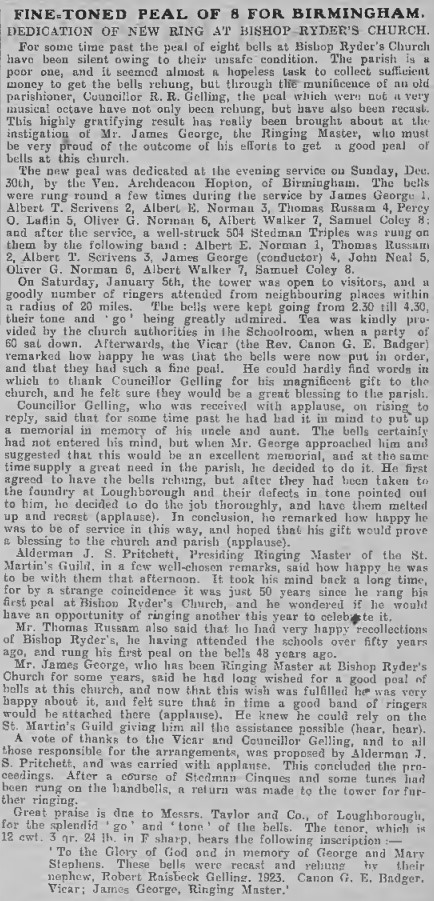
The bells fell silent in 1922 and, always considered to be of poor tone; (note the frequencies), were recast by Taylors the following year. The scrapping weights are given below. The frame was also lowered by 20 feet in the tower at this time. Their reopening is recorded in The Ringing World of January 18th 1924:
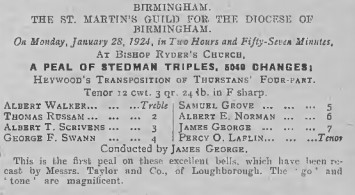
The first peal on the new bells was rung in January 1924:

A screen or partition was erected between the church and ringing room in 1936 in order to keep out the sound and prevent the loss of heat. According to the faculty papers, “The noise from the bell ringing chamber disturbs to a very considerable degree the quiet of the church before service” … “especially as the Head Ringer [James George] is an old man, who very audibly encourages his team in their efforts”.
A ringing character and stalwart of the exercise, James George rang tower bells well into his eighties. His activities were curtailed by the war and by the amputation of a leg, but he rang in a handbell peal on his 95th birthday. He spent the last few years of his life in Bournemouth where he died, aged 97, in March 1951.
Until the time of the closure of this church the bells were popular with peal bands, 197 in total being rung, the last being in August 1959.

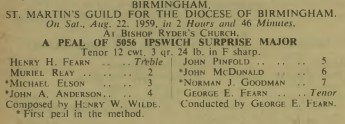
The bells were transferred to Harborne to replace the 8 bells there. (q.v.)
(Most of the above bell information is quoted directly (with permission) from the research notes of Chris Pickford)
Details of the First Ring of Bells
1 William Blews & Sons, Birmingham 1868 5-0-21 26.50″ 1642.0Hz (G+80c)
2 William Blews & Sons, Birmingham 1868 5-1-13 26.25″ 1540.0Hz (F#+69c)
3 William Blews & Sons, Birmingham 1868 5-2-07 28.75″ 1359.0Hz (E+52c)
4 William Blews & Sons, Birmingham 1868 5-3-21 30.00″ 1206.0Hz (D+46c)
5 William Blews & Sons, Birmingham 1868 6-3-18 32.50″ 1070.0Hz (C+38c)
6 William Blews & Sons, Birmingham 1868 7-1-27 34.00″ 1007.0Hz (B+33c)
7 William Blews & Sons, Birmingham 1868 9-3-25 37.00″ 912.0Hz (A+62c)
8 William Blews & Sons, Birmingham 1868 11-1-21 40.25″ 800.0Hz (G+35c)
Details of the Recast Ring of Bells
1 John Taylor & Co, Loughborough 1923 3-1-11 24.375″ 1484.0Hz (F#+5c)
2 John Taylor & Co, Loughborough 1923 3-2-10 25.375″ 1399.0Hz (Ex+3c)
3 John Taylor & Co, Loughborough 1923 4-0-07 27.125″ 1246.0Hz (D#+2c)
4 John Taylor & Co, Loughborough 1923 4-1-04 28.375″ 1112.0Hz (C#+5c)
5 John Taylor & Co, Loughborough 1923 5-2-17 31.125″ 990.0Hz (B+4c)
6 John Taylor & Co, Loughborough 1923 6-2-18 32.875″ 930.0Hz (A#-4c)
7 John Taylor & Co, Loughborough 1923 8-3-22 36.50″ 832.5Hz (G#+4c)
8 John Taylor & Co, Loughborough 1923 12-3-24 40.875″ 742.0Hz (F#+5c)
Inscriptions
All are inscribed “WILLIAM BLEWS AND SONS, BIRMINGHAM, 1868” and have the Taylor’s mark and “RECAST 1923” on their waists, the tenor on the opposite side has:
| TO THE GLORY OF GOD AND IN MEMORY OF GEORGE AND MARY STEPHENS THESE BELLS WERE RECAST AND REHUNG BY THEIR NEPHEW ROBERT RAISBECK GELLING * * * CANON G.E. BADGER, VICAR JAMES GEORGE, RINGING MASTER |
| Photo Gallery |
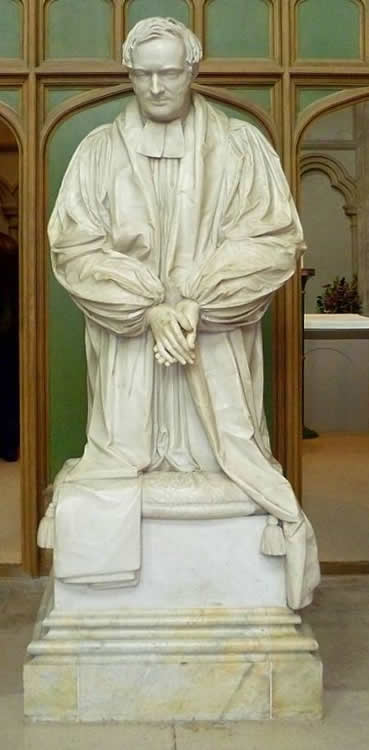 |
| The Monument to Bishop Ryder in Lichfield Cathedral |